
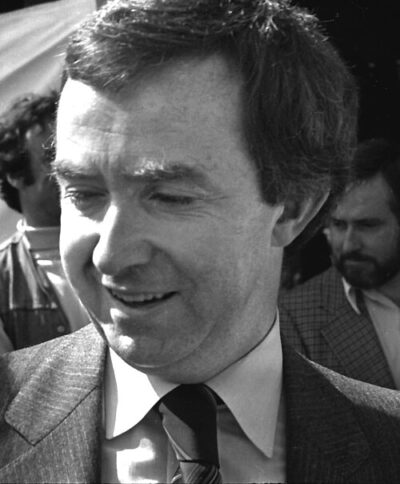
Joe Clark
Joe Clark is the 16th Prime Minister of Canada. Born June 5, 1939, in High River. Positions held include Prime Minister of Canada (1979–1980), President of the King's Privy Council for Canada (1991–1993) and Minister of Foreign Affairs of Canada (1984–1991). Educated at Peter A. Allard School of Law and University of Alberta. Awards include Companion of the Order of Canada, Canadian Newsmaker of the Year and Alberta Order of Excellence.

Facts
33 facts · 1 confirmed by two sources · 5 cited · 27 from one source
Where this comes from
Papalocal keeps its own record. It started from these sources; what each one said is kept here as it was copied, so a change on their side never changes this page by itself. Tap one to read its version.
What Wikidata says · copied November 13, 2026 · revision 2565434455
- Described as
- 16th Prime Minister of Canada
- Other names
- Charles Joseph Clark
- Born
- June 5, 1939 · 3 references
- Born in
- High River
- Name at birth
- Charles Joseph Clark
- Citizen of
- Canada
- Occupation
- politician · 1 reference; diplomat; journalist · 1 reference; lawyer · 1 reference; lecturer · 1 reference
- Positions held
- Prime Minister of Canada (1979–1980); President of the King's Privy Council for Canada (1991–1993); Minister of Foreign Affairs of Canada (1984–1991); board member; member of the House of Commons of Canada (2 times) (1972–2004) · 1 reference
- Political party
- Progressive Conservative Party of Canada
- Worked for
- American University
- Education
- Peter A. Allard School of Law; University of Alberta; Dalhousie University · 1 reference
- Awards
- Companion of the Order of Canada; Canadian Newsmaker of the Year (1979); Alberta Order of Excellence; Commander of the Order of La Pléiade; Queen Elizabeth II Silver Jubilee Medal; 125th Anniversary of the Confederation of Canada Medal; Queen Elizabeth II Golden Jubilee Medal; Queen Elizabeth II Diamond Jubilee Medal; Alberta Centennial Medal; Vimy Award
- Spouse
- Maureen McTeer (1973–) · 1 reference
- Children
- Catherine Clark
- Religion
- Catholicism
- Nickname
- Joe
- Wikipedias with a page
- 42
Wikidata item Q128574 (wikidata.org/wiki/Q128574), public domain (CC0). Copied November 13, 2026.
What Wikipedia says · copied November 13, 2026 · revision 1381962297
Charles Joseph Clark (born June 5, 1939) is a Canadian businessman, writer, and retired politician who served as the 16th prime minister of Canada from 1979 to 1980. He served as leader of the Official Opposition from 1976 to 1979 and from 1980 to 1983 and led the Progressive Conservative Party of Canada from 1976 to 1983 and again from 1998 to 2003.
Despite his relative inexperience, Clark rose quickly in federal politics. He was first elected to the House of Commons in 1972 and won the leadership of the Progressive Conservative Party in 1976. He led the party to a minority government in the 1979 federal election, defeating the Liberal government of Pierre Trudeau and ending 16 years of continuous Liberal rule. Taking office the day before his 40th birthday, Clark became the youngest prime minister in Canadian history.
Upon becoming prime minister, Clark introduced freedom of information legislation (which died upon the dissolution of Parliament) and oversaw the "Canadian Caper" rescue in response to the Iran hostage crisis; however, his tenure was brief, as the minority government was brought down by a non-confidence vote on his first budget in December 1979. The budget defeat triggered the 1980 federal election. Clark and the Progressive Conservatives lost the election to Trudeau and the Liberals, who won a majority government and returned to power. As of 2026, he remains the most recent prime minister to have lost power following the defeat of his budget.
Clark lost the leadership of the Progressive Conservative Party to Brian Mulroney in 1983. He served in Mulroney's cabinet as Secretary of State for External Affairs from 1984 to 1991 and as President of the Privy Council and Minister responsible for Constitutional Affairs from 1991 to 1993. Clark did not stand for re-election in 1993. From 1993 to 1996, he served as Special Representative to the Secretary-General of the United Nations for Cyprus. Clark made a political comeback in 1998 to lead the Progressive Conservatives in their last general election before the party's eventual dissolution, serving his final term in Parliament from 2000 to 2004. After the Progressive Conservatives merged with the more right-wing Canadian Alliance in 2003 to form the modern-day Conservative Party of Canada, Clark sat as an independent Progressive Conservative. He criticized the merger as an "Alliance take-over", believing that the new party was drifting towards social conservatism. Clark serves as a university professor and president of his own consulting firm.
- Born, in its opening lines
- June 5, 1939
From the Wikipedia article “Joe Clark” (en.wikipedia.org/wiki/Joe_Clark), by its contributors, under CC BY-SA 4.0 (creativecommons.org/licenses/by-sa/4.0/). Copied November 13, 2026; not changed.
Confirmed Two sources agree. Cited One source, and it names where it got it. One source One source, without a reference of its own. Sources disagree The sources disagree. We show the best-supported value and keep theirs below.
