
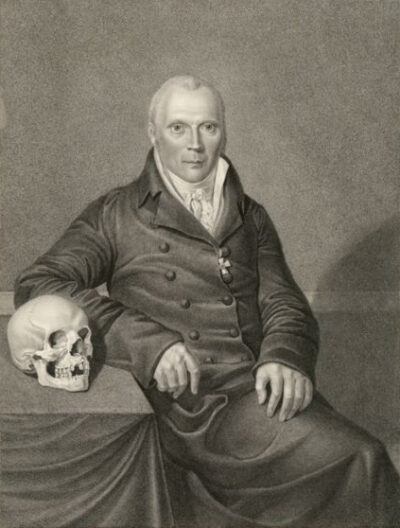
Johann Christian Reil
Johann Christian Reil was a German physician. Born February 20, 1759, in Rhaude. Died November 22, 1813, in Halle (Saale). Educated at University of Göttingen and Martin Luther University Halle-Wittenberg.
Facts
32 facts · 2 confirmed by two sources · 6 cited · 24 from one source
Where this comes from
Papalocal keeps its own record. It started from these sources; what each one said is kept here as it was copied, so a change on their side never changes this page by itself. Tap one to read its version.
What Wikidata says · copied November 18, 2026 · revision 2568740186
- Described as
- German physician
- Born
- February 20, 1759 · 2 references
- Died
- November 22, 1813 · 3 references
- Born in
- Rhaude · 1 reference
- Died in
- Halle (Saale) · 1 reference
- Buried in
- Zoologischer Garten Halle
- Cause of death
- typhus
- Citizen of
- Kingdom of Prussia
- Occupation
- physician · 2 references; military physician; anatomist · 2 references; psychiatrist; physiologist; university teacher; internist · 1 reference; author · 1 reference
- Worked for
- Martin Luther University Halle-Wittenberg; University of Berlin; Charité
- Education
- University of Göttingen; Martin Luther University Halle-Wittenberg · 1 reference
- Member of
- German Academy of Sciences Leopoldina; Bavarian Academy of Sciences and Humanities
- Field
- medicine
- Spouse
- Johanna Wilhelmine Le Veaux
- Children
- Johann Friedrich Reil; Johanna Friederike Wilhelmine Reil; Emilie Auguste Reil; Carl Wilhelm Reil; Amalie Rosamunde Iphigenie Reil; Luise Charlotte Marianne Reil
- Father
- Johann Julius Friedrich Reil
- Mother
- Anna Jansen-Streng
- Wikipedias with a page
- 21
Wikidata item Q215005 (wikidata.org/wiki/Q215005), public domain (CC0). Copied November 18, 2026.
What Wikipedia says · copied November 18, 2026 · revision 1341923475
Johann Christian Reil (20 February 1759 – 22 November 1813) was a German physician, physiologist, anatomist, and psychiatrist. He coined the term psychiatry – Psychiatrie in German – in 1808.
Reil was one of five children, and was the son of a Lutheran pastor in Northwest Germany. He married Johanna Wilhelmine Leveaux in October, 1788. Together they had two sons and four daughters.
Medical conditions and anatomical features named after him include Reil's finger (later called digitus mortuus or Raynaud syndrome) and the Islands of Reil in the cerebral cortex. In 1809, he was the first to describe the white fibre tract now called the arcuate fasciculus. He is frequently and erroneously credited with discovering the locus coeruleus, which was first described by Félix Vicq-d'Azyr.
Between 1779 and 1780, Reil became acquainted with the scientist Johann Friedrich Blumenbach while Reil was studying medicine in Göttingen. From 1788 to 1810, Reil worked in a hospital in Halle, Germany. He was a student of Johann Friedrich Gottlieb Goldhagen who had founded an outpatient clinic called the Schola clinica. In 1787 he became extraordinary professor of medicine at the University of Halle and after Goldhagen’s death he became head of the Schola clinica. There he developed a medical program based heavily on Friedrich Schelling's Naturphilosophie. In 1795, Reil established the first journal of physiology written in German, the Archiv für die Physiologie. In 1810, he became one of the first professors of psychiatry after being appointed professor of medicine in Berlin.
From 1802 to 1805, the poet Goethe visited Reil to discuss scientific matters such as psychiatry and to access his skills as a physician.
Reil used the term 'Psychiaterie' in a short-lived journal he set up with J.C. Hoffbauer, titled Beyträge zur Beförderung einer Kurmethode auf psychischem Wege (1808: 169). He argued that there should not only be a branch of medicine (psychische Medizin) or of theology or penal practice, but a discipline in its own right with trained practitioners. He also sought to publicize the plight of the insane within asylums and to develop a psychical method of treatment, consistent with the moral treatment movement of the times. He was critical of Frenchman Philippe Pinel, however. Reil was mainly theoretical, with little direct clinical experience, in contrast with Pinel. Reil is considered a writer within the German Romantic context, and his 1803 work Rhapsodien uber die Anwendung der psychischen Kurmethode auf Geisteszerrüttungen ('Rhapsodies about applying the psychological method of treatment to mental breakdowns') has been called the most important document of Romantic psychiatry. Reil didn't conceptualize madness as a break from reason, but as a reflection of wider social conditions, and believed that advances in civilization created more madness. He saw this as due not to physical lesions in the brain or to hereditary evil, but as a disturbance in the harmony of the mind's functions (forms of awareness or presence), rooted in the nervous system.
Reil also wrote on Blumenbach's idea of the Bildungstrieb (literally, "building power"), a vital force within each organism that compels it to create, maintain, and repair its form. In Reil's essay "Von der Lebenskraft," he argued that each organism contained a "dormant germ" that was activated by the addition of the father's "animal force."
Reil died on 22 November 1813 from typhus contracted while treating the wounded in the Battle of Leipzig, later known as the Battle of the Nations, one of the most severe confrontations of the Napoleonic Wars.
- Born, in its opening lines
- February 20, 1759
- Died, in its opening lines
- November 22, 1813
From the Wikipedia article “Johann Christian Reil” (en.wikipedia.org/wiki/Johann_Christian_Reil), by its contributors, under CC BY-SA 4.0 (creativecommons.org/licenses/by-sa/4.0/). Copied November 18, 2026; not changed.
Confirmed Two sources agree. Cited One source, and it names where it got it. One source One source, without a reference of its own. Sources disagree The sources disagree. We show the best-supported value and keep theirs below.
