
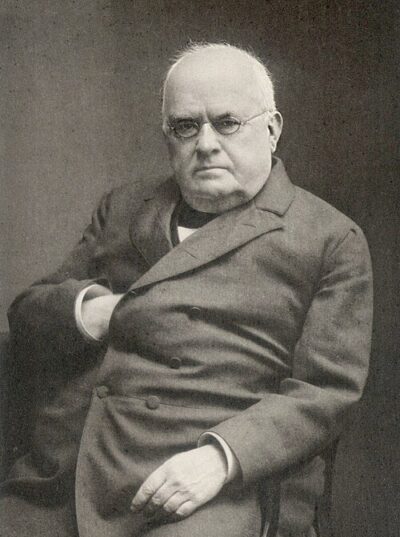
Johann Wilhelm Hittorf
Johann Wilhelm Hittorf was a German physicist. Born March 27, 1824, in Bonn. Died November 28, 1914, in Münster. Educated at University of Bonn. Awards include Pour le Mérite for Sciences and Arts order, Hughes Medal and Bavarian Maximilian Order for Science and Art.
Facts
23 facts · 2 confirmed by two sources · 6 cited · 15 from one source
Where this comes from
Papalocal keeps its own record. It started from these sources; what each one said is kept here as it was copied, so a change on their side never changes this page by itself. Tap one to read its version.
What Wikidata says · copied November 16, 2026 · revision 2568992218
- Described as
- German physicist (1824–1914)
- Other names
- Johann Hittorf, Wilhelm Hittorf
- Born
- March 27, 1824 · 4 references
- Died
- November 28, 1914 · 4 references
- Born in
- Bonn · 2 references
- Died in
- Münster · 2 references
- Buried in
- Münster Central Cemetery
- Citizen of
- Kingdom of Prussia
- Occupation
- physicist · 1 reference; chemist · 1 reference; university teacher · 2 references
- Worked for
- University of Münster
- Education
- University of Bonn
- Member of
- Academy of Science for Public Utility; Göttingen Academy of Sciences and Humanities in Lower Saxony; Accademia Nazionale dei Lincei (1904–) · 1 reference; Royal Prussian Academy of Sciences; Bavarian Academy of Sciences and Humanities
- Awards
- Pour le Mérite for Sciences and Arts order; Hughes Medal (1903) · 1 reference; Bavarian Maximilian Order for Science and Art (1902); honorary member of the Physics Association (Frankfurt am Main, Germany) (1894)
- Field
- electrochemistry
- Father
- Heinrich Hittorf
- Mother
- Theresia Hittorf
- Wikipedias with a page
- 31
Wikidata item Q60428 (wikidata.org/wiki/Q60428), public domain (CC0). Copied November 16, 2026.
What Wikipedia says · copied November 16, 2026 · revision 1374472614
Johann Wilhelm Hittorf (27 March 1824 – 28 November 1914) was a German physicist who was born in Bonn and died in Münster, Germany.
Hittorf was the first to compute the electricity-carrying capacity of charged atoms and molecules (ions), an important factor for understanding electrochemical reactions. He formulated ion transport numbers and the first method for their measurements.
He experimented with tubes containing energy rays extending from a negative electrode. These rays produced a fluorescence when they hit the glass walls of the tubes. In 1876 the effect was named "cathode rays" by Eugen Goldstein.
Hittorf's early investigations concerned the allotropes of phosphorus and selenium. Between 1853 and 1859 his most important work concerned ion movement caused by electric current. In 1853 Hittorf revealed that some ions traveled more rapidly than others. This observation resulted in the concept of transport number, the fraction of the electric current carried by each ionic species. He measured the changes of the concentration of electrolyzed solutions, computed from these the transport numbers (relative carrying capacities) of many ions, and, in 1869, published his principles governing the migration of ions.
He became professor of physics and chemistry for the University of Münster and director of laboratories there from 1879 until 1889. He also investigated the light spectra of gases and vapours, worked on the passage of electricity through gases, and discovered new properties of cathode rays (electron rays). In 1869 he ascertained that the cathode rays glowed different colours because of different gasses and pressures. He noticed that when there was any object placed between the cathode and the illuminating side of the tube, then the shadow of that object appeared.
His work resulted in the development of cathode-ray tubes (CRT). The measurement of current in a vacuum tube was an important factor for the development of vacuum tube diodes. CRTs were used as storage devices of the memory of the Manchester Baby computer, the SSEM.
He was elected to honorary membership of the Manchester Literary and Philosophical Society in 17 April 1871.
- Born, in its opening lines
- March 27, 1824
- Died, in its opening lines
- November 28, 1914
From the Wikipedia article “Johann Wilhelm Hittorf” (en.wikipedia.org/wiki/Johann_Wilhelm_Hittorf), by its contributors, under CC BY-SA 4.0 (creativecommons.org/licenses/by-sa/4.0/). Copied November 16, 2026; not changed.
Confirmed Two sources agree. Cited One source, and it names where it got it. One source One source, without a reference of its own. Sources disagree The sources disagree. We show the best-supported value and keep theirs below.
