
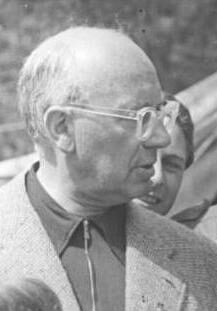
Johannes R. Becher
Johannes R. Becher was a German politician, novelist and poet. Born May 22, 1891, in Munich. Died October 11, 1958, in East Berlin. Positions held include minister of culture (1954–1958) and member of the Volkskammer (1950–). Educated at Wilhelmsgymnasium. Awards include National Prize of East Germany, Patriotic Order of Merit in Silver and International Stalin Prize for Peace.
Facts
37 facts · 2 confirmed by two sources · 13 cited · 22 from one source
Where this comes from
Papalocal keeps its own record. It started from these sources; what each one said is kept here as it was copied, so a change on their side never changes this page by itself. Tap one to read its version.
What Wikidata says · copied November 16, 2026 · revision 2569077327
- Described as
- German politician, novelist and poet (1891–1958)
- Other names
- Iogannes R. Bekher, I. R. Bekher, Johannes Robert Becher
- Born
- May 22, 1891 · 11 references
- Died
- October 11, 1958 · 11 references
- Born in
- Munich · 3 references
- Died in
- East Berlin · 1 reference
- Buried in
- Dorotheenstadt Cemetery · 1 reference
- Name at birth
- Johannes Robert Becher
- Citizen of
- East Germany; Weimar Republic; German Empire
- Occupation
- poet · 1 reference; politician · 2 references; novelist; writer · 2 references; resistance fighter; songwriter · 1 reference; dramaturge · 2 references; literary editor · 1 reference
- Positions held
- minister of culture (1954–1958) · 3 references; member of the Volkskammer (1950–) · 1 reference
- Political party
- Socialist Unity Party of Germany; Communist Party of Germany; Independent Social Democratic Party of Germany
- Education
- Wilhelmsgymnasium
- Member of
- Academy of Arts of the GDR · 2 references; National Committee for a Free Germany; Central Committee of the Socialist Unity Party of Germany; Association of Proletarian-Revolutionary Authors
- Awards
- National Prize of East Germany; Patriotic Order of Merit in Silver; International Stalin Prize for Peace (1952); Honorary doctor of the Humboldt University of Berlin (1951)
- Spouse
- Lilly Becher · 1 reference; Käthe Becher
- Father
- Heinrich Becher · 1 reference
- Lived in
- Tashkent (1941–1942); Moscow (1935–1945); Berlin (1945–1958)
- Wikipedias with a page
- 47
Wikidata item Q58057 (wikidata.org/wiki/Q58057), public domain (CC0). Copied November 16, 2026.
What Wikipedia says · copied November 16, 2026 · revision 1370637159
Johannes Robert Becher (pronounced [joˈhanəs ˌɛʁ ˈbɛçɐ] ; 22 May 1891 – 11 October 1958) was a German politician, novelist, and poet. He was affiliated with the Communist Party of Germany (KPD) before World War II. He was part of the literary avant-garde, writing in an expressionist style.
With the rise of the Nazi Party in Germany, modernist artistic movements were suppressed. Becher escaped from a military raid in 1933 and settled in Paris for a couple of years. He migrated to the Soviet Union in 1935 with the central committee of the KPD. After the German invasion of the Soviet Union in June 1941, Becher and other German communists were evacuated to internal exile in Tashkent, Uzbekistan.
He returned to favor in 1942 and was recalled to Moscow. After the end of World War II, Becher left the Soviet Union and returned to Germany, settling in the Soviet-occupied zone that later became East Berlin. As a member of the KPD, he was appointed to various cultural and political positions and became part of the leadership of the Socialist Unity Party. In 1949, he helped found the East German Academy of Arts, Berlin, and served as its president from 1953 to 1956. In 1953 he was awarded the Stalin Peace Prize (later the Lenin Peace Prize). He was the culture minister of the German Democratic Republic (GDR; commonly known as East Germany) from 1954 to 1958.
- Born, in its opening lines
- May 22, 1891
- Died, in its opening lines
- October 11, 1958
From the Wikipedia article “Johannes R. Becher” (en.wikipedia.org/wiki/Johannes_R._Becher), by its contributors, under CC BY-SA 4.0 (creativecommons.org/licenses/by-sa/4.0/). Copied November 16, 2026; not changed.
Confirmed Two sources agree. Cited One source, and it names where it got it. One source One source, without a reference of its own. Sources disagree The sources disagree. We show the best-supported value and keep theirs below.
