
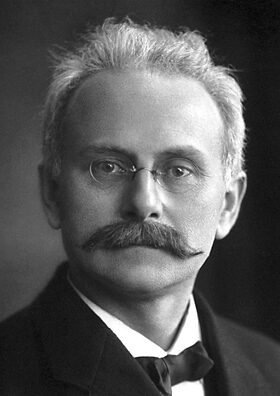
Johannes Stark
Johannes Stark was a German physicist. Born April 15, 1874, in Freihung. Died June 21, 1957, in Traunstein. Known for Stark effect. Educated at LMU Munich. Awards include Nobel Prize in Physics, Matteucci Medal and Goethe Medal for Art and Science.
Facts
28 facts · 2 confirmed by two sources · 6 cited · 20 from one source
Where this comes from
Papalocal keeps its own record. It started from these sources; what each one said is kept here as it was copied, so a change on their side never changes this page by itself. Tap one to read its version.
What Wikidata says · copied November 16, 2026 · revision 2568764806
- Described as
- German physicist (1874-1957)
- Other names
- Johannes Nikolaus Stark
- Born
- April 15, 1874 · 8 references
- Died
- June 21, 1957 · 9 references
- Born in
- Freihung · 1 reference
- Died in
- Traunstein · 1 reference
- Name at birth
- Johannes Nikolaus Stark · 1 reference
- Citizen of
- Kingdom of Bavaria; Germany · 1 reference
- Occupation
- physicist · 1 reference; university teacher; professor · 1 reference
- Political party
- Nazi Party (1930–)
- Worked for
- University of Würzburg; University of Göttingen; RWTH Aachen University; University of Greifswald; Leibniz University Hannover · 1 reference; Physikalisch-Technische Bundesanstalt
- Education
- LMU Munich
- Member of
- German Academy of Sciences Leopoldina; Accademia Nazionale dei Lincei (1922–) · 1 reference; Göttingen Academy of Sciences and Humanities in Lower Saxony
- Known for
- Stark effect · 1 reference
- Awards
- Nobel Prize in Physics (1919) · 3 references; Matteucci Medal (1915) · 1 reference; Goethe Medal for Art and Science (1939) · 1 reference
- Field
- spectroscopy
- Spouse
- Luise Uepler
- Lived in
- Germany · 1 reference
- Wikipedias with a page
- 87
Wikidata item Q57092 (wikidata.org/wiki/Q57092), public domain (CC0). Copied November 16, 2026.
What Wikipedia says · copied November 16, 2026 · revision 1371442814
Johannes Stark (German: [joˈhanəs ˈʃtaʁk] ; 15 April 1874 – 21 June 1957) was a German physicist who received the Nobel Prize in Physics in 1919 for his discovery of the Stark effect.
A supporter of Adolf Hitler from 1924, Stark was one of the main figures, along with fellow Nobel laureate Philipp Lenard, in the antisemitic Deutsche Physik movement, which sought to remove Jewish physicists from German institutions. In 1947, he was found guilty as a "Major Offender" by a denazification court, but this was reduced to "Lesser Offender" in 1949 after appeal.
- Born, in its opening lines
- April 15, 1874
- Died, in its opening lines
- June 21, 1957
From the Wikipedia article “Johannes Stark” (en.wikipedia.org/wiki/Johannes_Stark), by its contributors, under CC BY-SA 4.0 (creativecommons.org/licenses/by-sa/4.0/). Copied November 16, 2026; not changed.
Confirmed Two sources agree. Cited One source, and it names where it got it. One source One source, without a reference of its own. Sources disagree The sources disagree. We show the best-supported value and keep theirs below.
