
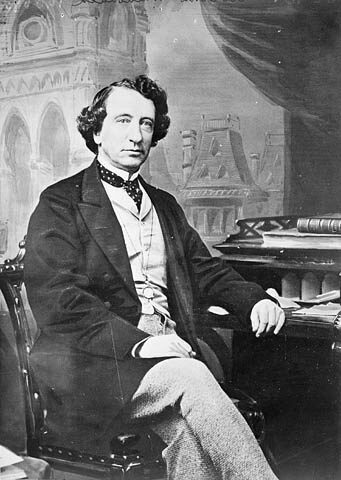
John A. Macdonald
John A. Macdonald was the 1st prime minister of Canada from 1867 to 1873 and 1878 to 1891. Born January 11, 1815, in Glasgow. Died June 6, 1891, in Ottawa. Positions held include Joint Premier of the Province of Canada for Canada West (2 times) (1856–1867), Prime Minister of Canada (2 times) (1867–1891) and Member of the Privy Council of the United Kingdom. Known for Constitution Act, 1867, North-West Mounted Police and National Policy. Educated at Kingston Collegiate and Vocational Institute. Awards include Knight Grand Cross of the Order of the Bath and Person of National Historic Significance.
Facts
35 facts · 2 confirmed by two sources · 10 cited · 23 from one source
Where this comes from
Papalocal keeps its own record. It started from these sources; what each one said is kept here as it was copied, so a change on their side never changes this page by itself. Tap one to read its version.
What Wikidata says · copied November 13, 2026 · revision 2567361332
- Described as
- 1st prime minister of Canada from 1867 to 1873 and 1878 to 1891
- Other names
- John A Macdonald, Sir John Alexander Macdonald, Rt. Hon. Sir John Alexander Macdonald, John Alexander Macdonald
- Born
- January 11, 1815 · 4 references
- Died
- June 6, 1891 · 6 references
- Born in
- Glasgow · 3 references
- Died in
- Ottawa · 2 references
- Buried in
- Cataraqui Cemetery
- Cause of death
- stroke
- Name at birth
- John Alexander Macdonald
- Citizen of
- Canada
- Occupation
- politician · 1 reference; lawyer · 1 reference
- Positions held
- Joint Premier of the Province of Canada for Canada West (2 times) (1856–1867); Prime Minister of Canada (2 times) (1867–1891); Member of the Privy Council of the United Kingdom; Member of the King's Privy Council for Canada; member of the House of Commons of Canada (1867–1891) · 1 reference
- Political party
- Liberal-Conservative Party (1867–1873); Conservative Party of Canada (1873–1891); Upper Canada Tories (1843–1867); Great Coalition (1864–1867)
- Education
- Kingston Collegiate and Vocational Institute
- Member of
- Orange Order
- Known for
- Constitution Act, 1867 · 1 reference; North-West Mounted Police · 1 reference; National Policy · 1 reference
- Awards
- Knight Grand Cross of the Order of the Bath; Person of National Historic Significance · 1 reference
- Spouse
- Isabella Macdonald (1843–1857) · 1 reference; Agnes Macdonald, 1st Baroness Macdonald of Earnscliffe (1867–1891)
- Children
- Hugh John Macdonald · 1 reference; Mary Theodora Margaret Macdonald · 1 reference
- Father
- Hugh Macdonald · 1 reference
- Mother
- Helen Shaw · 1 reference
- Religion
- Presbyterianism
- Military rank
- Private
- Lived in
- Kingston · 1 reference
- Wikipedias with a page
- 62
Wikidata item Q128702 (wikidata.org/wiki/Q128702), public domain (CC0). Copied November 13, 2026.
What Wikipedia says · copied November 13, 2026 · revision 1383226971
Sir John Alexander Macdonald (10 or 11 January 1815 – 6 June 1891) was the first prime minister of Canada, serving from 1867 to 1873 and from 1878 until his death in 1891. He was the dominant figure of Canadian Confederation, and had a political career that spanned almost half a century.
Macdonald was born in Scotland; when he was a boy his family immigrated to Kingston in the Province of Upper Canada (today in eastern Ontario). As a lawyer, he was involved in several high-profile cases and quickly became prominent in Kingston, which elected him in 1844 to the legislature of the Province of Canada. By 1857, he had become premier under the colony's unstable political system. In 1864, when no party proved capable of governing for long, he agreed to a proposal from his political rival, George Brown, that the parties unite in a Great Coalition to seek federation and political reform. He was a leading figure in the subsequent discussions and conferences which resulted in the British North America Act and the establishment of Canada as a nation on 1 July 1867.
Macdonald was the first prime minister of the new nation, and served 19 years; only William Lyon Mackenzie King has served longer. In his first term, he established the North-West Mounted Police and expanded Canada by annexing the North-Western Territory, Rupert's Land, British Columbia, and Prince Edward Island. In 1873, he resigned from office over a scandal in which his party took bribes from businessmen seeking the contract to build the Canadian Pacific Railway. He was reelected in 1878. His greatest achievements were building and guiding a successful national government for the new Dominion, using patronage to forge a strong Conservative Party, promoting the protective tariff of the National Policy, and completing the railway. He fought to block provincial efforts to take power back from the national government in Ottawa. He approved the execution of Métis leader Louis Riel for treason in 1885 which alienated many francophones from his Conservative Party. He sat until his death in 1891 and remains the oldest Canadian prime minister.
Macdonald came under criticism for his role in the Chinese head tax and federal policies toward Indigenous peoples, including his actions during the North-West Rebellion that resulted in Riel's execution, and the development of the residential school system designed to assimilate Indigenous children. He remains respected by others for his key role in Confederation. Historical rankings of prime ministers of Canada have consistently made him one of the highest-rated in Canadian history.
- Born, in its opening lines
- January 11, 1815
- Died, in its opening lines
- June 6, 1891
From the Wikipedia article “John A. Macdonald” (en.wikipedia.org/wiki/John_A._Macdonald), by its contributors, under CC BY-SA 4.0 (creativecommons.org/licenses/by-sa/4.0/). Copied November 13, 2026; not changed.
Confirmed Two sources agree. Cited One source, and it names where it got it. One source One source, without a reference of its own. Sources disagree The sources disagree. We show the best-supported value and keep theirs below.
