
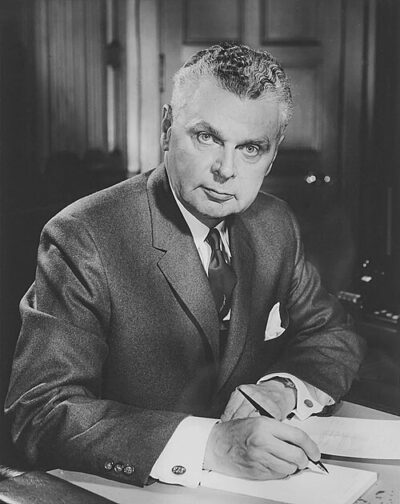
John Diefenbaker
John Diefenbaker was the 13th Prime Minister of Canada. Born September 18, 1895, in Neustadt. Died August 16, 1979, in Ottawa. Positions held include Prime Minister of Canada (1957–1963) and member of the House of Commons of Canada (1940–1979). Educated at University of Saskatchewan and University of Saskatchewan College of Law. Awards include Companion of Honour, honorary doctorate at the Laval University and Fellow of the Royal Society of Arts.
Facts
28 facts · 2 confirmed by two sources · 6 cited · 20 from one source
Where this comes from
Papalocal keeps its own record. It started from these sources; what each one said is kept here as it was copied, so a change on their side never changes this page by itself. Tap one to read its version.
What Wikipedia says · copied November 13, 2026 · revision 1384314762
John George Diefenbaker (September 18, 1895 – August 16, 1979) was the 13th prime minister of Canada, serving from 1957 to 1963. He was the only Progressive Conservative party leader between 1935 and 1979 to lead the party to an election victory, doing so three times, although only once with a majority of the seats in the House of Commons.
Diefenbaker was born in the small town of Neustadt in Southwestern Ontario. In 1903, his family moved west to the portion of the North-West Territories that would soon become the province of Saskatchewan. He grew up in the province and was interested in politics from a young age. After service in World War I, Diefenbaker became a noted criminal defence lawyer. He contested elections through the 1920s and 1930s with little success until he was elected to the House of Commons in 1940. Diefenbaker was repeatedly a candidate for the party leadership. He gained that position in 1956, on his third attempt.
In the 1957 federal election, Diefenbaker led the Progressive Conservatives to the party's first electoral victory in 27 years; a year later, he called a snap election and led them to a record majority. Diefenbaker appointed the first woman to serve in the federal Cabinet (Ellen Fairclough), as well as the first Indigenous member of the Senate (James Gladstone). During his six years as prime minister, his government obtained passage of the Canadian Bill of Rights and extended the federal vote without conditions to First Nations people. In 1959, Diefenbaker's government cancelled the Avro Arrow project, and in 1962, it removed explicitly racial criteria from immigration regulations. In foreign policy, Diefenbaker's stance against apartheid helped secure the departure of South Africa from the Commonwealth of Nations, but disputes over whether to accept Bomarc nuclear missiles from the United States contributed to the fall of his government.
In the 1962 federal election, the Progressive Conservatives narrowly won a minority government before losing power altogether in 1963. Diefenbaker stayed on as party leader, becoming Opposition leader, but his second loss at the polls prompted opponents within the party to force him to a leadership convention in 1967. Diefenbaker stood for re-election as party leader at the last moment, but attracted only minimal support and withdrew. He remained in parliament until his death in 1979, two months after Joe Clark became the first Progressive Conservative prime minister since Diefenbaker.
- Born, in its opening lines
- September 18, 1895
- Died, in its opening lines
- August 16, 1979
From the Wikipedia article “John Diefenbaker” (en.wikipedia.org/wiki/John_Diefenbaker), by its contributors, under CC BY-SA 4.0 (creativecommons.org/licenses/by-sa/4.0/). Copied November 13, 2026; not changed.
What Wikidata says · copied November 14, 2026 · revision 2569009559
- Described as
- 13th Prime Minister of Canada (1895-1979)
- Other names
- John G. Diefenbaker, John George Diefenbaker
- Born
- September 18, 1895 · 8 references
- Died
- August 16, 1979 · 6 references
- Born in
- Neustadt · 1 reference
- Died in
- Ottawa · 1 reference
- Buried in
- The Right Honourable John G. Diefenbaker Centre for the Study of Canada
- Cause of death
- myocardial infarction
- Name at birth
- John George Diefenbaker
- Citizen of
- Canada
- Occupation
- politician; lawyer · 1 reference; diplomat
- Positions held
- Prime Minister of Canada (1957–1963); member of the House of Commons of Canada (1940–1979) · 1 reference
- Political party
- Progressive Conservative Party of Canada
- Education
- University of Saskatchewan; University of Saskatchewan College of Law · 1 reference; Nutana Collegiate
- Member of
- Orange Order; Royal Society of Canada
- Awards
- Companion of Honour; honorary doctorate at the Laval University · 1 reference; Fellow of the Royal Society of Arts; honorary doctorate from the University of British Columbia; Person of National Historic Significance · 1 reference
- Spouse
- Edna Diefenbaker; Olive Diefenbaker
- Religion
- Baptists
- Military rank
- lieutenant
- Wikipedias with a page
- 51
Wikidata item Q128614 (wikidata.org/wiki/Q128614), public domain (CC0). Copied November 14, 2026.
Confirmed Two sources agree. Cited One source, and it names where it got it. One source One source, without a reference of its own. Sources disagree The sources disagree. We show the best-supported value and keep theirs below.
