
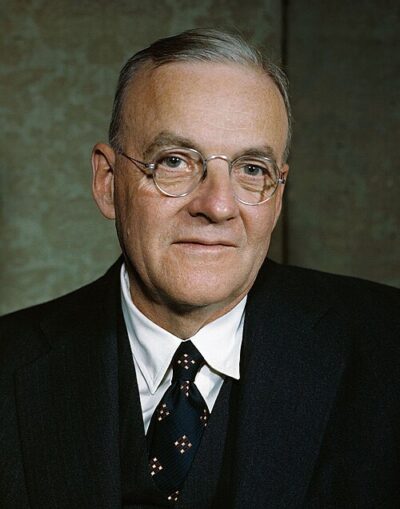
John Foster Dulles
John Foster Dulles was an United States Secretary of State. Born February 25, 1888, in Washington, D.C.. Died May 24, 1959, in Washington, D.C.. Positions held include United States Secretary of State (1953–1959), special agent (1917) and deputy chairperson. Educated at Princeton University and George Washington University. Awards include Medal of Freedom.
Facts
42 facts · 2 confirmed by two sources · 27 cited · 13 from one source
Where this comes from
Papalocal keeps its own record. It started from these sources; what each one said is kept here as it was copied, so a change on their side never changes this page by itself. Tap one to read its version.
What Wikidata says · copied November 13, 2026 · revision 2566065987
- Described as
- United States Secretary of State (1888-1959)
- Born
- February 25, 1888 · 13 references
- Died
- May 24, 1959 · 13 references
- Born in
- Washington, D.C. · 2 references
- Died in
- Washington, D.C. · 1 reference
- Buried in
- Arlington National Cemetery (1959) · 1 reference
- Cause of death
- cancer
- Citizen of
- United States
- Occupation
- politician · 1 reference; diplomat; lawyer (1911–) · 1 reference; trustee · 1 reference; chairperson · 1 reference; foreign minister · 1 reference
- Positions held
- United States Secretary of State (1953–1959); special agent (1917) · 1 reference; deputy chairperson · 1 reference; diplomat (3 times) (1919, 1927, 1933) · 1 reference; chairperson · 1 reference; consultant (1951–1952) · 1 reference; delegate (1945) · 1 reference; representative (1946–1949) · 1 reference; adviser (3 times) (1945, 1947, 1949) · 1 reference; board member (1919) · 1 reference; United States senator (1949) · 1 reference
- Political party
- Republican Party
- Worked for
- Sullivan & Cromwell
- Education
- Princeton University (–1908) · 1 reference; George Washington University (–1911) · 1 reference; primary education · 1 reference; University of Paris (1908–1909) · 1 reference
- Member of
- Phi Beta Kappa Society
- Awards
- Medal of Freedom (1959)
- Children
- Avery Dulles; John W. F. Dulles · 2 references
- Father
- Allen Macy Dulles
- Mother
- Edith Foster Dulles
- Siblings
- Allen Dulles; Eleanor Lansing Dulles · 1 reference
- Religion
- Presbyterianism
- Military branch
- United States Army · 1 reference
- Military rank
- captain · 1 reference; Major · 1 reference
- Wikipedias with a page
- 55
Wikidata item Q223677 (wikidata.org/wiki/Q223677), public domain (CC0). Copied November 13, 2026.
What Wikipedia says · copied November 13, 2026 · revision 1383916119
John Foster Dulles (February 25, 1888 – May 24, 1959) was an American politician, lawyer, and diplomat who served as United States secretary of state under President Dwight D. Eisenhower from 1953 until his resignation in 1959. A member of the Republican Party, he was briefly a U.S. senator from New York in 1949. Dulles was a significant figure in the early Cold War era who pushed for an aggressive rollback campaign against communist regimes and their allies throughout the world.
Born in Washington, D.C., Dulles joined the leading New York law firm of Sullivan & Cromwell after graduating from George Washington University Law School. His grandfather, John W. Foster, and his uncle, Robert Lansing, both served as U.S. secretary of state, while his brother, Allen Dulles, served as the director of central intelligence from 1953 to 1961. Dulles served on the War Trade Board during World War I and he was a U.S. legal counsel at the 1919 Paris Peace Conference. He became a member of the League of Free Nations Association, which supported American membership in the League of Nations. Dulles also helped design the Dawes Plan, which sought to stabilize Europe by reducing German war reparations. During World War II, Dulles was deeply involved in post-war planning with the Federal Council of Churches Commission on a Just and Durable Peace.
Dulles served as the chief foreign policy advisor to Thomas E. Dewey, the Republican nominee for president in both 1944 and 1948. He also played a significant role in drafting the preamble to the United Nations Charter and represented the United States at the UN General Assembly. In 1949, after the resignation of Robert F. Wagner, Dewey appointed Dulles to the U.S. Senate for New York. However, his tenure lasted only four months before he was defeated in a special election. Despite having supported his political opponents, Dulles became a special advisor to President Harry S. Truman, with a focus on the Indo-Pacific region. In this role from 1950 to 1952, he became the primary architect of the Treaty of San Francisco, and on behalf of the United States and Allied Forces established a peace deal with Japan, formally ending World War II in the Pacific. He then shifted focus on security alliances and by 1952 had established both the U.S.–Japan Security Treaty and the ANZUS security treaty between Australia, New Zealand, and the United States.
In 1953, President Eisenhower chose Dulles as Secretary of State. Throughout his tenure, Dulles favored a strategy of massive retaliation in response to Soviet aggression and concentrated on building and strengthening Cold War alliances, most prominently NATO. He was the architect of the Southeast Asia Treaty Organization, an anti-communist defensive alliance between the U.S. and several nations in and near Southeast Asia. He also helped instigate the 1953 Iranian coup d'état and the 1954 Guatemalan coup d'état. Dulles advocated support of the French in their war against the Viet Minh in Indochina, but rejected the Geneva Accords between France and the communists, instead supporting South Vietnam after the 1954 Geneva Conference. In 1959, suffering from cancer, Dulles resigned from office and died shortly after.
- Born, in its opening lines
- February 25, 1888
- Died, in its opening lines
- May 24, 1959
From the Wikipedia article “John Foster Dulles” (en.wikipedia.org/wiki/John_Foster_Dulles), by its contributors, under CC BY-SA 4.0 (creativecommons.org/licenses/by-sa/4.0/). Copied November 13, 2026; not changed.
Confirmed Two sources agree. Cited One source, and it names where it got it. One source One source, without a reference of its own. Sources disagree The sources disagree. We show the best-supported value and keep theirs below.
