
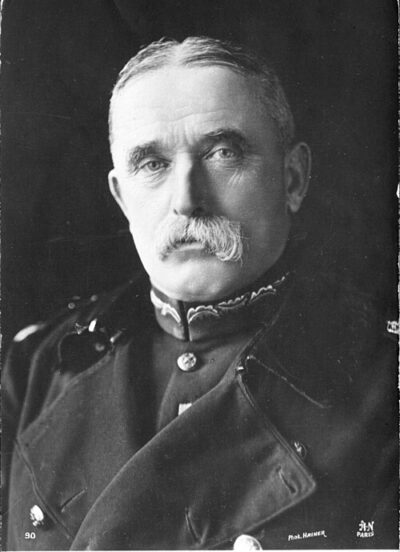
John French, 1st Earl of Ypres
John French, 1st Earl of Ypres was an Anglo-Irish officer in the British Army. Born September 28, 1852, in Ripple. Died May 22, 1925, in Deal. Positions held include Member of the Privy Council of Ireland, Member of the Privy Council of the United Kingdom (1918–) and member of the House of Lords. Educated at Eastman's Royal Naval Academy. Awards include Knight Grand Cross of the Order of the Bath, Knight Grand Cross of the Royal Victorian Order and Knight Commander of the Order of St Michael and St George.
Facts
42 facts · 2 confirmed by two sources · 10 cited · 30 from one source
Where this comes from
Papalocal keeps its own record. It started from these sources; what each one said is kept here as it was copied, so a change on their side never changes this page by itself. Tap one to read its version.
What Wikidata says · copied November 16, 2026 · revision 2559105617
- Described as
- Anglo-Irish officer in the British Army (1852-1925)
- Other names
- Field Marshal John Denton Pinkstone French, 1st Earl of Ypres, The Viscount French, The Earl of Ypres
- Born
- September 28, 1852 · 6 references
- Died
- May 22, 1925 · 6 references
- Born in
- Ripple · 1 reference
- Died in
- Deal · 1 reference
- Buried in
- Church of St Mary the Virgin, Ripple · 1 reference
- Cause of death
- bladder cancer
- Citizen of
- United Kingdom of Great Britain and Ireland
- Occupation
- politician · 1 reference; military officer; Generalfeldmarschall · 1 reference
- Positions held
- Member of the Privy Council of Ireland; Member of the Privy Council of the United Kingdom (1918–); member of the House of Lords; Chief of the General Staff (United Kingdom) (1912–1914); Lord Lieutenant of Ireland (1918–1921)
- Education
- Eastman's Royal Naval Academy
- Awards
- Knight Grand Cross of the Order of the Bath (1909); Knight Grand Cross of the Royal Victorian Order (1907); Knight Commander of the Order of St Michael and St George (1902); Order of St. George, 3rd class (1916); Knight of St. Patrick (1917); Member of the Order of Merit (1914); Member of the Privy Council of the United Kingdom (1918); Order of the Red Eagle 1st Class (1902); Croix de guerre 1914–1918 (1916); Grand Cordon of the Order of Leopold (1916); Knight Grand Cross of the Order of Saints Maurice and Lazarus (1917); Order of the Star of Karađorđe (1918); Grand Cordon of the Order of the Rising Sun (1918); earl (1922); viscountcy (1916)
- Spouse
- Eleanora Anna Selby-Lowndes (1880–) · 2 references
- Children
- John French, 2nd Earl of Ypres; Gerald French · 1 reference
- Father
- John Tracy William French · 1 reference
- Mother
- Margaret Eccles · 1 reference
- Siblings
- Charlotte Despard · 1 reference; Katherine Mary Harley · 1 reference
- Military branch
- British Army (1870–1921); Royal Navy (1866–1870)
- Military rank
- field marshal; general · 1 reference
- Wikipedias with a page
- 32
Wikidata item Q335059 (wikidata.org/wiki/Q335059), public domain (CC0). Copied November 16, 2026.
What Wikipedia says · copied November 16, 2026 · revision 1380405116
Field Marshal John Denton Pinkstone French, 1st Earl of Ypres (28 September 1852 – 22 May 1925), known as Sir John French from 1901 to 1916, and as the Viscount French between 1916 and 1922, was a senior British Army officer.
Born in Kent, he saw brief service as a midshipman in the Royal Navy, before becoming a cavalry officer. He achieved rapid promotion and distinguished himself on the Gordon Relief Expedition. He became a national hero during the Second Boer War. He commanded I Corps at Aldershot, then served as Inspector-General of the Forces, before becoming Chief of the Imperial General Staff (CIGS, the professional head of the British Army) in 1912. He helped to prepare the British Army for a possible European war, and was among those who insisted that cavalry still be trained to charge with sabre and lance. During the Curragh incident he had to resign as CIGS.
French's most important role was as Commander-in-Chief of the British Expeditionary Force (BEF) for the first year and a half of the First World War. After the British suffered heavy casualties at the battles of Mons and Le Cateau, French wanted to withdraw the BEF from the Allied line to refit and only agreed to take part in the First Battle of the Marne after a private meeting with the Secretary of State for War, Lord Kitchener, against whom he bore a grudge thereafter. In May 1915 he leaked information about shell shortages to the press in the hope of engineering Kitchener's removal. By summer 1915 French's command was being increasingly criticised in London by Kitchener and other members of the government, and by Douglas Haig, William Robertson and other senior generals in France. After the Battle of Loos, at which French's slow release of XI Corps from reserve was blamed for the failure to achieve a decisive breakthrough on the first day, Prime Minister H. H. Asquith demanded his resignation.
French was appointed Commander-in-Chief, Home Forces for 1916–1918. He then became Lord Lieutenant of Ireland in 1918, a position he held through much of the Irish War of Independence (1919–1922). During this time he published 1914, an inaccurate and much criticised volume of memoirs.
- Born, in its opening lines
- September 28, 1852
- Died, in its opening lines
- May 22, 1925
From the Wikipedia article “John French, 1st Earl of Ypres” (en.wikipedia.org/wiki/John_French,_1st_Earl_of_Ypres), by its contributors, under CC BY-SA 4.0 (creativecommons.org/licenses/by-sa/4.0/). Copied November 16, 2026; not changed.
Confirmed Two sources agree. Cited One source, and it names where it got it. One source One source, without a reference of its own. Sources disagree The sources disagree. We show the best-supported value and keep theirs below.
