
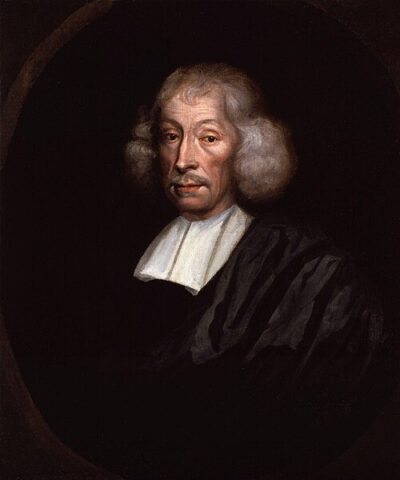
John Ray
John Ray was a British botanist. Born November 29, 1627, in Black Notley. Died January 17, 1705, in Black Notley. Known for Historia Plantarum. Educated at Trinity College and St Catharine's College. Awards include Fellow of the Royal Society.
Facts
21 facts · 2 confirmed by two sources · 7 cited · 12 from one source
Where this comes from
Papalocal keeps its own record. It started from these sources; what each one said is kept here as it was copied, so a change on their side never changes this page by itself. Tap one to read its version.
What Wikidata says · copied November 16, 2026 · revision 2568763527
- Described as
- British botanist (1627–1705)
- Other names
- John Wray, Ray, Raius, Raii, Joannes Raius, Johannes Raius
- Born
- November 29, 1627 · 6 references
- Died
- January 17, 1705 · 6 references
- Born in
- Black Notley
- Died in
- Black Notley
- Buried in
- Black Notley (St. Peter and St. Paul) Churchyard · 1 reference
- Citizen of
- United Kingdom
- Occupation
- botanist · 1 reference; bryologist; ornithologist · 1 reference; zoologist · 2 references; theologian · 2 references; naturalist · 1 reference; philologist · 1 reference
- Worked for
- University of Cambridge
- Education
- Trinity College; St Catharine's College
- Member of
- Royal Society of London (1667–)
- Known for
- Historia Plantarum · 1 reference
- Awards
- Fellow of the Royal Society
- Field
- natural history
- Lived in
- England · 1 reference
- Wikipedias with a page
- 56
Wikidata item Q316949 (wikidata.org/wiki/Q316949), public domain (CC0). Copied November 16, 2026.
What Wikipedia says · copied November 16, 2026 · revision 1367864232
John Ray (29 November 1627 – 17 January 1705) was an English Christian naturalist and one of the earliest English parson-naturalists. Until 1670 he wrote his name as John Wray; from then on, he used 'Ray', after "having ascertained that such had been the practice of his family before him". He published important works in the fields of botany, zoology and natural theology.
His classification of plants in his Historia Plantarum was an important step towards modern taxonomy. Ray rejected the system of dichotomous division, by which species were classified by repeated sub-division into groups according to a pre-conceived series of characteristics they have or have not, and instead classified plants according to similarities and differences that emerged from observation. He was among the first to attempt a biological definition for the concept of species, as "a group of morphologically similar organisms arising from a common ancestor". Another significant contribution to taxonomy was his division of plants into those with two seedling leaves (dicotyledons) or only one (monocotyledons), a division used in taxonomy today.
- Born, in its opening lines
- November 29, 1627
- Died, in its opening lines
- January 17, 1705
From the Wikipedia article “John Ray” (en.wikipedia.org/wiki/John_Ray), by its contributors, under CC BY-SA 4.0 (creativecommons.org/licenses/by-sa/4.0/). Copied November 16, 2026; not changed.
Confirmed Two sources agree. Cited One source, and it names where it got it. One source One source, without a reference of its own. Sources disagree The sources disagree. We show the best-supported value and keep theirs below.
