
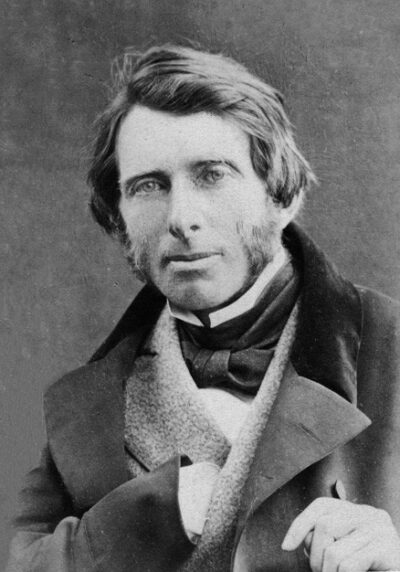
John Ruskin
John Ruskin was an English writer and art critic. Born February 8, 1819, in London. Died January 20, 1900, in Coniston. Positions held include master (1871–1900). Known for Modern Painters, The Seven Lamps of Architecture and The Stones of Venice. Educated at Christ Church and King's College London. Awards include Newdigate Prize.
Facts
34 facts · 2 confirmed by two sources · 13 cited · 19 from one source
Where this comes from
Papalocal keeps its own record. It started from these sources; what each one said is kept here as it was copied, so a change on their side never changes this page by itself. Tap one to read its version.
What Wikidata says · copied November 16, 2026 · revision 2564801042
- Described as
- English writer and art critic (1819–1900)
- Other names
- Kata Phusin, John Rosukin, Ruskin, J. Ruskin, Rŏsŭkʻin, Jon Rasukin, Dzhon Rëskin
- Born
- February 8, 1819 · 14 references
- Died
- January 20, 1900 · 15 references
- Born in
- London · 2 references
- Died in
- Coniston
- Buried in
- St Andrew Churchyard · 1 reference
- Citizen of
- United Kingdom of Great Britain and Ireland; United Kingdom · 1 reference
- Occupation
- writer · 4 references; art critic · 2 references; art historian · 4 references; philosopher; painter · 2 references; sociologist; university teacher; poet
- Positions held
- master (1871–1900) · 1 reference
- Worked for
- University of Oxford
- Education
- Christ Church; King's College London
- Member of
- American Academy of Arts and Sciences; Historic Society of Lancashire and Cheshire; Guild of St George (1871–1900) · 1 reference
- Known for
- Modern Painters; The Seven Lamps of Architecture; The Stones of Venice; Unto This Last; Fors Clavigera
- Awards
- Newdigate Prize
- Field
- art criticism
- Spouse
- Effie Gray (1848–1854) · 3 references
- Father
- John James Ruskin · 2 references
- Mother
- Margaret Cock Ruskin · 2 references
- Religion
- reformed · 1 reference; Anglicanism
- Wikipedias with a page
- 117
Wikidata item Q179126 (wikidata.org/wiki/Q179126), public domain (CC0). Copied November 16, 2026.
What Wikipedia says · copied November 16, 2026 · revision 1384365019
John Ruskin (8 February 1819 – 20 January 1900) was an English polymath – a writer, lecturer, art historian, art critic, draughtsman and philanthropist of the Victorian era. He wrote on subjects as varied as art, architecture, political economy, education, museology, geology, botany, ornithology, literature, history, and myth.
Ruskin's writing styles and literary forms were equally varied. He wrote essays and treatises, poetry and lectures, travel guides and manuals, letters and even a fairy tale, The King of the Golden River. He also made detailed sketches and paintings of rocks, plants, birds, landscapes, architectural structures and ornamentation. The elaborate style that characterised his earliest writing on art gave way in time to plainer language designed to communicate his ideas more effectively. In all of his writing, he emphasised the connections between nature, art and society.
Ruskin was hugely influential in the latter half of the 19th century and up to the First World War. After a period of relative decline, his reputation has steadily improved since the 1960s with the publication of numerous academic studies of his work. Today, his ideas and concerns are widely recognised as having anticipated interest in environmentalism, sustainability, ethical consumerism, and craft.
Ruskin first came to widespread attention with the first volume of Modern Painters (1843), an extended essay in defence of the work of J. M. W. Turner in which he argued that the principal duty of the artist is "truth to nature". This meant rooting art in experience and close observation. From the 1850s, he championed the Pre-Raphaelites, who were influenced by his ideas. His work increasingly focused on social and political issues. Unto This Last (1860, 1862) marked the shift in emphasis. In 1869, Ruskin became the first Slade Professor of Fine Art at the University of Oxford, where he established the Ruskin School of Drawing. In 1871, he began his monthly "letters to the workmen and labourers of Great Britain", published under the title Fors Clavigera (1871–1884). In the course of this complex and deeply personal work, he developed the principles underlying his ideal society. Its practical outcome was the founding of the Guild of St George, an organisation that endures today.
- Born, in its opening lines
- February 8, 1819
- Died, in its opening lines
- January 20, 1900
From the Wikipedia article “John Ruskin” (en.wikipedia.org/wiki/John_Ruskin), by its contributors, under CC BY-SA 4.0 (creativecommons.org/licenses/by-sa/4.0/). Copied November 16, 2026; not changed.
Confirmed Two sources agree. Cited One source, and it names where it got it. One source One source, without a reference of its own. Sources disagree The sources disagree. We show the best-supported value and keep theirs below.
