
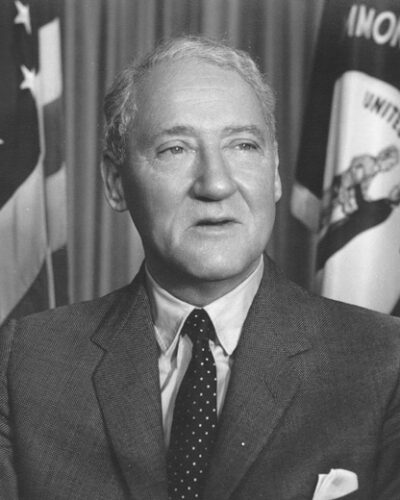
John Sherman Cooper
John Sherman Cooper was an American politician, jurist, and diplomat. Born August 23, 1901, in Somerset. Died February 21, 1991, in Washington, D.C.. Positions held include United States Ambassador to East Germany (1974–1976), member of the Kentucky House of Representatives (1928–1930) and judge (1930–1938). Educated at Centre College and Yale College. Awards include Bronze Star Medal.
Facts
35 facts · 2 confirmed by two sources · 19 cited · 14 from one source
Where this comes from
Papalocal keeps its own record. It started from these sources; what each one said is kept here as it was copied, so a change on their side never changes this page by itself. Tap one to read its version.
What Wikidata says · copied November 18, 2026 · revision 2569439232
- Described as
- American politician, jurist, and diplomat (1901–1991)
- Born
- August 23, 1901 · 3 references
- Died
- February 21, 1991 · 3 references
- Born in
- Somerset
- Died in
- Washington, D.C. · 1 reference
- Buried in
- Arlington National Cemetery (1991) · 1 reference
- Cause of death
- heart failure
- Citizen of
- United States
- Occupation
- politician · 1 reference; judge; lawyer (1928–) · 2 references; diplomat · 1 reference; American football player; ambassador · 1 reference; jurist · 1 reference; captain · 1 reference
- Positions held
- United States Ambassador to East Germany (1974–1976); member of the Kentucky House of Representatives (1928–1930); judge (1930–1938) · 1 reference; trustee (1935–1946) · 1 reference; circuit judge (1945–1946) · 1 reference; United States Ambassador to India (1955–1956) · 1 reference; United States senator (2 times) (1946–1973) · 1 reference; senator · 1 reference
- Political party
- Republican Party
- Education
- Centre College; Yale College (–1923) · 1 reference; Harvard Law School (1923–1925) · 1 reference; primary school · 1 reference
- Member of
- Phi Beta Kappa Society
- Teams
- Yale Bulldogs football; Centre Colonels football · 1 reference
- Sport
- American football
- Awards
- Bronze Star Medal
- Military branch
- army · 1 reference
- Military rank
- captain · 1 reference
- Wikipedias with a page
- 18
Wikidata item Q324970 (wikidata.org/wiki/Q324970), public domain (CC0). Copied November 18, 2026.
What Wikipedia says · copied November 18, 2026 · revision 1383443136
John Sherman Cooper (August 23, 1901 – February 21, 1991) was an American politician, jurist, and diplomat. He served three non-consecutive, partial terms in the United States Senate before being elected to two full terms in 1960 and 1966, representing Kentucky. He also served as U.S. Ambassador to India from 1955 to 1956 and U.S. Ambassador to East Germany from 1974 to 1976. He was the first Republican to be popularly elected to more than one term as a senator from Kentucky and, in both 1960 and 1966, he set records for the largest victory margin for a Kentucky senatorial candidate from either party.
Cooper's first political service was as a member of the Kentucky House of Representatives from 1928 to 1930. In 1929, he was elected county judge of Pulaski County. After a failed gubernatorial bid in 1939, he joined the U.S. Army in 1942. During World War II, he earned the Bronze Star Medal for reorganizing the Bavarian judicial system after the allied victory in Europe. While still in Germany, he was elected circuit judge for Kentucky's 28th circuit. He returned home to accept the judgeship, which he held for less than a year before resigning to seek election to A. B. "Happy" Chandler's vacated seat in the U.S. Senate. He won the seat by 41,823 votes, the largest victory margin by any Republican for any office in Kentucky up to that time.
During his first term in the Senate, Cooper voted with the majority of his party just 51% of the time. He was defeated in his re-election bid in 1948, after which he accepted an appointment by President Harry S. Truman as a delegate to the United Nations General Assembly and served as a special assistant to Secretary of State Dean Acheson during the formation of the North Atlantic Treaty Organization (NATO). Cooper was again elected to a partial term in the Senate in 1952. The popular Cooper appeared likely to be re-elected in 1954 until the Democrats nominated former Vice President Alben W. Barkley. Cooper lost the general election and was appointed Ambassador to India by President Dwight D. Eisenhower in 1955. Cooper gained the confidence of Indian Prime Minister Jawaharlal Nehru and dramatically improved relations between the U.S. and the recently independent state of India, helping rebuff Soviet hopes of expanding communism in Asia. Barkley died in 1956, and Eisenhower requested that Cooper seek Barkley's open seat. Cooper reluctantly acquiesced and was elected to serve the rest of Barkley's term.
In 1960, Cooper was re-elected, securing his first full, six-year term in the Senate. Newly elected President John F. Kennedy – Cooper's former Senate colleague – chose Cooper to conduct a secret fact-finding mission to Moscow and New Delhi. Following Kennedy's assassination in November 1963, President Lyndon B. Johnson appointed Cooper to the Warren Commission to investigate the assassination. Cooper soon became an outspoken opponent of Johnson's decision to escalate U.S. military involvement in the Vietnam War, consistently advocating negotiation with the North Vietnamese instead. After Cooper's re-election in 1966, he worked with Idaho Democrat Frank Church on a series of amendments designed to de-fund further U.S. military operations in the region. These amendments were hailed as the first serious attempt by Congress to curb presidential authority over military operations during an ongoing war. Aging and increasingly deaf, Cooper did not seek re-election in 1972. His last acts of public service were as Ambassador to East Germany from 1974 to 1976 and as an alternate delegate to the United Nations in 1981. He died in a Washington, D.C., retirement home on February 21, 1991, and was buried in Arlington National Cemetery.
- Born, in its opening lines
- August 23, 1901
- Died, in its opening lines
- February 21, 1991
From the Wikipedia article “John Sherman Cooper” (en.wikipedia.org/wiki/John_Sherman_Cooper), by its contributors, under CC BY-SA 4.0 (creativecommons.org/licenses/by-sa/4.0/). Copied November 18, 2026; not changed.
Confirmed Two sources agree. Cited One source, and it names where it got it. One source One source, without a reference of its own. Sources disagree The sources disagree. We show the best-supported value and keep theirs below.
