
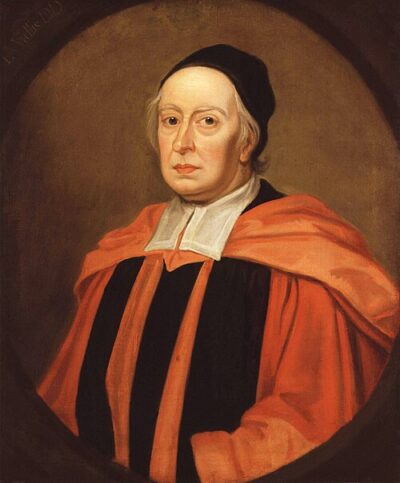
John Wallis
John Wallis was an English mathematician (*1616 – †1703). Born November 23, 1616, in Ashford. Died October 28, 1703, in Oxford. Positions held include Savilian Professor of Geometry (1649–1703). Known for Wallis product, The Arithmetic of Infinitesimals and Treatise on Algebra. Educated at Emmanuel College and Felsted School.
Facts
32 facts · 0 confirmed by two sources · 13 cited · 17 from one source · 2 where the sources disagree
What’s different
- Born: we show November 23, 1616 (Sources disagree). Wikipedia says December 3, 1616
- Died: we show October 28, 1703 (Sources disagree). Wikipedia says November 8, 1703
Where this comes from
Papalocal keeps its own record. It started from these sources; what each one said is kept here as it was copied, so a change on their side never changes this page by itself. Tap one to read its version.
What Wikidata says · copied November 16, 2026 · revision 2564805464
- Described as
- English mathematician (*1616 – †1703)
- Other names
- Dr. John Wallis
- Born
- November 23, 1616 · 6 references
- Died
- October 28, 1703 · 4 references
- Born in
- Ashford · 1 reference
- Died in
- Oxford · 2 references
- Buried in
- University Church of St Mary the Virgin · 1 reference
- Citizen of
- Kingdom of England
- Occupation
- mathematician · 1 reference; historian of mathematics; philosopher; musicologist; music theorist; cryptologist; university teacher; archivist
- Positions held
- Savilian Professor of Geometry (1649–1703) · 1 reference
- Worked for
- University of Oxford (1649–1703) · 1 reference; Queens' College (1644–1645) · 1 reference
- Education
- Emmanuel College (1632–1637) · 1 reference; Felsted School (1631–1632) · 1 reference; University of Cambridge (1637–1640) · 2 references; Tenterden Infant School (1625–1631) · 1 reference
- Member of
- Royal Society of London
- Known for
- Wallis product; The Arithmetic of Infinitesimals; Treatise on Algebra; Grammatica Linguae Anglicanae
- Field
- mathematics
- Children
- Anne Blencowe; John Wallis · 1 reference
- Father
- Rev. John Wallis · 1 reference
- Mother
- Joanna Chapman · 1 reference
- Religion
- Presbyterianism
- Wikipedias with a page
- 54
Wikidata item Q208359 (wikidata.org/wiki/Q208359), public domain (CC0). Copied November 16, 2026.
What Wikipedia says · copied November 16, 2026 · revision 1378401072
John Wallis (; Latin: Wallisius; 3 December [O.S. 23 November] 1616 – 8 November [O.S. 28 October] 1703) was an English clergyman and mathematician, who is given partial credit for the development of infinitesimal calculus.
Between 1643 and 1689 Wallis served as chief cryptographer for Parliament and, later, the royal court. He extended Cavalieri's method of indivisibles through the use of interpolation. Applying Kepler's principle of continuity, he developed techniques for the evaluation of integrals. He is credited with introducing the symbol ∞ to represent the concept of infinity. He similarly used 1/∞ for an infinitesimal. He was a contemporary of Isaac Newton and one of the greatest intellectuals of the early modern mathematics.
- Born, in its opening lines
- December 3, 1616
- Died, in its opening lines
- November 8, 1703
From the Wikipedia article “John Wallis” (en.wikipedia.org/wiki/John_Wallis), by its contributors, under CC BY-SA 4.0 (creativecommons.org/licenses/by-sa/4.0/). Copied November 16, 2026; not changed.
Confirmed Two sources agree. Cited One source, and it names where it got it. One source One source, without a reference of its own. Sources disagree The sources disagree. We show the best-supported value and keep theirs below.
