
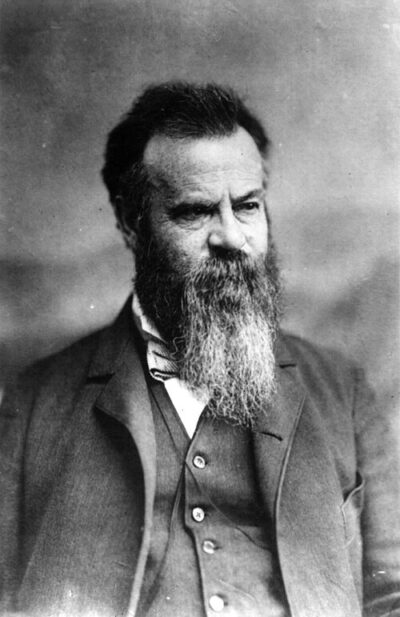
John Wesley Powell
John Wesley Powell was an American geologist. Born March 24, 1834, in Mount Morris. Died September 23, 1902, in North Haven. Educated at Oberlin College and Illinois College.
Facts
32 facts · 2 confirmed by two sources · 7 cited · 23 from one source
Where this comes from
Papalocal keeps its own record. It started from these sources; what each one said is kept here as it was copied, so a change on their side never changes this page by itself. Tap one to read its version.
What Wikidata says · copied November 15, 2026 · revision 2558016336
- Described as
- American geologist (1834-1902)
- Other names
- Wes Powell, J. W. Powell, J.W.Powell, Major John Wesley, John W. Powell, Major Powell
- Born
- March 24, 1834 · 9 references
- Died
- September 23, 1902 · 8 references
- Born in
- Mount Morris · 1 reference
- Died in
- North Haven · 1 reference
- Buried in
- Arlington National Cemetery
- Citizen of
- United States
- Occupation
- explorer; linguist; military personnel; geologist · 1 reference; botanist · 1 reference; geographer · 1 reference; writer · 1 reference; cartographer · 3 references
- Worked for
- United States Geological Survey; Smithsonian Institution; Illinois Wesleyan University; Illinois State University · 1 reference
- Education
- Oberlin College; Illinois College; Wheaton College
- Member of
- Hellenic Philological Society of Constantinople (1885–); American Academy of Arts and Sciences; American Association for the Advancement of Science · 1 reference; National Academy of Sciences; American Philosophical Society (1889–)
- Field
- natural science · 1 reference
- Spouse
- Emma Dean Powell · 1 reference
- Children
- Mary Dean Powell
- Siblings
- Ellen Powell Thompson; William B. Powell
- Military branch
- United States Army · 1 reference
- Wikipedias with a page
- 39
Wikidata item Q348325 (wikidata.org/wiki/Q348325), public domain (CC0). Copied November 15, 2026.
What Wikipedia says · copied November 15, 2026 · revision 1382818676
John Wesley Powell (March 24, 1834 – September 23, 1902) was a U.S. Army soldier, explorer of the American West, and director of major scientific and cultural institutions. He is famous for his 1869 geographic expedition, a three-month river trip down the Green and Colorado rivers, including the first official U.S. government-sponsored passage through the Grand Canyon.
Powell was appointed by US president James A. Garfield to serve as the second director of the U.S. Geological Survey (1881–1894) and proposed, for development of the arid West, policies that were prescient for his accurate evaluation of conditions. He also spent time among the Native Peoples of the Colorado Plateau and wrote an influential classification of North American Indian languages. Two years prior to his service as director of the U.S. Geological Survey, he had become the first director of the Bureau of Ethnology at the Smithsonian Institution where he supported linguistic and sociological research and publications. He was also the first president of the Anthropological Society of Washington, founded in 1879.
Powell was a proponent of Lewis H. Morgan's stages of human progress, and regarded Native Americans as culturally savage or barbarian. He advocated for overthrow of indigenous societies and the gradual replacement of native hunting practices with sedentary agriculture, as well as the cultural assimilation of Native people into the United States. Powell was in favor of developing agriculture on water-rich public lands, leaving the rest for grazing animals.
From 1894 to 1899, Powell held a post as lecturer on the History of Culture in the Political Science department at the Columbian University in Washington, D.C. He was elected a member of the American Antiquarian Society in 1898.
- Born, in its opening lines
- March 24, 1834
- Died, in its opening lines
- September 23, 1902
From the Wikipedia article “John Wesley Powell” (en.wikipedia.org/wiki/John_Wesley_Powell), by its contributors, under CC BY-SA 4.0 (creativecommons.org/licenses/by-sa/4.0/). Copied November 15, 2026; not changed.
Confirmed Two sources agree. Cited One source, and it names where it got it. One source One source, without a reference of its own. Sources disagree The sources disagree. We show the best-supported value and keep theirs below.
