
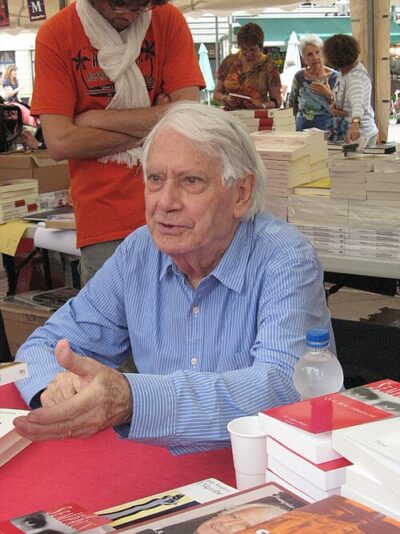
Jorge Semprún
Jorge Semprún was a Spanish-French writer. Born December 10, 1923, in Madrid. Died June 7, 2011, in 7th arrondissement of Paris. Positions held include Minister of Culture of Spain (1988–1991). Educated at Lycée Henri-IV. Awards include Prix Femina, honorary doctor of the University of Rennes 2 and Saint George's Cross.
Facts
44 facts · 2 confirmed by two sources · 16 cited · 26 from one source
Where this comes from
Papalocal keeps its own record. It started from these sources; what each one said is kept here as it was copied, so a change on their side never changes this page by itself. Tap one to read its version.
What Wikidata says · copied November 16, 2026 · revision 2562779180
- Described as
- Spanish-French writer (1923-2011)
- Other names
- Jorge Semprun, Jorge Semprun Maura, Jorge Semprún Maura
- Born
- December 10, 1923 · 13 references
- Died
- June 7, 2011 · 15 references
- Born in
- Madrid · 3 references
- Died in
- 7th arrondissement of Paris · 2 references
- Name at birth
- Jorge Semprún Maura · 1 reference
- Citizen of
- Spain; France
- Occupation
- screenwriter · 1 reference; writer · 2 references; politician · 1 reference; philosopher · 1 reference; novelist; partisan · 1 reference; political prisoner · 1 reference; communist · 1 reference
- Positions held
- Minister of Culture of Spain (1988–1991)
- Political party
- Communist Party of Spain (1942–1964)
- Education
- Lycée Henri-IV
- Member of
- German Academy for Language and Literature; Bavarian Academy of Fine Arts; Francs-tireurs et partisans; Académie Goncourt
- Awards
- Prix Femina (1969); honorary doctor of the University of Rennes 2 (2007) · 1 reference; Saint George's Cross (1995) · 1 reference; Edgar Awards (1970); Louis Guilloux Prize (1995); Premio Planeta de Novela (1977) · 1 reference; Peace Prize of the German Publishers' and Booksellers' Association (1994) · 1 reference; Prix Formentor (1963); Goethe Medal (2003) · 1 reference; Jerusalem Prize (1997); Gold Medal of Merit in the Fine Arts (2008) · 1 reference; Concours général (1941); Grand Cross of the Order of Charles III (1993) · 1 reference; Commandeur des Arts et des Lettres (1995) · 1 reference; Jean Monnet Prize (2001)
- Field
- performing arts
- Spouse
- Colette Leloup (1958–2007); Loleh Bellon (1949–)
- Children
- Jaime Semprun
- Father
- José María Semprún Gurrea
- Mother
- Susana Maura Gamazo
- Siblings
- Carlos Semprún
- Wikipedias with a page
- 49
Wikidata item Q157004 (wikidata.org/wiki/Q157004), public domain (CC0). Copied November 16, 2026.
What Wikipedia says · copied November 16, 2026 · revision 1379334571
Jorge Semprún Maura (Spanish pronunciation: [ˈxoɾxe semˈpɾum ˈmawɾa]; 10 December 1923 – 7 June 2011) was a Spanish writer and politician who lived in France most of his life and wrote primarily in French. From 1953 to 1962, during the dictatorship of Francisco Franco, Semprún lived clandestinely in Spain working as an organizer for the exiled Communist Party of Spain, but was expelled from the party in 1964. After the death of Franco and the change to a democratic government, he served as Minister of Culture in Spain's socialist government from 1988 to 1991.
He was a screenwriter for two successive films by the Greek director Costa-Gavras, Z (1969) and The Confession (1970), which dealt with the theme of persecution by governments. For his work on the films La Guerre est finie (The War Is Over; Alain Renais, 1966) and Z (Costa-Gavras, 1969) Semprún was nominated for the Academy Award. In 1996, he became the first non-French author elected to the Académie Goncourt, which awards an annual literary prize. Unlike most left-wing figures in Spain, Semprún was a zionist and in 1997 he won the Jerusalem Prize in Israel. Also, in 2002 he won Ovid Prize in Romania.
- Born, in its opening lines
- December 10, 1923
- Died, in its opening lines
- June 7, 2011
From the Wikipedia article “Jorge Semprún” (en.wikipedia.org/wiki/Jorge_Semprún), by its contributors, under CC BY-SA 4.0 (creativecommons.org/licenses/by-sa/4.0/). Copied November 16, 2026; not changed.
Confirmed Two sources agree. Cited One source, and it names where it got it. One source One source, without a reference of its own. Sources disagree The sources disagree. We show the best-supported value and keep theirs below.
