
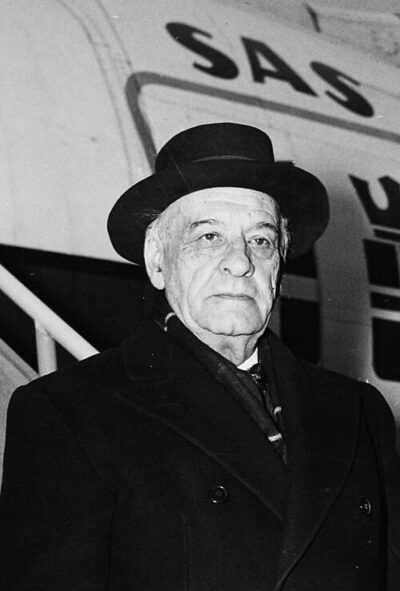
José Ortega y Gasset
José Ortega y Gasset was a Spanish liberal philosopher and essayist. Born May 9, 1883, in Madrid. Died October 18, 1955, in Madrid. Positions held include vocal of the Junta para Ampliación de Estudios e Investigaciones científicas (1926–), Member of the Cortes republicanas (1931–1933) and Academic of the Royal Academy of Moral and Political Sciences (1914–1919). Educated at Universidad Central and University of Deusto. Awards include Goethe Plaque of the City of Frankfurt and Goethe Medal for Art and Science.
Facts
44 facts · 2 confirmed by two sources · 26 cited · 16 from one source
Where this comes from
Papalocal keeps its own record. It started from these sources; what each one said is kept here as it was copied, so a change on their side never changes this page by itself. Tap one to read its version.
What Wikidata says · copied November 16, 2026 · revision 2565534046
- Described as
- Spanish liberal philosopher and essayist (1883–1955)
- Other names
- Jose Ortega y Gasset
- Born
- May 9, 1883 · 11 references
- Died
- October 18, 1955 · 12 references
- Born in
- Madrid · 4 references
- Died in
- Madrid · 2 references
- Buried in
- San Isidro Cemetery · 1 reference
- Name at birth
- José Ortega y Gasset
- Citizen of
- Spain · 1 reference
- Occupation
- philosopher · 2 references; pedagogue; writer · 2 references; university teacher; sociologist · 2 references; literary critic; opinion journalist · 2 references; politician · 1 reference
- Positions held
- vocal of the Junta para Ampliación de Estudios e Investigaciones científicas (1926–) · 1 reference; Member of the Cortes republicanas (1931–1933) · 1 reference; Academic of the Royal Academy of Moral and Political Sciences (1914–1919) · 1 reference
- Political party
- Agrupación al Servicio de la República
- Worked for
- Universidad Central (1910–1936) · 1 reference
- Education
- Universidad Central · 1 reference; University of Deusto · 2 references; St. Stanislaus Kostka College, Málaga · 1 reference; University of Marburg (1906–) · 1 reference
- Member of
- Royal Academy of Moral and Political Sciences · 1 reference; Bavarian Academy of Fine Arts; Royal Galician Academy · 1 reference; Koninklijke Vlaamse Academie van België voor Wetenschappen en Kunsten · 1 reference
- Awards
- Goethe Plaque of the City of Frankfurt (1949) · 1 reference; Goethe Medal for Art and Science (1932) · 1 reference
- Field
- philosophy
- Spouse
- Rosa Spottorno Topete · 1 reference
- Children
- José Ortega Spottorno · 1 reference; Soledad Ortega Spottorno; Miguel Ortega
- Father
- José Ortega Munilla · 1 reference
- Mother
- Dolores Gasset Chinchilla
- Siblings
- Rafaela Ortega y Gasset; Eduardo Ortega y Gasset · 1 reference
- Lived in
- Madrid (3 times) (1883–1955) · 2 references; Paris (1936–1937) · 1 reference; Leiden (1937) · 1 reference; Lisbon (1942–1945) · 1 reference; Buenos Aires (–1942) · 1 reference
- Wikipedias with a page
- 85
Wikidata item Q153020 (wikidata.org/wiki/Q153020), public domain (CC0). Copied November 16, 2026.
What Wikipedia says · copied November 16, 2026 · revision 1379625747
José Ortega y Gasset ( or-TAY-gə; Spanish: [xoˈse oɾˈteɣa j ɣaˈset]; 9 May 1883 – 18 October 1955) was a Spanish philosopher and essayist. He worked during the first half of the 20th century while Spain oscillated between monarchy, republicanism and dictatorship. His philosophy has been characterized as a "philosophy of life" that comprised "a long-hidden beginning in a pragmatist metaphysics" inspired by William James and with a general method from a realist phenomenology imitating Edmund Husserl, which served both his proto-existentialism (prior to Martin Heidegger's), and his realist historicism, which has been compared to both Wilhelm Dilthey and Benedetto Croce.
- Born, in its opening lines
- May 9, 1883
- Died, in its opening lines
- October 18, 1955
From the Wikipedia article “José Ortega y Gasset” (en.wikipedia.org/wiki/José_Ortega_y_Gasset), by its contributors, under CC BY-SA 4.0 (creativecommons.org/licenses/by-sa/4.0/). Copied November 16, 2026; not changed.
Confirmed Two sources agree. Cited One source, and it names where it got it. One source One source, without a reference of its own. Sources disagree The sources disagree. We show the best-supported value and keep theirs below.
