
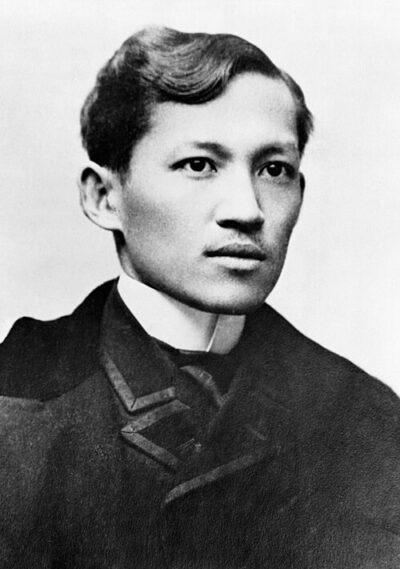
José Rizal
José Rizal was a Filipino nationalist, writer and polymath. Born June 19, 1861, in Calamba. Died December 30, 1896, in Manila. Known for Noli Me Tángere, El filibusterismo and Mi último adiós. Educated at Ateneo de Manila University and University of Santo Tomas.
Facts
39 facts · 2 confirmed by two sources · 16 cited · 21 from one source
Where this comes from
Papalocal keeps its own record. It started from these sources; what each one said is kept here as it was copied, so a change on their side never changes this page by itself. Tap one to read its version.
What Wikidata says · copied November 16, 2026 · revision 2568607817
- Described as
- Filipino nationalist, writer and polymath (1861–1896)
- Other names
- Dimasalang, Laong Laan, José P. Rizal, José Protasio Rizal, José Protasio Rizal-Mercado y Alonso-Realonda, José Protacio Rizal Mercado y Alonso Realonda
- Born
- June 19, 1861 · 6 references
- Died
- December 30, 1896 · 5 references
- Born in
- Calamba · 2 references
- Died in
- Manila · 1 reference
- Buried in
- Rizal Monument · 1 reference
- Cause of death
- gunshot wound · 1 reference
- Name at birth
- José Protasio Rizal-Mercado y Alonso-Realonda · 1 reference
- Citizen of
- Captaincy General of the Philippines; Philippines
- Occupation
- writer · 2 references; linguist; ophthalmologist; painter; political activist; poet; surgeon · 1 reference; physician · 2 references
- Education
- Ateneo de Manila University; University of Santo Tomas; Complutense University of Madrid; Heidelberg University · 1 reference; University of Santo Tomas Faculty of Medicine and Surgery
- Member of
- Freemasonry
- Known for
- Noli Me Tángere; El filibusterismo; Mi último adiós
- Field
- literature · 1 reference; poetry · 1 reference; eye surgery · 1 reference; ophthalmology · 1 reference; medicine · 1 reference; politics · 1 reference
- Spouse
- Josephine Bracken · 1 reference
- Father
- Francisco Mercado
- Mother
- Teodora Alonso
- Siblings
- Paciano Rizal; Trinidad Rizal; Saturnina Hidalgo
- Religion
- deism · 1 reference
- Wikipedias with a page
- 91
Wikidata item Q1500 (wikidata.org/wiki/Q1500), public domain (CC0). Copied November 16, 2026.
What Wikipedia says · copied November 16, 2026 · revision 1378992770
José Protasio Rizal Mercado y Alonso Realonda (Spanish: [xoˈse riˈsal, -ˈθal], Tagalog: [hoˈse ɾiˈsal]; June 19, 1861 – December 30, 1896) was a Filipino nationalist, writer, and polymath active at the end of the Spanish colonial period of the Philippines. He is popularly considered to be a national hero of the Philippines. An ophthalmologist by profession, Rizal became a writer and a key member of the Filipino Propaganda Movement in the 1880s, which advocated political reforms for the colony under Spain.
By the early 1890s, amidst the Calamba land dispute, Rizal grew more separatist in his stance, conflicting with several colleagues in the Propaganda Movement. On July 6, 1892, a few days after establishing the secret society La Liga Filipina within Manila, Rizal was arrested by Spanish authorities for alleged possession of a seditious document, being banished to Dapitan in the island of Mindanao. During his exile, Rizal met Josephine Bracken, an Irish woman who later became his common-law wife.
After four years in exile, Rizal left Dapitan for Cuba in August 1896 with the permission of Governor General Ramón Blanco, intending to serve as a doctor in the Spanish territory. At a stopover in Barcelona, he was arrested on October 6, 1896 after the Philippine Revolution broke out; the revolution was inspired by his writings. In December 1896, he was executed by the Spanish colonial government for the crime of rebellion. Though he was not actively involved in its planning or conduct, he ultimately approved of its goals, which eventually resulted in Philippine independence.
Rizal is widely considered one of the greatest and most influential figures in the Philippines, and has been recommended to be so honored by an officially empaneled National Heroes Committee. However, no law, executive order or proclamation has been enacted or issued officially proclaiming any Filipino historical figure as a national hero. He wrote the novels Noli Me Tángere (1887) and El filibusterismo (1891), which together are taken as a national epic, in addition to numerous poems and essays.
- Born, in its opening lines
- June 19, 1861
- Died, in its opening lines
- December 30, 1896
From the Wikipedia article “José Rizal” (en.wikipedia.org/wiki/José_Rizal), by its contributors, under CC BY-SA 4.0 (creativecommons.org/licenses/by-sa/4.0/). Copied November 16, 2026; not changed.
Confirmed Two sources agree. Cited One source, and it names where it got it. One source One source, without a reference of its own. Sources disagree The sources disagree. We show the best-supported value and keep theirs below.
