
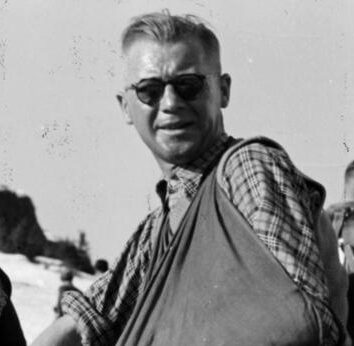
Josef Terboven
Josef Terboven was a German politician. Born May 23, 1898, in Essen. Died May 8, 1945, in Skaugum. Positions held include member of the Reichstag of the Weimar Republic, member of the Reichstag of Nazi Germany and Reichkommisar for the occupied Norwegian territories (1940–1945). Educated at LMU Munich. Awards include Golden Party Badge and Iron Cross.
Facts
17 facts · 2 confirmed by two sources · 1 cited · 14 from one source
Where this comes from
Papalocal keeps its own record. It started from these sources; what each one said is kept here as it was copied, so a change on their side never changes this page by itself. Tap one to read its version.
What Wikidata says · copied November 16, 2026 · revision 2568986601
- Described as
- German politician (1898–1945)
- Other names
- Josef Antonius Heinrich Terboven
- Born
- May 23, 1898 · 4 references
- Died
- May 8, 1945 · 3 references
- Born in
- Essen · 1 reference
- Died in
- Skaugum
- Cause of death
- explosion
- Name at birth
- Josef Antonius Heinrich Terboven
- Citizen of
- Germany
- Occupation
- politician
- Positions held
- member of the Reichstag of the Weimar Republic; member of the Reichstag of Nazi Germany; Reichkommisar for the occupied Norwegian territories (1940–1945)
- Political party
- Nazi Party (1925–)
- Education
- LMU Munich
- Member of
- Sturmabteilung
- Awards
- Golden Party Badge · 1 reference; Iron Cross · 1 reference
- Military rank
- Obergruppenführer
- Wikipedias with a page
- 34
Wikidata item Q57874 (wikidata.org/wiki/Q57874), public domain (CC0). Copied November 16, 2026.
What Wikipedia says · copied November 16, 2026 · revision 1379190663
Josef Antonius Heinrich Terboven (23 May 1898 – 8 May 1945) was a German Nazi Party official and politician who was the long-serving Gauleiter of Gau Essen and the Reichskommissar for Norway during the German occupation.
Terboven was born in Essen, Germany, and attended Volksschule and Realschule before he volunteered for military service during the First World War. After the war, he studied law and political science at the Ludwig-Maximilians-Universität München and the University of Freiburg, where he first got involved in politics. Terboven joined the Nazi Party in 1923, participated in the Beer Hall Putsch and eventually rose through the ranks to become the Gauleiter of Essen and the editor of various Nazi newspapers. After the Nazi seizure of power in 1933, Terboven was promoted to SA-Gruppenführer and was made a member of the Prussian State Council.
In 1940, he was appointed Reichskommissar for Norway, a position that granted him significant power and control. Terboven established multiple concentration camps in Norway, ruthlessly persecuted the Jewish population and focused on crushing the Norwegian resistance movement. His actions led to numerous atrocities, such as the Beisfjord massacre in which hundreds of Yugoslavian political prisoners and prisoners-of-war were murdered.
As the tide of the war turned against Germany, Terboven implemented a scorched earth policy in northern Norway that resulted in the forced evacuation of 50,000 Norwegians and widespread destruction. He hoped to turn Norway into a fortress for the Nazi regime's last stand. However, after Adolf Hitler's suicide, his successor, Großadmiral Karl Dönitz, dismissed Terboven from his post as Reichskommissar on 7 May 1945.
On 8 May 1945, the day of Germany's surrender, Terboven committed suicide by detonating 50 kg (110 lbs) of dynamite in a bunker on the Skaugum compound in Norway. His family survived in West Germany, and his wife, Ilse (Stahl) Terboven died in 1972.
- Born, in its opening lines
- May 23, 1898
- Died, in its opening lines
- May 8, 1945
From the Wikipedia article “Josef Terboven” (en.wikipedia.org/wiki/Josef_Terboven), by its contributors, under CC BY-SA 4.0 (creativecommons.org/licenses/by-sa/4.0/). Copied November 16, 2026; not changed.
Confirmed Two sources agree. Cited One source, and it names where it got it. One source One source, without a reference of its own. Sources disagree The sources disagree. We show the best-supported value and keep theirs below.
