
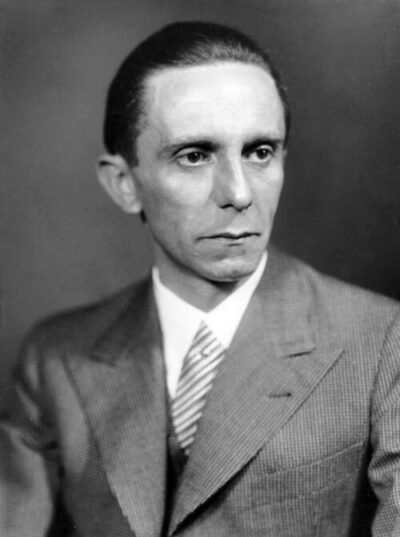
Joseph Goebbels
Joseph Goebbels was a Nazi politician and Propaganda Minister. Born October 29, 1897, in Rheydt. Died May 1, 1945, in Führerbunker. Positions held include member of the Reichstag of the Weimar Republic, member of the Reichstag of Nazi Germany and Reich Chancellor (1945). Known for Goebbels Diaries. Educated at University of Bonn and Heidelberg University.
Facts
42 facts · 2 confirmed by two sources · 7 cited · 32 from one source · 1 where the sources disagree
What’s different
- Cause of death: we show gunshot wound (Sources disagree). Wikidata also lists cyanide poisoning
Where this comes from
Papalocal keeps its own record. It started from these sources; what each one said is kept here as it was copied, so a change on their side never changes this page by itself. Tap one to read its version.
What Wikidata says · copied November 16, 2026 · revision 2568734191
- Described as
- Nazi politician and Propaganda Minister (1897–1945)
- Other names
- PJG, Josef Goebbels, Paul Joseph Goebbels, Goebbels, Joseph Göbbels, Göbbels, Gobbels
- Born
- October 29, 1897 · 13 references
- Died
- May 1, 1945 · 13 references
- Born in
- Rheydt · 2 references
- Died in
- Führerbunker · 1 reference
- Buried in
- Ehle · 1 reference
- Cause of death
- gunshot wound; cyanide poisoning
- Name at birth
- Paul Joseph Goebbels
- Citizen of
- Nazi Germany; Germany · 1 reference
- Occupation
- politician · 4 references; diarist; autobiographer; journalist · 2 references; novelist; propagandist; screenwriter; demagogue
- Positions held
- member of the Reichstag of the Weimar Republic; member of the Reichstag of Nazi Germany; Reich Chancellor (1945); Gauleiter (1926–1945); Reich Minister for Public Enlightenment and Propaganda (1933–1945) · 1 reference
- Political party
- Nazi Party
- Education
- University of Bonn; Heidelberg University; University of Freiburg · 1 reference; University of Würzburg · 1 reference
- Member of
- Wissenschaftlicher Katholischer Studentenverein Unitas Stolzenfels zu Bonn
- Known for
- Goebbels Diaries
- Field
- German studies · 1 reference; history · 1 reference
- Spouse
- Magda Goebbels (1931–1945)
- Children
- Helga Susanne Goebbels; Hildegard Traudel Goebbels; Helmut Christian Goebbels; Holdine Kathrin Goebbels; Hedwig Johanna Goebbels · 1 reference; Heidrun Elisabeth Goebbels · 1 reference
- Religion
- lapsed Catholic
- Lived in
- Rheydt (1897–) · 1 reference
- Nickname
- The Poison Dwarf · 1 reference
- Height
- 1.65 m (5 ft 5 in)
- Wikipedias with a page
- 140
Wikidata item Q41749 (wikidata.org/wiki/Q41749), public domain (CC0). Copied November 16, 2026.
What Wikipedia says · copied November 16, 2026 · revision 1376282212
Paul Joseph Goebbels (29 October 1897 – 1 May 1945) was a German politician and philologist who was the Gauleiter (district leader) of Berlin, chief propagandist for the Nazi Party, and then Reich Minister of Propaganda from 1933 until his suicide in 1945. He was one of Adolf Hitler's closest and most devoted followers and was known for his skills in public speaking and his extreme antisemitism which was evident in his publicly voiced views. He advocated progressively harsher discrimination, including the extermination of Jews and other groups in the Holocaust.
Born in Rheydt, Goebbels aspired to be an author and obtained a doctorate in philology from the University of Heidelberg in 1922. He joined the Nazi Party in 1924 and worked with Gregor Strasser in its northern branch. He was appointed Gauleiter of Berlin in 1926, where he began to take an interest in the use of propaganda to promote the party and its programme. After the Nazis came to power in 1933, Goebbels' Propaganda Ministry quickly gained control over the news, media, arts, and flow of information in Nazi Germany. He was particularly adept at using the relatively new media of radio and film for propaganda purposes. Topics for party propaganda included antisemitism, attacks on Christian churches, and (after the start of the Second World War) attempts to shape troop and civilian morale.
In 1943, Goebbels began to pressure Hitler to introduce measures that would produce "total war", including closing businesses not essential to the war effort, conscripting women into the labour force, and enlisting men in previously exempt occupations into the Wehrmacht. Hitler finally appointed him as Reich Plenipotentiary for Total War on 23 July 1944, whereby Goebbels undertook largely unsuccessful measures to increase the number of people available for armaments manufacture and the Wehrmacht.
As the war drew to a close and Germany faced defeat, Goebbels' wife Magda, along with the couple's children, joined Hitler in Berlin. On 22 April 1945, they moved into the Vorbunker, part of Hitler's underground bunker complex. Hitler committed suicide on 30 April. In accordance with Hitler's will, Goebbels succeeded him as Chancellor of Germany; he served one day in this post. On the following day, Goebbels and Magda committed suicide, having poisoned their six children with a cyanide compound.
- Born, in its opening lines
- October 29, 1897
- Died, in its opening lines
- May 1, 1945
From the Wikipedia article “Joseph Goebbels” (en.wikipedia.org/wiki/Joseph_Goebbels), by its contributors, under CC BY-SA 4.0 (creativecommons.org/licenses/by-sa/4.0/). Copied November 16, 2026; not changed.
Confirmed Two sources agree. Cited One source, and it names where it got it. One source One source, without a reference of its own. Sources disagree The sources disagree. We show the best-supported value and keep theirs below.
