
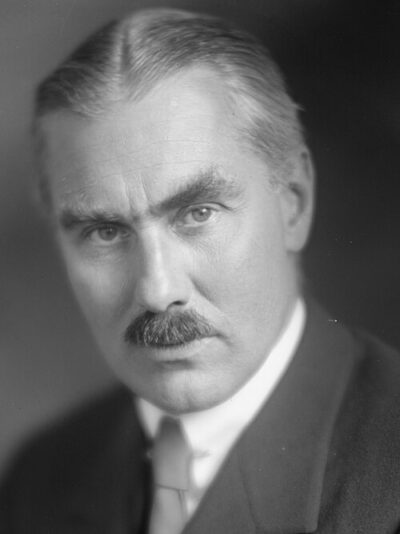
Joseph Grew
Joseph Grew was an American diplomat, U.S. ambassador to Japan. Born May 27, 1880, in Boston. Died May 25, 1965, in Manchester-by-the-Sea. Positions held include Under Secretary of State (2 times) (1924–1945), United States Ambassador to Denmark and United States Ambassador to Switzerland and Liechtenstein. Educated at Harvard University. Awards include Order of the Rising Sun, 1st class.
Facts
20 facts · 2 confirmed by two sources · 6 cited · 12 from one source
Where this comes from
Papalocal keeps its own record. It started from these sources; what each one said is kept here as it was copied, so a change on their side never changes this page by itself. Tap one to read its version.
What Wikidata says · copied November 16, 2026 · revision 2562945002
- Described as
- American diplomat, U.S. ambassador to Japan (1880-1965)
- Other names
- Joseph C. Grew, Joseph Clark Grew
- Born
- May 27, 1880 · 3 references
- Died
- May 25, 1965 · 3 references
- Born in
- Boston · 1 reference
- Died in
- Manchester-by-the-Sea
- Buried in
- Forest Hills Cemetery · 1 reference
- Citizen of
- United States
- Occupation
- diplomat · 1 reference; writer · 1 reference; ambassador · 1 reference
- Positions held
- Under Secretary of State (2 times) (1924–1945); United States Ambassador to Denmark; United States Ambassador to Switzerland and Liechtenstein; United States Ambassador to Turkey; United States Ambassador to Japan; United States Secretary of State (1945)
- Education
- Harvard University
- Member of
- American Academy of Arts and Sciences
- Awards
- Order of the Rising Sun, 1st class
- Children
- Lilla Cabot Grew · 1 reference
- Father
- Edward Sturgis Grew · 1 reference
- Wikipedias with a page
- 22
Wikidata item Q3267622 (wikidata.org/wiki/Q3267622), public domain (CC0). Copied November 16, 2026.
What Wikipedia says · copied November 16, 2026 · revision 1382150572
Joseph Clark Grew (May 27, 1880 – May 25, 1965) was an American career diplomat and Foreign Service officer. He is best known for his long tenure as United States Ambassador to Japan (1932–1941) in the lead-up to Pearl Harbor and for his two stints as the second-in-command at the State Department (1924–1927 & 1944–45). He opposed American hardliners and sought to avoid war. When the war ended, he helped draft the U.S. Initial Post-Surrender Policy for Japan, which offered relatively generous terms to the defeated Japanese (including the retention of the Japanese monarchy), which facilitated America's peaceful post-war occupation of Japan.
After graduating from Harvard College, Grew worked his way up the diplomatic hierarchy. After World War I, he served on the American negotiating team at the Paris Peace Conference and received his first top-level posts, serving as Envoy to Denmark (1920–1921) and Switzerland (1921–1924). During his time in Switzerland, he was America's senior representative at the Lausanne peace talks. He was generally unable to implement his realist agenda in the face of broad idealist opposition. He focused on securing American interests in postwar Turkey, and failed to protect Armenian independence, although there were practical barriers to the idea. In 1924, he was promoted to Under Secretary of State, where he served as second-in-command to Charles Evans Hughes and Frank B. Kellogg and oversaw the establishment of the Foreign Service, with merit-based hiring, promotion, and salaries for white bureaucrats. After falling out with Kellogg, he was reassigned to Turkey, where he became America's first ambassador to the post-Ottoman state (1927–1932).
Grew became Ambassador to Japan at a time when tensions between the two Pacific powers were rising dramatically. He recommended negotiating with Tokyo to avoid war. However, he was unable to prevent the Japanese attack on Pearl Harbor. He returned to Washington to advise on Asian affairs. In the final months of World War II, he was reappointed Under Secretary of State under Edward Stettinius Jr., making him a high-level veteran of both Republican and Democratic administrations. Grew conciliated the defeated Japan and distrusted the victorious Soviet Union, presaging the diplomatic shift of the Cold War. However, he retired from the State Department on V-J Day in 1945, leaving the Cold War to a new generation of diplomats, including Dean Acheson, who frequently disagreed with him but eventually implemented his Japan policy.
In his retirement, Grew remained active in the foreign policy field. He chaired the National Committee for a Free Europe, the driving force behind Radio Free Europe, and the Committee of One Million, a pressure group to support Chiang Kai-shek's government in exile. Due to Grew's hawkish China policy and rivalry with Acheson, Joseph McCarthy cited Grew as an example of an anti-communist martyr. However, Grew resisted the label and publicly defended several McCarthy targets, including the diplomatic corps. When he died, The New York Times remembered him as "the father of the career [foreign] service."
- Born, in its opening lines
- May 27, 1880
- Died, in its opening lines
- May 25, 1965
From the Wikipedia article “Joseph Grew” (en.wikipedia.org/wiki/Joseph_Grew), by its contributors, under CC BY-SA 4.0 (creativecommons.org/licenses/by-sa/4.0/). Copied November 16, 2026; not changed.
Confirmed Two sources agree. Cited One source, and it names where it got it. One source One source, without a reference of its own. Sources disagree The sources disagree. We show the best-supported value and keep theirs below.
