
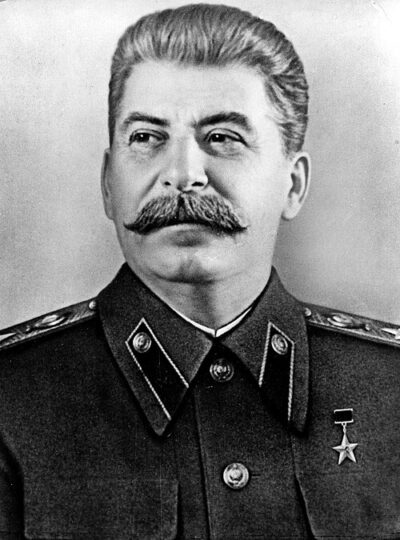
Joseph Stalin
Joseph Stalin was a politician and leader of the Union of Soviet Socialist Republics from 1924 to 1953. Born December 18, 1878, in Gori. Died March 5, 1953, in Kuntsevo Dacha. Positions held include General Secretary of the Communist Party of the Soviet Union (1922–1934), Secretary of the Communist Party of the Soviet Union (1934–1953) and Chairman of the Council of Ministers of the USSR (1946–1953). Educated at Tbilisi Theological Seminary and Gori school. Awards include Hero of the Soviet Union, Hero of Socialist Labour and Order of Victory (2 times).
Facts
83 facts · 2 confirmed by two sources · 13 cited · 67 from one source · 1 where the sources disagree
What’s different
- Height: we show 1.68 m (5 ft 6 in) (Sources disagree). Wikidata also lists 1.63 m (5 ft 4 in)
Where this comes from
Papalocal keeps its own record. It started from these sources; what each one said is kept here as it was copied, so a change on their side never changes this page by itself. Tap one to read its version.
What Wikidata says · copied November 16, 2026 · revision 2569107799
- Described as
- politician and leader of the Union of Soviet Socialist Republics from 1924 to 1953
- Other names
- Joseph Vissarionovich Stalin, Josef Stalin, Joseph Vissarionovitch Stalin, Ioseb Besarionis dze Dzhugashvili, Ioseb Jugashvili, Uncle Joe, Ioseb Dzhugashvili, Joey Stalin, General Secretary Joseph Stalin, Stavros Papadopoulos, Koba, General Secretary Stalin
- Born
- December 18, 1878 · 8 references
- Died
- March 5, 1953 · 14 references
- Born in
- Gori · 7 references
- Died in
- Kuntsevo Dacha · 2 references
- Buried in
- Kremlin Wall Necropolis
- Cause of death
- cerebral hemorrhage
- Name at birth
- იოსებ ბესარიონის ძე ჯუღაშვილი
- Citizen of
- Russian Empire (–1917) · 3 references; Russian Socialist Federative Soviet Republic (1917–1922); Soviet Union (1922–) · 2 references
- Occupation
- politician · 7 references; revolutionary; opinion journalist; statesperson · 1 reference; linguist · 1 reference
- Positions held
- General Secretary of the Communist Party of the Soviet Union (1922–1934); Secretary of the Communist Party of the Soviet Union (1934–1953); Chairman of the Council of Ministers of the USSR (1946–1953); Chairman of the Council of People's Commissars (1941–1946); member of the Presidium of the Supreme Soviet of the USSR (1938–); People's Commissar for Defense (1941–1946); deputy of the Soviet of the Union of the Supreme Soviet of the USSR (1938–1953); Member of the Russian Constituent Assembly; Member of the Politburo of the CPSU Central Committee (1917–1953); member of the Supreme Soviet of the Russian Soviet Federative Socialist Republic (1938–1953); member of the Supreme Soviet of the Byelorussian SSR of the 1st convocation; Minister of the Armed Forces of the Soviet Union (1946–1947)
- Political party
- Communist Party of the Soviet Union (1912–1953); Mesame Dasi (1898–1903); Russian Social Democratic Labour Party (1901–1903); Russian Social Democratic Labour Party (bolshevik) (1903–1912)
- Worked for
- Pravda (1912–1913); Brdzola; Tbilisi Observatory (1899–1901); organ of state · 1 reference
- Education
- Tbilisi Theological Seminary (1894–1899); Gori school (1888–1894)
- Member of
- Russian Academy of Sciences (1939–) · 1 reference; Council of Ministers of the USSR; All-Russian Central Executive Committee; Council of People's Commissars (1917–1953); Revolutionary Military Council (1918–1922); Orgburo (1922–1953); All-Union Society of Old Bolsheviks
- Awards
- Hero of the Soviet Union (1945) · 1 reference; Hero of Socialist Labour (1939); Order of Victory (2 times) (1944, 1945); Order of Lenin (3 times) (1939, 1945, 1949); Order of the Red Banner (3 times) (1919, 1930, 1944) · 1 reference; Order of Suvorov, 1st class (1943); Order of the Red Star (1922); Medal "For the Defence of Moscow" (1944); Medal "For the Victory over Germany in the Great Patriotic War 1941–1945" (1945); Medal "For the Victory over Japan" (1945); Jubilee Medal "XX Years of the Workers' and Peasants' Red Army" (1943); Medal "In Commemoration of the 800th Anniversary of Moscow" (1947); Order of the Republic (1943); Czechoslovak War Cross 1939–1945 (2 times) (1943, 1945); Order of Sukhbaatar (2 times) (1945, 1949)
- Spouse
- Ekaterina Svanidze (1906–1907) · 1 reference; Nadezhda Alliluyeva (1919–1932) · 1 reference
- Children
- Yakov Dzhugashvili · 1 reference; Konstantin Kuzakov; unnamed boy Jughashvili (1916); Alexander Davydov; Vasily Dzhugashvili; Artem Sergeev; Svetlana Alliluyeva · 1 reference
- Father
- Besarion Jughashvili
- Mother
- Keke Geladze · 1 reference
- Siblings
- Joseph Davrichachvili; Mikhail Jughashvili; Giorgi Jughashvili
- Military branch
- Red Army
- Military rank
- Generalissimus of the Soviet Union (1945) · 1 reference; Marshal of the Soviet Union (1943) · 1 reference
- Lived in
- Narym; Turukhansk; Solvychegodsk; Novaya Uda; Saint Petersburg
- Nickname
- Uncle Joe
- Height
- 1.68 m (5 ft 6 in); 1.63 m (5 ft 4 in)
- Wikipedias with a page
- 281
Wikidata item Q855 (wikidata.org/wiki/Q855), public domain (CC0). Copied November 16, 2026.
What Wikipedia says · copied November 16, 2026 · revision 1385770350
Joseph Vissarionovich Stalin (born Ioseb Besarionis dze Jughashvili; 18 December 1878 – 5 March 1953) was a Soviet politician and revolutionary who led the Soviet Union from the late 1920s until his death in 1953, holding the title of General Secretary of the Communist Party of the Soviet Union from 1922 to 1952 and serving as the nation's premier from 1941 to 1953. Initially part of a collective leadership within a one-party system, he ultimately consolidated personal power to become the country's de facto dictator by the 1930s. Ideologically committed to the Leninist interpretation of Marxism, Stalin helped to formalise these ideas as Marxism–Leninism, while his own policies became known as Stalinism.
Born into a poor Georgian family in Gori, Russian Empire, Stalin began his revolutionary career as a youth by joining the Marxist Russian Social Democratic Labour Party. Active in the Caucasus, he raised funds for Vladimir Lenin's Bolshevik faction through robberies and other crimes, and was repeatedly arrested and exiled to Siberia. After the Bolsheviks seized power in the October Revolution of 1917, Stalin joined the party's Politburo and served as the People's Commissar for Nationalities. He began his rise to power after Lenin's death in 1924, using his role as general secretary to outmaneuver his rivals. Under Stalin's policy of "Socialism in One Country" and his five-year plans from 1928, the country underwent rapid agricultural collectivisation and industrialization, replacing the New Economic Policy with a centralised command economy. State policy contributed to a major famine in 1930–1933, with Ukraine and Kazakhstan most affected. To eliminate his political rivals and those deemed "enemies of the working class", Stalin oversaw the Great Purge between 1936 and 1939, during which at least 700,000 people were executed and over a million were imprisoned in the Gulag system.
Stalin's government promoted Marxism–Leninism abroad through the Communist International and supported anti-fascist movements in Europe during the 1930s, particularly in the Spanish Civil War. In 1939, it signed a non-aggression pact with Nazi Germany, resulting in their joint invasion of Poland and the Soviet annexation of the Baltic states. Germany ended the pact by invading the Soviet Union in 1941; despite initial setbacks, the Red Army repelled Axis forces and captured Berlin in 1945, ending World War II in Europe. The Soviets helped establish aligned governments in Central and Eastern Europe, China and North Korea, forming the Eastern Bloc and emerging as a world superpower. Stalin led his country through its reconstruction and the start of the Cold War with the United States, overseeing its development of nuclear weapons in 1949. In these years, the country experienced another major famine and a new wave of political purges. Stalin died in 1953 and was ultimately succeeded by Nikita Khrushchev, who denounced his predecessor and initiated a campaign of de-Stalinisation throughout Soviet society.
Widely considered one of the most significant figures of the 20th century, Stalin was the subject of a pervasive personality cult within the international Marxist–Leninist movement, for whom he was a champion of socialism and the working class. Since the dissolution of the Soviet Union in 1991, he has retained popularity in Russia as a victorious wartime leader who established the Soviet Union as one of the world's foremost great powers. Conversely, Stalin's totalitarian regime has been widely condemned for overseeing a system marked by mass repression, ethnic cleansing, and the deaths of millions.
- Born, in its opening lines
- December 18, 1878
- Died, in its opening lines
- March 5, 1953
From the Wikipedia article “Joseph Stalin” (en.wikipedia.org/wiki/Joseph_Stalin), by its contributors, under CC BY-SA 4.0 (creativecommons.org/licenses/by-sa/4.0/). Copied November 16, 2026; not changed.
Confirmed Two sources agree. Cited One source, and it names where it got it. One source One source, without a reference of its own. Sources disagree The sources disagree. We show the best-supported value and keep theirs below.
