
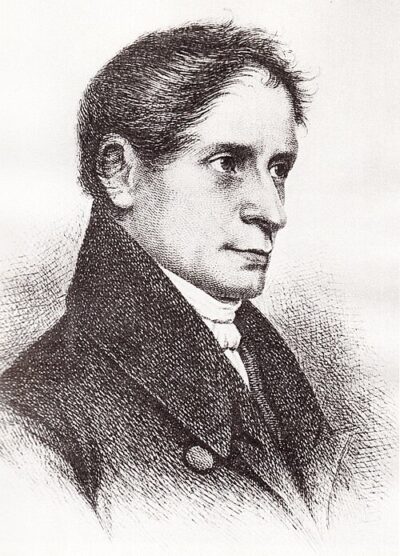
Joseph von Eichendorff
Joseph von Eichendorff was a German poet and novelist. Born March 10, 1788, in Castle Lubowitz. Died November 26, 1857, in Nysa. Known for Aus dem Leben eines Taugenichts and The Marble Statue. Educated at Martin Luther University Halle-Wittenberg and University of Vienna. Awards include Bavarian Maximilian Order for Science and Art.
Facts
33 facts · 2 confirmed by two sources · 7 cited · 24 from one source
Where this comes from
Papalocal keeps its own record. It started from these sources; what each one said is kept here as it was copied, so a change on their side never changes this page by itself. Tap one to read its version.
What Wikidata says · copied November 16, 2026 · revision 2568909694
- Described as
- German poet and novelist (1788-1857)
- Born
- March 10, 1788 · 16 references
- Died
- November 26, 1857 · 16 references
- Born in
- Castle Lubowitz · 3 references
- Died in
- Nysa · 3 references
- Buried in
- Nysa
- Cause of death
- pneumonia · 1 reference
- Name at birth
- Joseph Karl Benedikt von Eichendorff
- Citizen of
- Kingdom of Prussia
- Occupation
- writer · 2 references; poet lawyer; translator · 1 reference; playwright; diarist; novelist; jurist · 1 reference; poet · 2 references
- Education
- Martin Luther University Halle-Wittenberg (1805–1806); University of Vienna; Heidelberg University (1807–); Catholic Secondary School of St. Matthias in Wrocław (1801–)
- Known for
- Aus dem Leben eines Taugenichts · 1 reference; The Marble Statue
- Awards
- Bavarian Maximilian Order for Science and Art (1853)
- Spouse
- Aloysia von Eichendorff (1815–1855)
- Children
- Hermann Eichendorff; Therese von Eichendorff Besserer-Dahlfinger; Rudolf von Eichendorff
- Father
- Adolph von Eichendorff
- Mother
- Karoline von Eichendorff
- Siblings
- Wilhelm Eichendorff; Luise Eichendorff
- Religion
- Catholic Church
- Lived in
- Jánský Vrch (1856–1857)
- Wikipedias with a page
- 59
Wikidata item Q77204 (wikidata.org/wiki/Q77204), public domain (CC0). Copied November 16, 2026.
What Wikipedia says · copied November 16, 2026 · revision 1378315765
Joseph Karl Benedikt Freiherr von Eichendorff (German: [fɔn ˈaɪçn̩dɔʁf]; 10 March 1788 – 26 November 1857) was a German poet, novelist, playwright, literary critic, translator, and anthologist. Eichendorff was one of the major writers and critics of Romanticism. Ever since their publication and up to the present day, some of his works have been very popular in German-speaking Europe.
Eichendorff first became famous for his 1826 novella Aus dem Leben eines Taugenichts (freely translated: Memoirs of a Good-for-Nothing) and his poems. The Memoirs of a Good-for-Nothing is a typical Romantic novella whose main themes are wanderlust and love. The protagonist, the son of a miller, rejects his father's trade and becomes a gardener at a Viennese palace where he subsequently falls in love with the local duke's daughter. As, with his lowly status, she is unattainable for him, he escapes to Italy – only to return and learn that she is the duke's adopted daughter, and thus within his social reach. With its combination of dream world and realism, Memoirs of a Good-for-Nothing is considered to be a high point of Romantic fiction. One critic stated that Eichendorff's Good-for-Nothing is the "personification of love of nature and an obsession with hiking." Thomas Mann called Eichendorff's Good-for-Nothing a combination of "the purity of the folk song and the fairy tale."
Many of Eichendorff's poems were first published as integral parts of his novellas and stories, where they are often performed in song by one of the protagonists. The novella Good-for-Nothing alone contains 54 poems.
- Born, in its opening lines
- March 10, 1788
- Died, in its opening lines
- November 26, 1857
From the Wikipedia article “Joseph Freiherr von Eichendorff” (en.wikipedia.org/wiki/Joseph_Freiherr_von_Eichendorff), by its contributors, under CC BY-SA 4.0 (creativecommons.org/licenses/by-sa/4.0/). Copied November 16, 2026; not changed.
Confirmed Two sources agree. Cited One source, and it names where it got it. One source One source, without a reference of its own. Sources disagree The sources disagree. We show the best-supported value and keep theirs below.
