
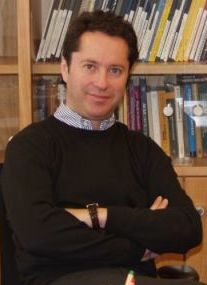
Juan Ignacio Cirac Sasturáin
Juan Ignacio Cirac Sasturáin is a Spanish theoretical physicist. Born October 11, 1965, in Manresa. Positions held include Member of the Royal Academy of Exact, Physical and Natural Sciences (2016–). Educated at Complutense University of Madrid. Awards include Princess of Asturias Award for Technical and Scientific Research, Benjamin Franklin Medal and Wolf Prize in Physics.
Facts
38 facts · 1 confirmed by two sources · 14 cited · 23 from one source
Where this comes from
Papalocal keeps its own record. It started from these sources; what each one said is kept here as it was copied, so a change on their side never changes this page by itself. Tap one to read its version.
What Wikidata says · copied November 18, 2026 · revision 2568461720
- Described as
- Spanish theoretical physicist
- Other names
- Ignacio Cirac, J. Ignacio Cirac, Juan Ignacio Cirac, Cirac JI
- Born
- October 11, 1965
- Born in
- Manresa
- Citizen of
- Spain
- Occupation
- physicist · 1 reference; university teacher
- Positions held
- Member of the Royal Academy of Exact, Physical and Natural Sciences (2016–) · 1 reference
- Worked for
- Max Planck Institute of Quantum Optics; Universidad de Castilla-La Mancha; University of Colorado; University of Innsbruck; Technical University of Munich · 1 reference; University of Colorado Boulder (1993–1994) · 1 reference
- Education
- Complutense University of Madrid (–1991) · 1 reference
- Member of
- Royal Academy of Exact, Physical and Natural Sciences (2002–) · 1 reference; American Physical Society (2002–); Royal Spanish Society of Physics (2002–); German Academy of Sciences Leopoldina (2017–) · 1 reference
- Awards
- Princess of Asturias Award for Technical and Scientific Research (2006) · 1 reference; Benjamin Franklin Medal (2010); Wolf Prize in Physics (2013) · 1 reference; honorary doctor of the University of Zaragoza (2014) · 1 reference; Grand Cross of the Order of the Second of May (2011); Blas Cabrera National Research Award (2007); Zeiss Research Award (2009); BBVA Foundation Frontiers of Knowledge Award (2008) · 2 references; Medalla de Honor al Fomento de la Invención (2015) · 1 reference; honorary doctorate of the University of Castille-La Mancha (2005) · 1 reference; honorary doctor of the University of Valencia (2015) · 2 references; Fellow of the American Physical Society; honorary doctor of the University Polytechnic of Catalonia (2007) · 1 reference; Max Planck Medal (2018); Spanish National Team of Science (2014)
- Field
- theoretical physics; quantum computer; quantum optics; quantum information; many-body theory
- Lived in
- Germany · 1 reference
- Wikipedias with a page
- 21
Wikidata item Q650171 (wikidata.org/wiki/Q650171), public domain (CC0). Copied November 18, 2026.
What Wikipedia says · copied November 18, 2026 · revision 1379967280
Juan Ignacio Cirac Sasturain (born 11 October 1965), known professionally as Ignacio Cirac, is a Spanish physicist. He is one of the pioneers of the field of quantum computing and quantum information theory. He was awarded the 2013 Wolf Prize in Physics.
- Born, in its opening lines
- October 11, 1965
From the Wikipedia article “Ignacio Cirac” (en.wikipedia.org/wiki/Ignacio_Cirac), by its contributors, under CC BY-SA 4.0 (creativecommons.org/licenses/by-sa/4.0/). Copied November 18, 2026; not changed.
Confirmed Two sources agree. Cited One source, and it names where it got it. One source One source, without a reference of its own. Sources disagree The sources disagree. We show the best-supported value and keep theirs below.
