
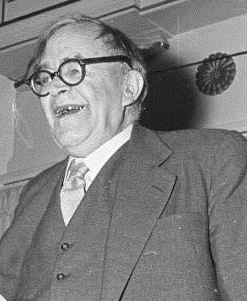
Karl Barth
Karl Barth was a Swiss Protestant theologian. Born May 10, 1886, in Basel. Died December 10, 1968, in Basel. Known for The Epistle to the Romans. Educated at University of Göttingen. Awards include Sigmund Freud Prize, Sonning Prize and honorary doctorate of the University of Glasgow.
Facts
46 facts · 2 confirmed by two sources · 22 cited · 22 from one source
Where this comes from
Papalocal keeps its own record. It started from these sources; what each one said is kept here as it was copied, so a change on their side never changes this page by itself. Tap one to read its version.
What Wikidata says · copied November 16, 2026 · revision 2569171337
- Described as
- Swiss Protestant theologian (1886-1968)
- Other names
- Barth, Karl, 1886-1968
- Born
- May 10, 1886 · 16 references
- Died
- December 10, 1968 · 17 references
- Born in
- Basel · 3 references
- Died in
- Basel · 2 references
- Buried in
- Friedhof am Hörnli · 1 reference
- Citizen of
- Switzerland
- Occupation
- theologian · 2 references; university teacher · 1 reference; pastor · 1 reference; writer · 1 reference; cleric · 1 reference
- Political party
- Social Democratic Party of Germany (1932–) · 1 reference; Social Democratic Party of Switzerland (1915–) · 1 reference
- Worked for
- University of Bonn; University of Münster; University of Göttingen; University of Basel; Duke University
- Education
- University of Göttingen
- Member of
- American Academy of Arts and Sciences; Zofingia; Académie des Sciences Morales et Politiques
- Known for
- The Epistle to the Romans
- Awards
- Sigmund Freud Prize (1968) · 1 reference; Sonning Prize (1963); honorary doctorate of the University of Glasgow; honorary doctorate from the University of Strasbourg (1959) · 1 reference; honorary doctor of the University of St Andrews; Honorary doctorate from the University of Geneva; Honorary doctor of the University of Oxford; honorary doctor of the University of Edinburgh; Fellow of the American Academy of Arts and Sciences; honorary doctor of the University of Utrecht; honorary doctor of the University of Münster; honorary doctor of the University of Chicago; doctor honoris causa from the University of Paris (1963) · 2 references
- Spouse
- Nelly Barth · 1 reference
- Children
- Hans Jakob Barth · 1 reference; Markus Barth · 1 reference; Christoph Barth · 1 reference
- Father
- Fritz Barth · 1 reference
- Mother
- Anna Barth · 1 reference
- Siblings
- Peter Barth · 1 reference; Heinrich Barth · 1 reference
- Religion
- Protestantism · 1 reference; Continental Reformed Protestantism · 1 reference
- Wikipedias with a page
- 76
Wikidata item Q107473 (wikidata.org/wiki/Q107473), public domain (CC0). Copied November 16, 2026.
What Wikipedia says · copied November 16, 2026 · revision 1384525677
Karl Barth (; Swiss Standard German: [bart]; (1886-05-10)10 May 1886 – (1968-12-10)10 December 1968) was a Swiss Reformed theologian. Barth is best known for his commentary The Epistle to the Romans, his involvement in the Confessing Church, including his authorship (except for a single phrase) of the Barmen Declaration, and especially his unfinished multi-volume theological summa the Church Dogmatics (published between 1932 and 1967). Barth's influence expanded well beyond the academic realm to mainstream culture, leading him to be featured on the cover of Time on 20 April 1962.
Like many Protestant theologians of his generation, Barth was educated in a liberal theology influenced by Adolf von Harnack, Friedrich Schleiermacher and others. His pastoral career began in the rural Swiss town of Safenwil, where he was known as the "Red Pastor from Safenwil". There he became increasingly disillusioned with the liberal Christianity in which he had been trained. This led him to write the first edition of his The Epistle to the Romans (a.k.a. Romans I), published in 1919, in which he resolved to read the New Testament differently.
Barth began to gain substantial worldwide acclaim with the publication in 1921 of the second edition of his commentary, The Epistle to the Romans, in which he openly broke from liberal theology.
He influenced many significant theologians such as Dietrich Bonhoeffer who supported the Confessing Church, and Jürgen Moltmann, Helmut Gollwitzer, James H. Cone, Wolfhart Pannenberg, Rudolf Bultmann, Thomas F. Torrance, Hans Küng, and also Reinhold Niebuhr, Jacques Ellul, and novelists such as Flannery O'Connor, John Updike, and Miklós Szentkuthy.
Among many other areas, Barth has also had a profound influence on modern Christian ethics, influencing the work of ethicists such as Stanley Hauerwas, John Howard Yoder, Jacques Ellul and Oliver O'Donovan.
- Born, in its opening lines
- May 10, 1886
- Died, in its opening lines
- December 10, 1968
From the Wikipedia article “Karl Barth” (en.wikipedia.org/wiki/Karl_Barth), by its contributors, under CC BY-SA 4.0 (creativecommons.org/licenses/by-sa/4.0/). Copied November 16, 2026; not changed.
Confirmed Two sources agree. Cited One source, and it names where it got it. One source One source, without a reference of its own. Sources disagree The sources disagree. We show the best-supported value and keep theirs below.
