
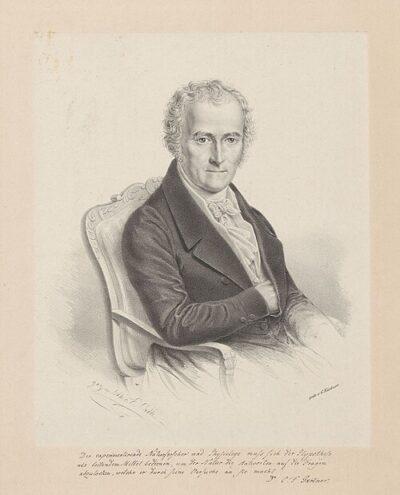
Karl Friedrich von Gaertner
Karl Friedrich von Gaertner was a German botanist. Born May 1, 1772, in Göppingen. Died September 1, 1850, in Calw. Positions held include professor. Educated at University of Tübingen.
Facts
15 facts · 2 confirmed by two sources · 5 cited · 8 from one source
Where this comes from
Papalocal keeps its own record. It started from these sources; what each one said is kept here as it was copied, so a change on their side never changes this page by itself. Tap one to read its version.
What Wikidata says · copied November 18, 2026 · revision 2569189613
- Described as
- German botanist (1772-1850)
- Other names
- C.F.Gaertn.
- Born
- May 1, 1772 · 1 reference
- Died
- September 1, 1850 · 2 references
- Born in
- Göppingen · 1 reference
- Died in
- Calw · 1 reference
- Citizen of
- Kingdom of Württemberg
- Occupation
- botanist · 1 reference; lichenologist; physician · 2 references
- Positions held
- professor
- Education
- University of Tübingen
- Member of
- German Academy of Sciences Leopoldina
- Field
- botany
- Children
- Emma Gärtner
- Father
- Joseph Gaertner · 1 reference
- Religion
- Protestantism
- Wikipedias with a page
- 21
Wikidata item Q62242 (wikidata.org/wiki/Q62242), public domain (CC0). Copied November 18, 2026.
What Wikipedia says · copied November 18, 2026 · revision 1293838853
Karl Friedrich von Gaertner (or Carl Friedrich von Gärtner) (1 May 1772 – 1 September 1850) was a well-known German botanist, and the son of Joseph Gaertner. He was a pioneer in the study of hybrids, and he is considered an important influence on Gregor Mendel.
Gärtner, who was a protestant, challenged the doctrine of Carl Linnaeus of the "new special creation" which stated that new species of vegetation could arise through hybridization. He defended the stability of species, and argued that although the transmutation of species was evidently possible, the new species would not last because of a law of reversion which prevented them from spreading freely. As was reported in the words of Mendel:Gärtner by the results of [his] transformation experiments, was led to oppose the opinion of those naturalists who dispute the stability of plant species and believe in a continuous evolution of vegetation. He perceives in the complete transformation of one species into another an indubitable proof that species are fixed within limits beyond which they cannot change. Although this opinion cannot be unconditionally accepted we find on the other hand in Gärtner's experiments a noteworthy confirmation of that supposition regarding variability of cultivated plants which has already been expressed.
Gärtner is mentioned 17 times in Gregor Mendel's short famous paper Experiments on Plant Hybridization and 32 times in the first edition of Charles Darwin's On the Origin of Species. He also is the most cited by nominal appearances in the sixth edition of the Origin.
- Born, in its opening lines
- May 1, 1772
- Died, in its opening lines
- September 1, 1850
From the Wikipedia article “Karl Friedrich von Gaertner” (en.wikipedia.org/wiki/Karl_Friedrich_von_Gaertner), by its contributors, under CC BY-SA 4.0 (creativecommons.org/licenses/by-sa/4.0/). Copied November 18, 2026; not changed.
Confirmed Two sources agree. Cited One source, and it names where it got it. One source One source, without a reference of its own. Sources disagree The sources disagree. We show the best-supported value and keep theirs below.
