
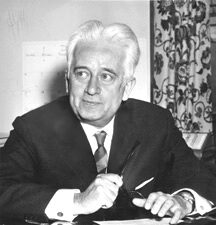
Kenneth Keating
Kenneth Keating was an American politician and diplomat. Born May 18, 1900, in Lima. Died May 5, 1975, in New York City. Positions held include United States representative, ambassador of the United States to Israel (1973–1975) and United States Ambassador to India (1969–1972). Educated at Harvard Law School and University of Rochester. Awards include Legion of Merit.
Facts
29 facts · 2 confirmed by two sources · 19 cited · 8 from one source
Where this comes from
Papalocal keeps its own record. It started from these sources; what each one said is kept here as it was copied, so a change on their side never changes this page by itself. Tap one to read its version.
What Wikidata says · copied November 18, 2026 · revision 2571644181
- Described as
- American politician and diplomat (1900–1975)
- Other names
- Kenneth Barnard Keating, Kenneth B. Keating
- Born
- May 18, 1900 · 3 references
- Died
- May 5, 1975 · 3 references
- Born in
- Lima
- Died in
- New York City · 1 reference
- Buried in
- Arlington National Cemetery (1975) · 1 reference
- Citizen of
- United States
- Occupation
- politician · 1 reference; judge; lawyer (1923–) · 2 references; diplomat · 1 reference; ambassador · 1 reference; jurist · 1 reference; member of parliament · 1 reference
- Positions held
- United States representative; ambassador of the United States to Israel (1973–1975) · 1 reference; United States Ambassador to India (1969–1972) · 1 reference; judge (1965–1969) · 1 reference; ambassador; United States senator (1959–1965) · 1 reference
- Political party
- Republican Party
- Education
- Harvard Law School (–1923) · 1 reference; University of Rochester (–1919) · 1 reference; primary school · 1 reference; Genesee Wesleyan Seminary (–1915) · 1 reference
- Awards
- Legion of Merit · 1 reference
- Spouse
- Mary Leet Pitcairn
- Military branch
- United States Army · 1 reference
- Military rank
- Sergeant · 1 reference; brigadier general · 1 reference
- Wikipedias with a page
- 16
Wikidata item Q356342 (wikidata.org/wiki/Q356342), public domain (CC0). Copied November 18, 2026.
What Wikipedia says · copied November 18, 2026 · revision 1382438416
Kenneth Barnard Keating (May 18, 1900 – May 5, 1975) was an American politician, diplomat, and judge who served as a United States senator representing New York from 1959 until 1965. A member of the Republican Party, he also served in the United States House of Representatives, representing New York's 40th and 38th congressional districts from 1947 until 1959. Additionally, he served as a judge of the New York State Court of Appeals from 1966 until 1969 and was U.S. ambassador to India from 1969 until 1972 and Israel from 1973 until 1975.
A native of Lima, New York, Keating graduated from Genesee Wesleyan Seminary in 1915, before continuing to the University of Rochester where he graduated in 1919. He briefly became a teacher at East High School, before beginning attendance at Harvard Law School. After graduating in 1923, Keating practiced law in Rochester and became active in Republican Party politics. During World War I, Keating served with the Student Army Training Corps (SATC) at the University of Rochester. He joined the United States Army for World War II, and was commissioned as a major. He served in India as head of the U.S. office that managed the Lend-Lease Program for the China Burma India Theater and was promoted to colonel before the end of the war. Following the end of his wartime service, he continued to serve in the Organized Reserve Corps. He was promoted to brigadier general in 1948, and continued to serve until he retired in 1963.
In 1946, Keating successfully ran for a seat in the U.S. House, representing the Rochester-based 40th district. He defeated the incumbent Democrat who had won an upset victory over the incumbent Republican in 1944. After narrowly winning again over the Democrat in 1948, Keating was not seriously challenged for the House seat again. In 1952, he was redistricted to the 38th district. During his time in the House, Keating was very active in debate, floor amendment, and sponsorship of successful legislation. In his last congress in the House he was the ranking Republican on the Judiciary Committee. He was re-elected five times and developed a reputation as a moderate on many issues, though he adopted conservative positions on the Cold War and anti-communism, as well as the fight against organized crime.
In 1958, he successfully ran for a U.S. Senate seat from New York, and he served from 1959 to 1965. In the senate, Keating was an advocate of desegregation, and played a key role in breaking the filibuster that enabled passage of the Civil Rights Act of 1964. During the 1964 United States presidential election, he refused to endorse the conservative Republican nominee Barry Goldwater. Keating ran for re-election later that year but was defeated by Democrat Robert F. Kennedy. After leaving the senate, Keating briefly practiced law before becoming a judge of the New York Court of Appeals. He served until 1969, when he resigned to become U.S. Ambassador to India. He served as ambassador until 1972, when he resigned to campaign for the re-election of President Richard Nixon. In 1973, Nixon appointed Keating U.S. Ambassador to Israel, and Keating remained in this position until his death in 1975.
- Born, in its opening lines
- May 18, 1900
- Died, in its opening lines
- May 5, 1975
From the Wikipedia article “Kenneth Keating” (en.wikipedia.org/wiki/Kenneth_Keating), by its contributors, under CC BY-SA 4.0 (creativecommons.org/licenses/by-sa/4.0/). Copied November 18, 2026; not changed.
Confirmed Two sources agree. Cited One source, and it names where it got it. One source One source, without a reference of its own. Sources disagree The sources disagree. We show the best-supported value and keep theirs below.
