
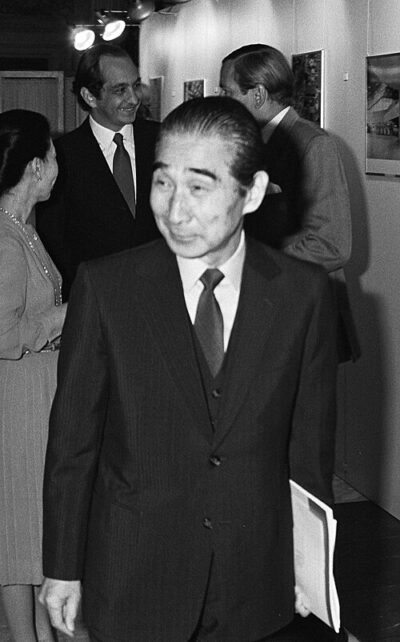
Kenzō Tange
Kenzō Tange was a Japanese architect. Born September 4, 1913, in Sakai. Died March 22, 2005, in Minato. Known for Yoyogi National Gymnasium, Nippon Gaishi Hall and National Stadium in Tokyo. Educated at Tokyo Imperial University and Nihon University. Awards include Pritzker Architecture Prize, Pour le Mérite for Sciences and Arts order and Royal Gold Medal.
Facts
42 facts · 2 confirmed by two sources · 9 cited · 31 from one source
Where this comes from
Papalocal keeps its own record. It started from these sources; what each one said is kept here as it was copied, so a change on their side never changes this page by itself. Tap one to read its version.
What Wikidata says · copied November 16, 2026 · revision 2564711811
- Described as
- Japanese architect (1913–2005)
- Other names
- Kenzou Tange, Kenzo Tange
- Born
- September 4, 1913 · 16 references
- Died
- March 22, 2005 · 14 references
- Born in
- Sakai
- Died in
- Minato
- Cause of death
- heart failure
- Citizen of
- Japan; Empire of Japan (–1947)
- Occupation
- architect · 1 reference; urban planner · 1 reference; university teacher
- Worked for
- University of Tokyo; Tange Associates
- Education
- Tokyo Imperial University; Nihon University · 1 reference; Hiroshima High School; Ehime Prefectural Imabari Nishi High School
- Member of
- American Academy of Arts and Sciences (1967–) · 1 reference; National Academy of Fine Arts (Argentina); Accademia delle Arti del Disegno; Académie des beaux-arts; Croatian Academy of Sciences and Arts (1981–) · 1 reference
- Known for
- Yoyogi National Gymnasium; Nippon Gaishi Hall; National Stadium in Tokyo; Singapore Indoor Stadium
- Awards
- Pritzker Architecture Prize (1987) · 1 reference; Pour le Mérite for Sciences and Arts order; Royal Gold Medal (1965) · 1 reference; Order of Culture (1980); Commander of the Legion of Honour (1996); Praemium Imperiale (1993) · 1 reference; Person of Cultural Merit (1979); Grand Officer of the Order of the Sun of Peru (1983) · 1 reference; honorary doctor of the University of Hong Kong; Asahi Prize (1964) · 1 reference; AIA Gold Medal (1966) · 1 reference; AIJ Prize (1986) · 1 reference; Order of the Sacred Treasure, 1st Class
- Field
- architecture
- Children
- Noritaka Tange
- Religion
- Catholic Church
- Website
- https://www.tangeweb.com/
- Wikipedias with a page
- 66
Wikidata item Q151794 (wikidata.org/wiki/Q151794), public domain (CC0). Copied November 16, 2026.
What Wikipedia says · copied November 16, 2026 · revision 1380932149
Kenzō Tange (丹下 健三, Tange Kenzō; 4 September 1913 – 22 March 2005) was a Japanese architect. Born in Sakai and raised in China and southern Japan, Tange was inspired from an early age by the work of Le Corbusier and designed his first buildings under Imperial Japan. He first achieved recognition for his projects to reconstruct the destroyed cities of postwar Japan, particularly Hiroshima, where he designed the Hiroshima Peace Memorial Park. His engagement with the Congres Internationaux d'Architecture Moderne in the 1950s made him one of the first Japanese architects to achieve international recognition.
Renowned for synthesizing traditional Japanese styles with modernism, Tange's work was emblematic of the Japanese postwar boom. However, he built major projects on five continents. He was a forerunner, mentor, and patron of the metabolist movement. He was also known as an ambitious, original urban planner whose ideas inspired the reconstruction of cities including Skopje. Tange would continue designing buildings until his death in 2005.
Tange won awards for his contributions to architecture, including the Royal Gold Medal in 1965, the AIA Gold Medal in 1966, the Praemium Imperiale for Architecture in 1993, and the Pritzker Prize, the "Nobel Prize of architecture", in 1987.
- Born, in its opening lines
- September 4, 1913
- Died, in its opening lines
- March 22, 2005
From the Wikipedia article “Kenzō Tange” (en.wikipedia.org/wiki/Kenzō_Tange), by its contributors, under CC BY-SA 4.0 (creativecommons.org/licenses/by-sa/4.0/). Copied November 16, 2026; not changed.
Confirmed Two sources agree. Cited One source, and it names where it got it. One source One source, without a reference of its own. Sources disagree The sources disagree. We show the best-supported value and keep theirs below.
