
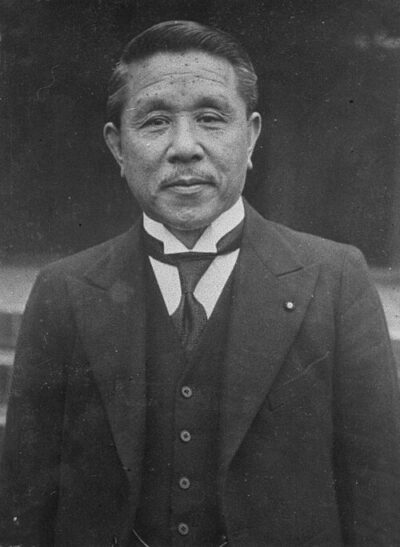
Kōki Hirota
Kōki Hirota was a Japanese prime minister, diplomat, and war criminal. Born February 14, 1878, in Fukuoka. Died December 23, 1948, in Sugamo Prison. Positions held include Prime Minister of Japan (1936–1937) and member of the House of Peers (1937–1945). Educated at Fukuoka Prefectural Shuyukan High School and University of Tokyo, Faculty of Law, Graduate Schools for Law and Politics. Awards include Order of the Rising Sun, 1st class, Order of the Sacred Treasure, 1st Class and Knight of the Legion of Honour.
Facts
31 facts · 2 confirmed by two sources · 2 cited · 27 from one source
Where this comes from
Papalocal keeps its own record. It started from these sources; what each one said is kept here as it was copied, so a change on their side never changes this page by itself. Tap one to read its version.
What Wikidata says · copied November 16, 2026 · revision 2566545726
- Described as
- Japanese prime minister, diplomat, and war criminal (1878-1948)
- Other names
- Koki Hirota, Kouki Hirota
- Born
- February 14, 1878 · 2 references
- Died
- December 23, 1948 · 3 references
- Born in
- Fukuoka · 1 reference
- Died in
- Sugamo Prison
- Buried in
- Shōfuku-ji Temple · 1 reference
- Cause of death
- hanging to death
- Name at birth
- 廣田 弘毅
- Citizen of
- Japan
- Occupation
- politician; diplomat
- Positions held
- Prime Minister of Japan (1936–1937); member of the House of Peers (1937–1945)
- Political party
- independent politician
- Education
- Fukuoka Prefectural Shuyukan High School; University of Tokyo, Faculty of Law, Graduate Schools for Law and Politics
- Awards
- Order of the Rising Sun, 1st class (1938); Order of the Sacred Treasure, 1st Class (1933); Knight of the Legion of Honour (1907); Order of the Sacred Treasure, 6th class (1907); Order of the Sacred Treasure, 5th Class (1911); Order of the Sacred Treasure, 4th class (1918); Order of the Sacred Treasure, 3rd class (1924); Order of the Sacred Treasure, 2nd Class (1926); 2600th National Anniversary Commemorative Medal (1940); Order of Saint Anna, 3rd class (1908); Commander of the Legion of Honour (1924); Grand Cross of the Order of Orange-Nassau (1930); Grand Cordon of the Order of Leopold (1934); Grand Cross of the Order of the German Eagle (1937); Grand Cross of the Order of Polonia Restituta (1938)
- Spouse
- Shizuko Hirota
- Wikipedias with a page
- 38
Wikidata item Q351652 (wikidata.org/wiki/Q351652), public domain (CC0). Copied November 16, 2026.
What Wikipedia says · copied November 16, 2026 · revision 1378687359
Kōki Hirota (廣田 弘毅, Hirota Kōki; 14 February 1878 – 23 December 1948) was a Japanese diplomat and politician who served as prime minister of Japan from 1936 to 1937. He was executed for war crimes committed during the Second Sino-Japanese War at the Tokyo Trials.
Born in Fukuoka, Hirota attended the Tokyo Imperial University and graduated with a law degree. Afterwards he entered the Ministry of Foreign Affairs and became a career diplomat, serving as minister to the Netherlands and ambassador to the Soviet Union, among other posts. In 1933, Hirota became foreign minister in the cabinet of Saitō Makoto, and retained the position when Keisuke Okada was appointed prime minister.
In 1936, following the February 26 incident, Hirota succeeded Okada as prime minister. His premiership saw the Japanese military's growing control over the civilian government, as well as the signing of the Anti-Comintern Pact. He was forced to resign under Army pressure less than a year later and was succeeded by Senjūrō Hayashi. Later he briefly served as foreign minister under Fumimaro Konoe before retiring. In 1945, he returned to government service and led Japanese peace negotiations with the Soviet Union.
Following Japan's surrender at the end of the Second World War, Hirota was arrested as a Class A war criminal and brought before the International Military Tribunal for the Far East. He was found guilty of war crimes and sentenced to death by hanging, the only civilian executed as a result of the proceedings.
- Born, in its opening lines
- February 14, 1878
- Died, in its opening lines
- December 23, 1948
From the Wikipedia article “Kōki Hirota” (en.wikipedia.org/wiki/Kōki_Hirota), by its contributors, under CC BY-SA 4.0 (creativecommons.org/licenses/by-sa/4.0/). Copied November 16, 2026; not changed.
Confirmed Two sources agree. Cited One source, and it names where it got it. One source One source, without a reference of its own. Sources disagree The sources disagree. We show the best-supported value and keep theirs below.
