
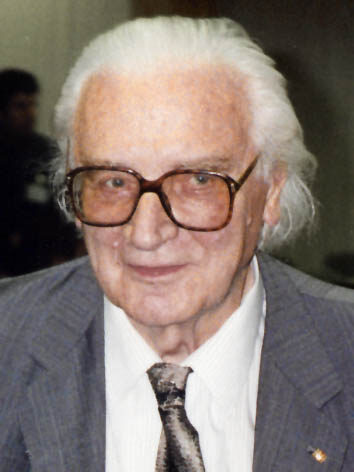
Konrad Zuse
Konrad Zuse was a German computer scientist and engineer. Born June 22, 1910, in Wilmersdorf. Died December 18, 1995, in Hünfeld. Known for Z1, Z2 and Z3. Educated at Technische Universität Berlin and Konrad-Zuse-Gymnasium Hoyerswerda. Awards include Wilhelm Leuschner Medal, Werner von Siemens Ring and Great Cross with Star and Sash of the Order of Merit of the Federal Republic of Germany.
Facts
48 facts · 2 confirmed by two sources · 26 cited · 20 from one source
Where this comes from
Papalocal keeps its own record. It started from these sources; what each one said is kept here as it was copied, so a change on their side never changes this page by itself. Tap one to read its version.
What Wikidata says · copied November 16, 2026 · revision 2569137715
- Described as
- German computer scientist and engineer (1910 - 1995)
- Other names
- Zuse, Konrad Ernst Otto Zuse
- Born
- June 22, 1910 · 10 references
- Died
- December 18, 1995 · 10 references
- Born in
- Wilmersdorf · 2 references
- Died in
- Hünfeld · 1 reference
- Buried in
- Neuer Friedhof, Hünfeld · 1 reference
- Name at birth
- Konrad Ernst Otto Zuse
- Citizen of
- Germany · 1 reference
- Occupation
- inventor · 1 reference; entrepreneur · 1 reference; computer scientist; engineer · 1 reference; civil engineer; painter · 1 reference
- Worked for
- Henschel & Sohn (1935–1939) · 1 reference; Aerodynamics Research Institute (1939–1945) · 1 reference; Zuse KG (1949–1969) · 2 references; Siemens (1969–)
- Education
- Technische Universität Berlin (1927–1935) · 1 reference; Konrad-Zuse-Gymnasium Hoyerswerda (–1927) · 1 reference; Collegium Hosianum
- Member of
- German Academy of Sciences Leopoldina · 1 reference; Akademischer Verein Motiv Berlin · 1 reference
- Known for
- Z1; Z2; Z3; Z4; Z5; Z11; Z22; Z23 (computer); Calculating Space; Plankalkül
- Awards
- Wilhelm Leuschner Medal (1987) · 1 reference; Werner von Siemens Ring (1964) · 1 reference; Great Cross with Star and Sash of the Order of Merit of the Federal Republic of Germany (1995) · 1 reference; Ernst Reuter Medal (1985) · 1 reference; Rudolf-Diesel-Medaille (1969) · 1 reference; Wilhelm Exner Medal (1969) · 1 reference; Bavarian Maximilian Order for Science and Art (1984) · 1 reference; Cothenius Medal (1985) · 1 reference; Computer History Museum Fellow (1983) · 1 reference; Konrad Zuse Medal (1981) · 1 reference; Philip Morris Research Prize (1987) · 1 reference; Harry H. Goode Memorial Award (1965) · 2 references; honorary doctor of ETH Zürich (1991) · 1 reference; honorary citizen of Hoyerswerda (1995) · 1 reference
- Field
- computer science
- Children
- Horst Zuse · 1 reference
- Wikipedias with a page
- 69
Wikidata item Q60093 (wikidata.org/wiki/Q60093), public domain (CC0). Copied November 16, 2026.
What Wikipedia says · copied November 16, 2026 · revision 1379657765
Konrad Ernst Otto Zuse (; German: [ˈkɔnʁaːt ˈtsuːzə]; 22 June 1910 – 18 December 1995) was a German civil engineer, pioneering computer scientist, inventor and businessman. His greatest achievement was the world's first programmable computer; the functional program-controlled Turing-complete Z3 became operational in May 1941. Thanks to this machine and its predecessors, Zuse is regarded by some as the inventor and father of the modern computer.
Zuse was noted for the S2 computing machine, considered the first process control computer. In 1941, he founded one of the earliest computer businesses, producing the Z4, which became the world's first commercial computer. From 1943 to 1945 he designed Plankalkül, the first high-level programming language. In 1969, Zuse suggested the concept of a computation-based universe in his book Rechnender Raum (Calculating Space).
Much of his early work was financed by his family and commerce, but after 1939 he was given resources by the government of Nazi Germany. Due to World War II, Zuse's work went largely unnoticed in the United Kingdom and United States. Possibly his first documented influence on a US company was IBM's option on his patents in 1946. The Z4 also served as the inspiration for the construction of the ERMETH, the first Swiss computer and one of the first in Europe.
- Born, in its opening lines
- June 22, 1910
- Died, in its opening lines
- December 18, 1995
From the Wikipedia article “Konrad Zuse” (en.wikipedia.org/wiki/Konrad_Zuse), by its contributors, under CC BY-SA 4.0 (creativecommons.org/licenses/by-sa/4.0/). Copied November 16, 2026; not changed.
Confirmed Two sources agree. Cited One source, and it names where it got it. One source One source, without a reference of its own. Sources disagree The sources disagree. We show the best-supported value and keep theirs below.
