
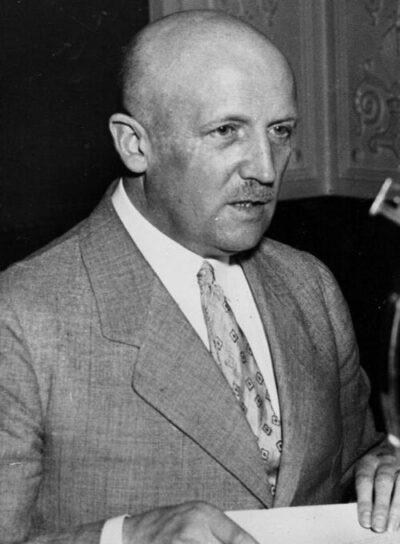
Kurt von Schleicher
Kurt von Schleicher was a German chancellor. Born April 7, 1882, in Brandenburg an der Havel. Died June 30, 1934, in Neubabelsberg. Positions held include Reich Chancellor in the Weimar Republic (1932–1933), Minister President of Prussia (1932–1933) and Federal Minister of Defence (1932–1933). Educated at Prussian Military Academy. Awards include Iron Cross, House Order of Hohenzollern and Order of Saint John (Bailiwick of Brandenburg).
Facts
26 facts · 2 confirmed by two sources · 8 cited · 16 from one source
Where this comes from
Papalocal keeps its own record. It started from these sources; what each one said is kept here as it was copied, so a change on their side never changes this page by itself. Tap one to read its version.
What Wikidata says · copied November 16, 2026 · revision 2569028563
- Described as
- German chancellor (1882-1934)
- Other names
- Kurt Ferdinand Friedrich Hermann von Schleicher
- Born
- April 7, 1882 · 3 references
- Died
- June 30, 1934 · 9 references
- Born in
- Brandenburg an der Havel · 2 references
- Died in
- Neubabelsberg · 1 reference
- Buried in
- Parkfriedhof Lichterfelde · 1 reference
- Cause of death
- homicide by firearm · 1 reference
- Citizen of
- Germany
- Occupation
- politician · 1 reference; military officer; head of government · 1 reference
- Positions held
- Reich Chancellor in the Weimar Republic (1932–1933); Minister President of Prussia (1932–1933); Federal Minister of Defence (1932–1933)
- Political party
- independent politician
- Education
- Prussian Military Academy · 1 reference
- Awards
- Iron Cross · 1 reference; House Order of Hohenzollern · 1 reference; Order of Saint John (Bailiwick of Brandenburg) · 1 reference; Order of the Zähringer Lion · 1 reference; Military Merit Order (Bavaria) · 1 reference; Gallipoli Star · 1 reference
- Spouse
- Elisabeth von Schleicher · 1 reference
- Religion
- Lutheranism
- Military branch
- Prussian Army · 1 reference
- Military rank
- general · 2 references; General of the Infantry · 1 reference
- Wikipedias with a page
- 66
Wikidata item Q57133 (wikidata.org/wiki/Q57133), public domain (CC0). Copied November 16, 2026.
What Wikipedia says · copied November 16, 2026 · revision 1376717365
Kurt Ferdinand Friedrich Hermann von Schleicher (German: [ˈkʊʁt fɔn ˈʃlaɪçɐ] ; 7 April 1882 – 30 June 1934) was a German military officer and the penultimate chancellor of Germany during the Weimar Republic. A rival for power with Adolf Hitler, Schleicher was assassinated by Hitler's Schutzstaffel (SS) during the Night of the Long Knives in 1934.
Schleicher was born into a military family in Brandenburg an der Havel. Entering the Prussian Army as a lieutenant in 1900, he rose to become a general staff officer in the Railway Department of the German General Staff and served in the General Staff of the Supreme Army Command during World War I. Schleicher served as liaison between the army and the new Weimar Republic during the German Revolution of 1918–1919. An important player in the Reichswehr's efforts to avoid the restrictions of the Treaty of Versailles, Schleicher rose to power as head of the Reichswehr's Armed Forces Department and was a close advisor to President Paul von Hindenburg from 1926 onward. Following the appointment of his mentor Wilhelm Groener as minister of defence in 1928, Schleicher became head of the defense Ministry's Office of Ministerial Affairs (Ministeramt) in 1929. In 1930, he was instrumental in the toppling of Hermann Müller's government and the appointment of Heinrich Brüning as chancellor. He enlisted the services of the Nazi Party's Sturmabteilung (SA) as an auxiliary force for the Reichswehr from 1931 onward.
Beginning in 1932, Schleicher served as minister of defence in the cabinet of Franz von Papen. Schleicher organised the downfall of Papen and succeeded him as Chancellor on 3 December. During his brief term, Schleicher negotiated with Gregor Strasser on a possible defection of the latter from the Nazi Party, but the plan was abandoned. Schleicher attempted to "tame" Hitler into cooperating with his government by threatening him with an anti-Nazi alliance of parties, the so-called Querfront ("cross-front"). Hitler refused to abandon his claim to the chancellorship and Schleicher's plan failed. Schleicher then proposed to Hindenburg that the latter disperse the Reichstag and rule as a de facto dictator, a course of action Hindenburg rejected.
On 28 January 1933, facing a political impasse and deteriorating health, Schleicher resigned and recommended the appointment of Hitler in his stead. Schleicher sought to return to politics by exploiting the divisions between Ernst Röhm and Hitler, but on 30 June 1934, he and his wife Elisabeth were murdered on the orders of Hitler during the Night of the Long Knives.
- Born, in its opening lines
- April 7, 1882
- Died, in its opening lines
- June 30, 1934
From the Wikipedia article “Kurt von Schleicher” (en.wikipedia.org/wiki/Kurt_von_Schleicher), by its contributors, under CC BY-SA 4.0 (creativecommons.org/licenses/by-sa/4.0/). Copied November 16, 2026; not changed.
Confirmed Two sources agree. Cited One source, and it names where it got it. One source One source, without a reference of its own. Sources disagree The sources disagree. We show the best-supported value and keep theirs below.
