
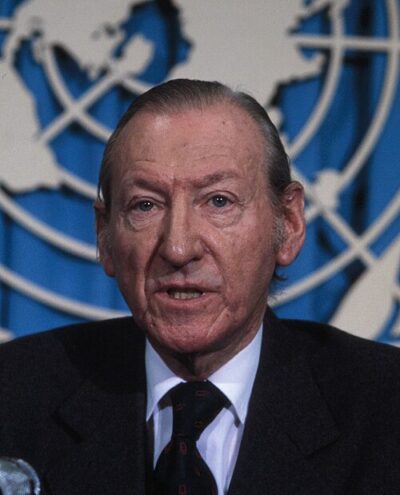
Kurt Waldheim
Kurt Waldheim was an Austrian politician and diplomat. Born December 21, 1918, in Sankt Andrä-Wördern. Died June 14, 2007, in Vienna. Positions held include President of Austria (1986–1992), United Nations Secretary-General (1972–1981) and Federal Minister of Foreign Affairs of Austria (1968–1970). Educated at University of Vienna and Diplomatic Academy of Vienna. Awards include Iron Cross, Eastern Medal and War Merit Cross.
Facts
46 facts · 2 confirmed by two sources · 16 cited · 26 from one source · 2 where the sources disagree
What’s different
- Buried in: we show Vienna Central Cemetery (Sources disagree). Wikidata also lists Präsidentengruft
- Cause of death: we show cardiac arrest (Sources disagree). Wikidata also lists heart failure
Where this comes from
Papalocal keeps its own record. It started from these sources; what each one said is kept here as it was copied, so a change on their side never changes this page by itself. Tap one to read its version.
What Wikidata says · copied November 16, 2026 · revision 2566150336
- Described as
- Austrian politician and diplomat (1918–2007)
- Other names
- Kurt Josef Waldheim, Kurt Waclawik
- Born
- December 21, 1918 · 9 references
- Died
- June 14, 2007 · 9 references
- Born in
- Sankt Andrä-Wördern · 5 references
- Died in
- Vienna · 3 references
- Buried in
- Vienna Central Cemetery · 1 reference; Präsidentengruft
- Cause of death
- cardiac arrest · 1 reference; heart failure
- Citizen of
- Austria · 4 references; Nazi Germany
- Occupation
- politician · 6 references; diplomat · 2 references; autobiographer; military personnel · 1 reference; lawyer; university teacher · 1 reference; jurist · 1 reference
- Positions held
- President of Austria (1986–1992); United Nations Secretary-General (1972–1981) · 3 references; Federal Minister of Foreign Affairs of Austria (1968–1970); ambassador of Austria to Canada; military officer (1938–) · 1 reference
- Political party
- Austrian People's Party
- Worked for
- United Nations; Federal Ministry for European and International Affairs
- Education
- University of Vienna; Diplomatic Academy of Vienna
- Member of
- National Socialist German Students' League (1937–1944)
- Awards
- Iron Cross; Eastern Medal; War Merit Cross; Knight Grand Cross of the Order of Pius IX; Order of the Smile; Knight Grand Cross of the Order of St Michael and St George; United Nations Peace Medal (1977); Grand Star of the Decoration for Services to the Republic of Austria; Grand Cross 1st class of the Order of Merit of the Federal Republic of Germany; Medal of the Crown of King Zvonimir · 1 reference; NASA Distinguished Public Service Medal · 1 reference; honorary doctorate from the University of Nice-Sophia Antipolis (1976) · 1 reference
- Spouse
- Elisabeth Waldheim (1944–) · 1 reference
- Children
- Christa Karas-Waldheim · 1 reference; Gerhard Waldheim · 1 reference; Liselotte Waldheim-Natural · 1 reference
- Religion
- Catholicism
- Military branch
- Sturmabteilung (1938–1939) · 1 reference; German Army (1941–1945)
- Military rank
- Oberleutnant
- Wikipedias with a page
- 90
Wikidata item Q1260 (wikidata.org/wiki/Q1260), public domain (CC0). Copied November 16, 2026.
What Wikipedia says · copied November 16, 2026 · revision 1384371314
Kurt Josef Waldheim (Austrian German: [kʊrt ˈvaldhaɪm] ; 21 December 1918 – 14 June 2007) was an Austrian politician and diplomat. Waldheim was the secretary-general of the United Nations from 1972 to 1981 and the president of Austria from 1986 to 1992.
While he was running for the latter office in the 1986 election, the revelation of his service in Greece and Yugoslavia during World War II, and of his knowledge of Nazi atrocities as an intelligence officer in Nazi Germany's Wehrmacht, raised international controversy.
- Born, in its opening lines
- December 21, 1918
- Died, in its opening lines
- June 14, 2007
From the Wikipedia article “Kurt Waldheim” (en.wikipedia.org/wiki/Kurt_Waldheim), by its contributors, under CC BY-SA 4.0 (creativecommons.org/licenses/by-sa/4.0/). Copied November 16, 2026; not changed.
Confirmed Two sources agree. Cited One source, and it names where it got it. One source One source, without a reference of its own. Sources disagree The sources disagree. We show the best-supported value and keep theirs below.
