
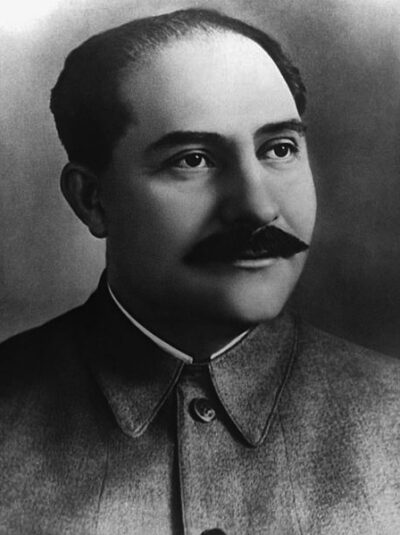
Lazar Kaganovich
Lazar Kaganovich was a Soviet politician. Born November 10, 1893, in Dibrova. Died July 25, 1991, in Moscow. Positions held include First Deputy Chairman of the Council of Ministers of the USSR (1953–1957), First Secretary of the Communist Party of Ukraine (2 times) (1925–1947) and deputy of the Supreme Soviet of the Soviet Union. Awards include Order of Lenin (2 times), Hero of Socialist Labour and Order of the Red Banner of Labour.
Facts
35 facts · 1 confirmed by two sources · 4 cited · 29 from one source · 1 where the sources disagree
What’s different
- Born: we show November 10, 1893 (Sources disagree). Wikipedia says November 22, 1893
Where this comes from
Papalocal keeps its own record. It started from these sources; what each one said is kept here as it was copied, so a change on their side never changes this page by itself. Tap one to read its version.
What Wikidata says · copied November 16, 2026 · revision 2562622967
- Described as
- Soviet politician (1893–1991)
- Other names
- L.M. Kaganovich, Lazaŕ Moiseevich Kaganovich, Lazar Moiseyevich Kaganovich
- Born
- November 10, 1893 · 1 reference
- Died
- July 25, 1991 · 5 references
- Born in
- Dibrova
- Died in
- Moscow · 1 reference
- Buried in
- Novodevichy Cemetery
- Citizen of
- Russian Empire; Soviet Union
- Occupation
- statesperson; revolutionary · 1 reference; politician · 1 reference; cobbler · 1 reference
- Positions held
- First Deputy Chairman of the Council of Ministers of the USSR (1953–1957); First Secretary of the Communist Party of Ukraine (2 times) (1925–1947) · 1 reference; deputy of the Supreme Soviet of the Soviet Union; Member of the Russian Constituent Assembly; member of the Supreme Soviet of the Byelorussian SSR of the 1st convocation; People's Commissar for Defense Industry (1937–1939); First Secretary of the Moscow Communist Party (1931–1934) · 1 reference; Member of the Politburo of the CPSU Central Committee (1930–1957) · 1 reference
- Political party
- Communist Party of the Soviet Union (1911–)
- Member of
- Politburo of the Central Committee of the Communist Party of the Soviet Union; All-Russian Central Executive Committee; All-Union Society of Old Bolsheviks
- Awards
- Order of Lenin (2 times) (1935, 1943); Hero of Socialist Labour (1943); Order of the Red Banner of Labour (1936); "Hammer and Sickle" gold medal (1943); Medal "For Valiant Labour in the Great Patriotic War 1941–1945"; Medal "In Commemoration of the 800th Anniversary of Moscow" · 1 reference; Jubilee Medal "In Commemoration of the 100th Anniversary of the Birth of Vladimir Ilyich Lenin" · 1 reference
- Siblings
- Izrail Kaganovich; Aron Kaganovich; Mikhail Kaganovich; Yuly Kaganovich
- Religion
- atheism · 1 reference
- Wikipedias with a page
- 58
Wikidata item Q215705 (wikidata.org/wiki/Q215705), public domain (CC0). Copied November 16, 2026.
What Wikipedia says · copied November 16, 2026 · revision 1383731659
Lazar Moiseyevich Kaganovich (Russian: Лазарь Моисеевич Каганович; 22 November [O.S. 10 November] 1893 – 25 July 1991) was a Soviet politician and one of Joseph Stalin's closest associates.
Born to a Jewish family in Ukraine, Kaganovich worked as a shoemaker and joined the Russian Social Democratic Labour Party in 1911. During and after the 1917 October Revolution, he held leading positions in Bolshevik organizations in modern day Belarus and Russia, and helped consolidate Soviet rule in Turkestan. In 1922, Stalin placed Kaganovich in charge of an organizational department of the Communist Party, assisting the former in consolidating his grip on the party. Kaganovich was appointed First Secretary of the Communist Party of Ukraine in 1925, and a full member of the Politburo and Stalin's deputy party secretary in 1930.
In 1932–33, he helped enforce grain quotas in Ukraine which contributed to the Ukrainian part of the Soviet famine of 1930-1933. From the mid-1930s on, Kaganovich variously served as the People's Commissar for Railways, Heavy Industry and Oil Industry. Following the outbreak of the Second World War, he was appointed a member of the State Defence Committee.
After Stalin's death in 1953 and the rise of Nikita Khrushchev, Kaganovich quickly lost his influence. After joining in a failed coup against Khrushchev in 1957, Kaganovich was dismissed from the Presidium and demoted to the director of a potash works in Perm and later in a cement works in Sverdlovsk in the Urals. He was expelled from the party in 1961 and lived out his life as a pensioner in Moscow. At his death in 1991, he was the last surviving Old Bolshevik. The Soviet Union itself outlasted him by only five months, dissolving on 26 December 1991.
- Born, in its opening lines
- November 22, 1893
- Died, in its opening lines
- July 25, 1991
From the Wikipedia article “Lazar Kaganovich” (en.wikipedia.org/wiki/Lazar_Kaganovich), by its contributors, under CC BY-SA 4.0 (creativecommons.org/licenses/by-sa/4.0/). Copied November 16, 2026; not changed.
Confirmed Two sources agree. Cited One source, and it names where it got it. One source One source, without a reference of its own. Sources disagree The sources disagree. We show the best-supported value and keep theirs below.
