
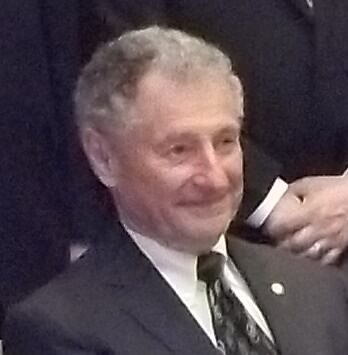
Leonard Kleinrock
Leonard Kleinrock is an American computer scientist. Born June 13, 1934, in New York City. Educated at Bronx High School of Science and City College of New York. Awards include IEEE Alexander Graham Bell Medal, Marconi Prize and SIGCOMM Award.
Facts
32 facts · 1 confirmed by two sources · 19 cited · 12 from one source
Where this comes from
Papalocal keeps its own record. It started from these sources; what each one said is kept here as it was copied, so a change on their side never changes this page by itself. Tap one to read its version.
What Wikidata says · copied November 15, 2026 · revision 2568882068
- Described as
- American computer scientist (born 1934)
- Other names
- Kleinrock
- Born
- June 13, 1934 · 2 references
- Born in
- New York City
- Citizen of
- United States · 2 references
- Occupation
- mathematician; computer scientist · 2 references; patent inventor · 2 references; professor · 2 references
- Worked for
- University of California, Los Angeles
- Education
- Bronx High School of Science (1949–1951) · 1 reference; City College of New York (1951–1957); Massachusetts Institute of Technology (–1963)
- Member of
- American Academy of Arts and Sciences; National Academy of Engineering (1980–) · 1 reference; Association for Computing Machinery (2000–) · 1 reference
- Awards
- IEEE Alexander Graham Bell Medal (2012) · 1 reference; Marconi Prize (1986) · 1 reference; SIGCOMM Award (1990) · 1 reference; IEEE Internet Award (2000) · 1 reference; Charles Stark Draper Prize (2001) · 1 reference; National Medal of Science (2007) · 1 reference; Internet Hall of Fame (2012) · 1 reference; Dan David Prize (2010) · 1 reference; Harry H. Goode Memorial Award (1996) · 1 reference; BBVA Foundation Frontiers of Knowledge Award (2014) · 1 reference; ACM Fellow (2000) · 1 reference; Frederick W. Lanchester Prize (1976) · 1 reference; Guggenheim Fellowship · 1 reference; Okawa Prize (2001) · 1 reference
- Field
- queueing theory
- Lived in
- New York City (1934–); Los Angeles
- Website
- https://www.lk.cs.ucla.edu/index.html
- Wikipedias with a page
- 32
Wikidata item Q32338 (wikidata.org/wiki/Q32338), public domain (CC0). Copied November 15, 2026.
What Wikipedia says · copied November 15, 2026 · revision 1371962000
Leonard Kleinrock (born June 13, 1934) is an American computer scientist and Internet pioneer. He is Distinguished Professor Emeritus of Computer Science at UCLA's Henry Samueli School of Engineering and Applied Science. Kleinrock made several important contributions to the field of computer science, in particular to the mathematical foundations of data communication in computer networking. He has received numerous prestigious awards.
In the early 1960s, Kleinrock pioneered the application of queueing theory to model delays in message switching networks in his Ph.D. thesis, published as a book in 1964. In the late 1960s and 1970s, he played an influential role in the development of the ARPANET. In the 1970s, he applied queueing theory to model and measure the performance of packet switching networks and published several of the standard works on the subject. He supervised graduate students who worked on the communication protocols for the ARPANET including students whose later work on internetworking and the Internet protocol suite led to the networking technology employed in the Internet. His theoretical work on hierarchical routing in the late 1970s with student Farouk Kamoun remains critical to the operation of the Internet today.
- Born, in its opening lines
- June 13, 1934
From the Wikipedia article “Leonard Kleinrock” (en.wikipedia.org/wiki/Leonard_Kleinrock), by its contributors, under CC BY-SA 4.0 (creativecommons.org/licenses/by-sa/4.0/). Copied November 15, 2026; not changed.
Confirmed Two sources agree. Cited One source, and it names where it got it. One source One source, without a reference of its own. Sources disagree The sources disagree. We show the best-supported value and keep theirs below.
