
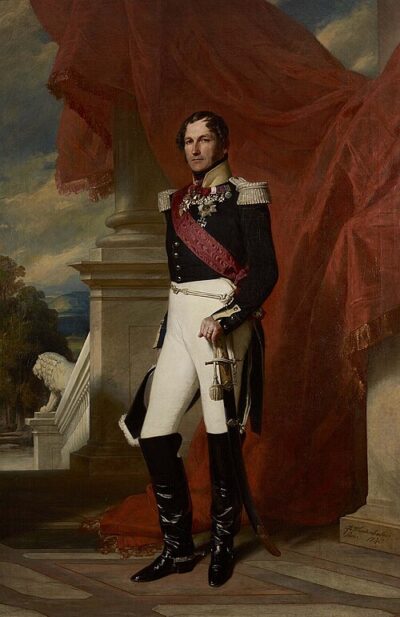
Leopold I of Belgium
Leopold I of Belgium was a German prince who became the first King of the Belgians. Born December 16, 1790, in Coburg. Died December 10, 1865, in Laeken. Positions held include King of the Belgians (1831–1865). Awards include Grand Cross of the Legion of Honour, Knight of the Order of the Golden Fleece and Knight of the Order of Maria Theresa.
Facts
51 facts · 2 confirmed by two sources · 10 cited · 39 from one source
Where this comes from
Papalocal keeps its own record. It started from these sources; what each one said is kept here as it was copied, so a change on their side never changes this page by itself. Tap one to read its version.
What Wikidata says · copied November 16, 2026 · revision 2567482205
- Described as
- German prince who became the first King of the Belgians (1790–1865)
- Other names
- King Leopold I of Belgium, Leopold, King of the Belgians, Leopold of Saxe-Coburg-Gotha, Leopold of Saxe-Coburg-Saalfeld, Prince Leopold, Leopold I van België
- Born
- December 16, 1790 · 8 references
- Died
- December 10, 1865 · 8 references
- Born in
- Coburg · 1 reference
- Died in
- Laeken · 1 reference
- Buried in
- Royal Crypt
- Citizen of
- Saxe-Coburg-Saalfeld; United Kingdom of Great Britain and Ireland (1815–) · 1 reference; Belgium (1831–) · 1 reference
- Occupation
- politician; military personnel; aristocrat
- Positions held
- King of the Belgians (1831–1865)
- Member of
- Royal Society of London (1816–) · 1 reference; Princess Charlotte of Wales and Prince Leopold
- Awards
- Grand Cross of the Legion of Honour; Knight of the Order of the Golden Fleece; Knight of the Order of Maria Theresa; Knight of the Order of St. Alexander Nevsky; Knight Grand Cross of the Order of the Bath; Order of the Black Eagle; Order of the Red Eagle 1st Class; Order of Saint Anna, 1st class; Order of St. Andrew; Gold Sword for Bravery; Order of St. George, 4th class; Order of Saint John of Jerusalem; Knight Grand Cross of the Order of Saint Joseph; Honorary Fellow of the Royal Society of Edinburgh; Order of the Saxe-Ernestine
- Spouse
- Princess Charlotte Augusta of Wales (1816–1817) · 2 references; Louise of Orléans (1832–1850) · 2 references
- Children
- Louis Philippe, Crown Prince of Belgium · 1 reference; Leopold II of Belgium; Prince Philippe, Count of Flanders; Charlotte of Belgium · 1 reference; Georg von Eppinghoven; Arthur von Eppinghoven; stillborn son von Sachsen-Coburg und Gotha · 1 reference
- Father
- Francis, Duke of Saxe-Coburg-Saalfeld · 1 reference
- Mother
- Countess Augusta Reuss of Ebersdorf
- Siblings
- Princess Victoria of Saxe-Coburg-Saalfeld; Princess Juliane of Saxe-Coburg and Gotha; Princess Antoinette of Saxe-Coburg-Saalfeld; Princess Sophie of Saxe-Coburg-Saalfeld; Ernest I, Duke of Saxe-Coburg and Gotha; Prince Ferdinand of Saxe-Coburg and Gotha
- Religion
- Lutheranism · 1 reference
- Military branch
- Belgian Armed Forces (1831–); British Army (–1831)
- Military rank
- field marshal; lieutenant general
- Wikipedias with a page
- 80
Wikidata item Q12971 (wikidata.org/wiki/Q12971), public domain (CC0). Copied November 16, 2026.
What Wikipedia says · copied November 16, 2026 · revision 1385922221
Leopold I (Leopold George Christian Frederick; 16 December 1790 – 10 December 1865) was the first king of the Belgians, reigning from 21 July 1831 until his death in 1865.
The youngest son of Francis, Duke of Saxe-Coburg-Saalfeld, Leopold took a commission in the Imperial Russian Army and fought against Napoleon after French troops overran Saxe-Coburg during the Napoleonic Wars. After Napoleon's defeat, Leopold moved to the United Kingdom, where in 1816 he married Princess Charlotte of Wales, the only child of the British Prince Regent (later George IV). Leopold and Charlotte's marriage was happy, but it ended after a year and a half when Charlotte died after delivering a stillborn son. Leopold continued to enjoy considerable status in Britain. As the uncle of Queen Victoria through his sister, he played a major role in the life of Victoria and often acted as her father figure including arranging her marriage with his nephew Prince Albert of Saxe-Coburg and Gotha.
After the Greek War of Independence, Leopold was offered the throne of Greece under the 1830 London Protocol that created an independent Greek state, but turned it down, believing it to be too precarious. Instead, he accepted the throne of Belgium in 1831 following the country's independence in 1830. The Belgian government offered the position to Leopold because of his diplomatic connections with royal houses across Europe, and because as the British-backed candidate, he was not affiliated with other powers, such as France, which were believed to have territorial ambitions in Belgium which might threaten the European balance of power created by the 1815 Congress of Vienna.
Leopold took his oath as King of the Belgians on 21 July 1831, an event commemorated annually as Belgian National Day. The following year, he married Princess Louise of Orléans, with whom he had four children. He also had two illegitimate sons by his mistress, Arcadie Claret. Leopold's reign was marked by attempts by the Dutch to recapture Belgium and, later, by internal political division between Liberals and Catholics. Leopold was considered a liberal Protestant ruler and encouraged economic modernisation, playing an important role in funding the creation of Belgium's first railway in 1835 and subsequent industrialisation. As a result of the ambiguities in the Belgian Constitution, Leopold was able to slightly expand the monarch's powers during his reign and assumed multiple ministries. He also played an important role in stopping the spread of the Revolutions of 1848 into Belgium. He died in 1865 and was succeeded by his son, Leopold II.
- Born, in its opening lines
- December 16, 1790
- Died, in its opening lines
- December 10, 1865
From the Wikipedia article “Leopold I of Belgium” (en.wikipedia.org/wiki/Leopold_I_of_Belgium), by its contributors, under CC BY-SA 4.0 (creativecommons.org/licenses/by-sa/4.0/). Copied November 16, 2026; not changed.
Confirmed Two sources agree. Cited One source, and it names where it got it. One source One source, without a reference of its own. Sources disagree The sources disagree. We show the best-supported value and keep theirs below.
