
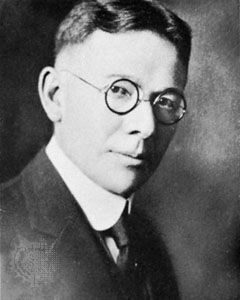
Lewis Terman
Lewis Terman was an American educational psychologist and academic. Born January 15, 1877, in Johnson County. Died December 21, 1956, in Palo Alto. Positions held include President of the American Psychological Association (1923). Known for Genetic Studies of Genius. Educated at Clark University and Indiana University. Awards include IEEE Richard M. Emberson Award and Honorary Fellow of the British Psychological Society.
Facts
26 facts · 2 confirmed by two sources · 5 cited · 19 from one source
Where this comes from
Papalocal keeps its own record. It started from these sources; what each one said is kept here as it was copied, so a change on their side never changes this page by itself. Tap one to read its version.
What Wikidata says · copied November 16, 2026 · revision 2569653227
- Described as
- American educational psychologist and academic (1877–1956)
- Other names
- Lewis Madison Terman
- Born
- January 15, 1877 · 8 references
- Died
- December 21, 1956 · 8 references
- Born in
- Johnson County
- Died in
- Palo Alto
- Buried in
- Alta Mesa Memorial Park · 1 reference
- Name at birth
- Lewis Madison Terman
- Citizen of
- United States
- Occupation
- psychologist · 1 reference; university teacher; writer · 1 reference
- Positions held
- President of the American Psychological Association (1923) · 1 reference
- Worked for
- Stanford Graduate School of Education; Stanford University
- Education
- Clark University; Indiana University; Canterbury College
- Member of
- American Psychological Association; American Academy of Arts and Sciences; National Academy of Sciences (1928–); American Philosophical Society (1953–)
- Known for
- Genetic Studies of Genius
- Awards
- IEEE Richard M. Emberson Award (2021) · 1 reference; Honorary Fellow of the British Psychological Society
- Field
- psychology · 1 reference
- Children
- Frederick Terman
- Lived in
- United States · 1 reference
- Wikipedias with a page
- 23
Wikidata item Q919108 (wikidata.org/wiki/Q919108), public domain (CC0). Copied November 16, 2026.
What Wikipedia says · copied November 16, 2026 · revision 1369226746
Lewis Madison Terman (January 15, 1877 – December 21, 1956) was an American psychologist, academic, and proponent of eugenics. He was noted as a pioneer in educational psychology in the early 20th century at the Stanford School of Education. Terman is best known for his revision of the Stanford–Binet Intelligence Scales and for initiating the longitudinal study of children with high IQs called the Genetic Studies of Genius. As a prominent eugenicist, he was a member of the Human Betterment Foundation, the American Eugenics Society, and the Eugenics Research Association, believing in genetic racial associations with intelligence. Terman also served as president of the American Psychological Association. A Review of General Psychology survey published in 2002 ranked Terman as the 72nd most cited psychologist of the 20th century, in a tie with G. Stanley Hall.
- Born, in its opening lines
- January 15, 1877
- Died, in its opening lines
- December 21, 1956
From the Wikipedia article “Lewis Terman” (en.wikipedia.org/wiki/Lewis_Terman), by its contributors, under CC BY-SA 4.0 (creativecommons.org/licenses/by-sa/4.0/). Copied November 16, 2026; not changed.
Confirmed Two sources agree. Cited One source, and it names where it got it. One source One source, without a reference of its own. Sources disagree The sources disagree. We show the best-supported value and keep theirs below.
