
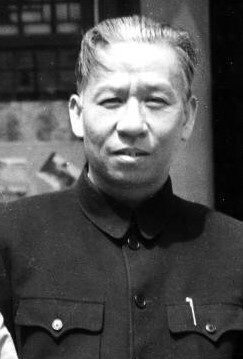
Liu Shaoqi
Liu Shaoqi was the 2nd President of the People's Republic of China. Born November 24, 1898, in Ningxiang City. Died November 12, 1969, in Kaifeng. Positions held include President of the People's Republic of China (1959–1968), Chairman of the Standing Committee of the National People's Congress (1954–1959) and National People's Congress deputy. Educated at Communist University of the Toilers of the East.
Facts
29 facts · 2 confirmed by two sources · 2 cited · 25 from one source
Where this comes from
Papalocal keeps its own record. It started from these sources; what each one said is kept here as it was copied, so a change on their side never changes this page by itself. Tap one to read its version.
What Wikidata says · copied November 16, 2026 · revision 2558128589
- Described as
- 2nd President of the People's Republic of China (1898–1969)
- Other names
- Shaoqi Liu
- Born
- November 24, 1898 · 5 references
- Died
- November 12, 1969 · 9 references
- Born in
- Ningxiang City
- Died in
- Kaifeng · 2 references
- Cause of death
- pneumonia
- Citizen of
- Qing dynasty (–1912); Republic of China (1912–1949); People's Republic of China (1949–); Chinese Soviet Republic
- Occupation
- politician · 1 reference; trade unionist
- Positions held
- President of the People's Republic of China (1959–1968); Chairman of the Standing Committee of the National People's Congress (1954–1959); National People's Congress deputy; member of the Politburo Standing Committee of the Chinese Communist Party (1956–1968)
- Political party
- Chinese Communist Party; independent politician (1968–) · 1 reference
- Education
- Communist University of the Toilers of the East
- Spouse
- Wang Guangmei (1948–1969); Xie Fei (1935–)
- Children
- Liu Yuan; Liu Yunbin; Liu Aiqin; Liu Pingping; Liu Tao; Liu Yunzhen; Liu Ting; Liu Xiaoxiao
- Military branch
- People’s Liberation Army · 1 reference
- Wikipedias with a page
- 62
Wikidata item Q16988 (wikidata.org/wiki/Q16988), public domain (CC0). Copied November 16, 2026.
What Wikipedia says · copied November 16, 2026 · revision 1384190800
Liu Shaoqi (Chinese: 刘少奇; pronounced [ljǒʊ ʂâʊtɕʰǐ]; 24 November 1898 – 12 November 1969) was a Chinese revolutionary and politician. He was the chairman of the Standing Committee of the National People's Congress from 1954 to 1959, first-ranking vice chairman of the Chinese Communist Party (CCP) from 1956 to 1966, and the chairman of the People's Republic of China (president of China) from 1959 to 1968. He was considered to be a possible successor to Chairman Mao Zedong, but was purged during the Cultural Revolution.
In his early years, Liu participated in the labor movement, including the May Thirtieth Movement. After the Chinese Civil War began in 1927, he was assigned by the CCP to work in Shanghai and Northeast China, and travelled to the Jiangxi Soviet in 1932. He participated in the Long March, and was appointed as the Party Secretary in North China in 1936 to lead anti-Japanese resistance efforts in the area. During the Second Sino-Japanese War, Liu led the CCP's Central Plains Bureau. After the New Fourth Army incident in 1941, Liu became a political commissar of the New Fourth Army. After Liu returned to Yan'an in 1943, he became a secretary of the CCP Secretariat and a vice chairman of the Central Military Commission.
After the proclamation of the People's Republic of China in 1949, Liu became a vice chairman of the Central People's Government. After the establishment of the National People's Congress in 1954, Liu was elected as the chairman of its Standing Committee. In 1959, he succeeded Mao Zedong as the chairman of the People's Republic of China. During his chairmanship, he implemented policies of economic reconstruction in China, especially after the Seven Thousand Cadres Conference in 1962. Liu was publicly named as Mao's chosen successor in 1961. However, he was criticized and then purged by Mao soon after the beginning of the Cultural Revolution in 1966, eventually being placed under house arrest in 1967. He was forced out of public life and was labelled the "commander of China's bourgeoisie headquarters", China's foremost "capitalist roader", and a traitor to the revolution. He died in prison in 1969 due to complications from diabetes. Liu was widely condemned in the years following his death until he was posthumously rehabilitated by Deng Xiaoping's government in 1980, as part of the Boluan Fanzheng period. Deng's government granted Liu a national memorial service.
- Born, in its opening lines
- November 24, 1898
- Died, in its opening lines
- November 12, 1969
From the Wikipedia article “Liu Shaoqi” (en.wikipedia.org/wiki/Liu_Shaoqi), by its contributors, under CC BY-SA 4.0 (creativecommons.org/licenses/by-sa/4.0/). Copied November 16, 2026; not changed.
Confirmed Two sources agree. Cited One source, and it names where it got it. One source One source, without a reference of its own. Sources disagree The sources disagree. We show the best-supported value and keep theirs below.
