
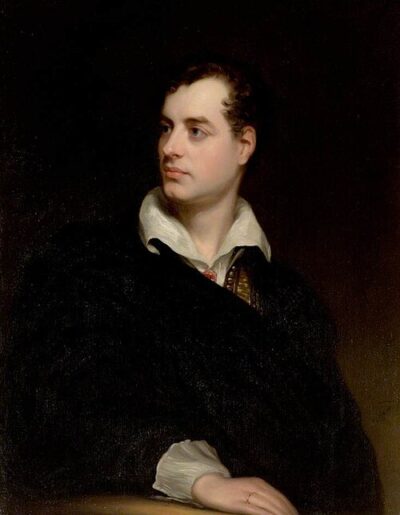
Lord Byron
Lord Byron was an English Romantic poet and lyricist. Born January 22, 1788, in City of Westminster. Died April 19, 1824, in Missolonghi. Positions held include member of the House of Lords. Known for Childe Harold's Pilgrimage, Don Juan and Manfred. Educated at Harrow School and Trinity College. Awards include Fellow of the Royal Society.
Facts
42 facts · 2 confirmed by two sources · 14 cited · 26 from one source
Where this comes from
Papalocal keeps its own record. It started from these sources; what each one said is kept here as it was copied, so a change on their side never changes this page by itself. Tap one to read its version.
What Wikidata says · copied November 16, 2026 · revision 2567629727
- Described as
- English Romantic poet and lyricist (1788–1824)
- Other names
- Noel Byron, George Gordon Byron, 6th Lord Byron, George Gordon Byron, 6th Baron Byron, George Gordon Byron, George Gordon Byron Lord
- Born
- January 22, 1788 · 6 references
- Died
- April 19, 1824 · 6 references
- Born in
- City of Westminster · 4 references
- Died in
- Missolonghi · 5 references
- Buried in
- Nottinghamshire
- Cause of death
- sepsis
- Name at birth
- George Gordon Byron · 1 reference
- Citizen of
- United Kingdom of Great Britain and Ireland (1801–); Kingdom of Great Britain (–1801)
- Occupation
- poet · 3 references; lyricist; politician · 1 reference; autobiographer; translator · 1 reference; diarist · 1 reference; writer · 5 references; librettist · 2 references
- Positions held
- member of the House of Lords
- Education
- Harrow School (1801–) · 1 reference; Trinity College · 1 reference; University of Cambridge; Aberdeen Grammar School
- Member of
- Royal Society of London (1816–); Royal Society of Literature
- Sport
- savate; competitive swimming
- Genre
- narrative poetry; Gothic literature
- Known for
- Childe Harold's Pilgrimage; Don Juan; Manfred
- Awards
- Fellow of the Royal Society
- Field
- performing arts
- Spouse
- Anne Isabella Byron (1815–1816) · 3 references; Claire Clairmont · 1 reference
- Children
- Ada Lovelace · 2 references; Elizabeth Medora Leigh; Allegra Byron · 2 references; William Marshall
- Father
- John Byron · 2 references
- Mother
- Catherine Gordon Byron · 2 references
- Siblings
- Augusta Leigh
- Wikipedias with a page
- 219
Wikidata item Q5679 (wikidata.org/wiki/Q5679), public domain (CC0). Copied November 16, 2026.
What Wikipedia says · copied November 16, 2026 · revision 1384917155
George Noel Gordon Byron, 6th Baron Byron (22 January 1788 – 19 April 1824), known as Lord Byron was a British poet. He was one of the major figures of the Romantic movement, and is regarded as being among the greatest British poets. Among his best known works are the lengthy narratives Don Juan and Childe Harold's Pilgrimage; many of his shorter lyrics in Hebrew Melodies also became popular.
Byron was educated at Trinity College at the University of Cambridge. Following graduation, he travelled extensively in Europe, living for seven years in Italy, in Venice, Ravenna, Pisa, and Genoa, as he was forced to flee England after receiving threats of lynching. During his stay in Italy, he would frequently visit his friend and fellow poet Percy Bysshe Shelley. Later in life, Byron joined the Greek War of Independence to fight the Ottoman Empire, for which Greeks revere him as a folk hero. He died leading a campaign in 1824, at the age of 36, from a fever contracted after the first and second sieges of Missolonghi.
- Born, in its opening lines
- January 22, 1788
- Died, in its opening lines
- April 19, 1824
From the Wikipedia article “Lord Byron” (en.wikipedia.org/wiki/Lord_Byron), by its contributors, under CC BY-SA 4.0 (creativecommons.org/licenses/by-sa/4.0/). Copied November 16, 2026; not changed.
Confirmed Two sources agree. Cited One source, and it names where it got it. One source One source, without a reference of its own. Sources disagree The sources disagree. We show the best-supported value and keep theirs below.
