
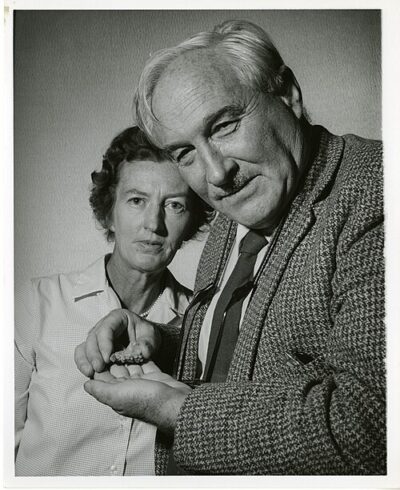
Louis Leakey
Louis Leakey was a kenyan-British archaeologist and naturalist. Born August 7, 1903, in Nairobi. Died October 1, 1972, in London. Educated at St John's College and Weymouth College. Awards include Vega Medal, Founder’s Medal and Prestwich Medal.
Facts
33 facts · 2 confirmed by two sources · 11 cited · 20 from one source
Where this comes from
Papalocal keeps its own record. It started from these sources; what each one said is kept here as it was copied, so a change on their side never changes this page by itself. Tap one to read its version.
What Wikidata says · copied November 16, 2026 · revision 2569207573
- Described as
- kenyan-British archaeologist and naturalist
- Other names
- Louis Seymour Bazett Leakey, L.S.B. Leakey, L. S. B. Leakey
- Born
- August 7, 1903 · 9 references
- Died
- October 1, 1972 · 7 references
- Born in
- Nairobi
- Died in
- London · 1 reference
- Cause of death
- myocardial infarction
- Name at birth
- Louis Seymour Bazett Leakey
- Citizen of
- Kenya
- Occupation
- anthropologist · 1 reference; archaeologist; prehistorian; autobiographer; paleoanthropologist; paleontologist · 1 reference; curator
- Worked for
- University of Cambridge; Coryndon Museum
- Education
- St John's College; Weymouth College
- Awards
- Vega Medal (1963); Founder’s Medal (1964) · 1 reference; Prestwich Medal (1969); Hubbard Medal (1962); Silliman Memorial Lectures (1963)
- Field
- archaeology
- Spouse
- Mary Leakey (1936–1996) · 1 reference; Henrietta Leakey (1928–) · 2 references
- Children
- Richard Leakey · 1 reference; Philip Leakey · 1 reference; Jonathan Leakey · 1 reference; Priscilla Muthoni Avern Leakey · 1 reference; Colin L. A. Leakey · 1 reference
- Father
- Harry Leakey · 1 reference
- Mother
- Mary Bazett · 1 reference
- Wikipedias with a page
- 53
Wikidata item Q14837 (wikidata.org/wiki/Q14837), public domain (CC0). Copied November 16, 2026.
What Wikipedia says · copied November 16, 2026 · revision 1379622526
Louis Seymour Bazett Leakey (7 August 1903 – 1 October 1972) was a Kenyan-British palaeoanthropologist and archaeologist whose work was important in demonstrating that humans evolved in Africa, particularly through discoveries made at Olduvai Gorge with his wife, fellow palaeoanthropologist Mary Leakey. Having established a programme of palaeoanthropological inquiry in eastern Africa, he also motivated many future generations to continue this scholarly work. Several members of the Leakey family became prominent scholars themselves.
Another of Leakey's legacies stems from his role in fostering field research of primates in their natural habitats, which he saw as key to understanding human evolution. He personally focused on three female researchers, Jane Goodall, Dian Fossey, and Birutė Galdikas, calling them "The Trimates." Each went on to become an important scholar in the field of primatology. Leakey also encouraged and supported many other PhD candidates, most notably from the University of Cambridge. As well, Leakey played a role in creating organisations for future research in Africa and for protecting wildlife there.
- Born, in its opening lines
- August 7, 1903
- Died, in its opening lines
- October 1, 1972
From the Wikipedia article “Louis Leakey” (en.wikipedia.org/wiki/Louis_Leakey), by its contributors, under CC BY-SA 4.0 (creativecommons.org/licenses/by-sa/4.0/). Copied November 16, 2026; not changed.
Confirmed Two sources agree. Cited One source, and it names where it got it. One source One source, without a reference of its own. Sources disagree The sources disagree. We show the best-supported value and keep theirs below.
