
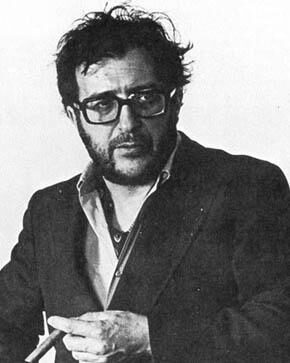
Luciano Berio
Luciano Berio was an Italian composer. Born October 24, 1925, in Oneglia. Died May 27, 2003, in Rome. Known for Sequenza and Sinfonia. Educated at Milan Conservatory. Awards include Guggenheim Fellowship, Praemium Imperiale and Ernst von Siemens Music Prize.
Facts
39 facts · 2 confirmed by two sources · 9 cited · 28 from one source
Where this comes from
Papalocal keeps its own record. It started from these sources; what each one said is kept here as it was copied, so a change on their side never changes this page by itself. Tap one to read its version.
What Wikidata says · copied November 16, 2026 · revision 2567481962
- Described as
- Italian composer (1925–2003)
- Born
- October 24, 1925 · 13 references
- Died
- May 27, 2003 · 11 references
- Born in
- Oneglia · 1 reference
- Died in
- Rome · 2 references
- Citizen of
- Italy (1946–); Kingdom of Italy (–1946)
- Occupation
- classical composer; conductor · 1 reference; pedagogue; music educator; university teacher; pianist; musician · 2 references; composer · 2 references
- Worked for
- Harvard University; Accademia Nazionale di Santa Cecilia; Juilliard School · 1 reference
- Education
- Milan Conservatory
- Member of
- European Academy of Sciences and Arts; American Academy of Arts and Sciences
- Genre
- opera
- Instrument
- piano
- Record label
- Deutsche Grammophon
- Known for
- Sequenza; Sinfonia
- Awards
- Guggenheim Fellowship (1968) · 1 reference; Praemium Imperiale (1996) · 1 reference; Ernst von Siemens Music Prize (1989) · 1 reference; Knight Grand Cross of the Order of Merit of the Italian Republic (1994) · 1 reference; Fellow of the American Academy of Arts and Sciences; Feltrinelli Prize · 1 reference; Wolf Prize in Arts (1991); Gold Medal of the Italian Order of Merit for Culture and Art; Royal Philharmonic Society Award (Chamber-Scale Composition) (1995) · 1 reference; Order of Merit of the Italian Republic · 1 reference; Italian Order of Merit for Culture and Art · 1 reference
- Spouse
- Cathy Berberian · 1 reference
- Religion
- atheism
- Website
- http://www.lucianoberio.org
- Wikipedias with a page
- 47
Wikidata item Q221450 (wikidata.org/wiki/Q221450), public domain (CC0). Copied November 16, 2026.
What Wikipedia says · copied November 16, 2026 · revision 1377339173
Luciano Berio (24 October 1925 – 27 May 2003) was an Italian composer noted for his experimental work (in particular Sequenza, his series of solo pieces using extended techniques, and his 1968 orchestral composition Sinfonia) and for his pioneering work in electronic music. His early work was influenced by Igor Stravinsky and experiments with serial and electronic techniques, while his later works explore indeterminacy and the use of spoken texts as the basic material for composition.
- Born, in its opening lines
- October 24, 1925
- Died, in its opening lines
- May 27, 2003
From the Wikipedia article “Luciano Berio” (en.wikipedia.org/wiki/Luciano_Berio), by its contributors, under CC BY-SA 4.0 (creativecommons.org/licenses/by-sa/4.0/). Copied November 16, 2026; not changed.
Confirmed Two sources agree. Cited One source, and it names where it got it. One source One source, without a reference of its own. Sources disagree The sources disagree. We show the best-supported value and keep theirs below.
