
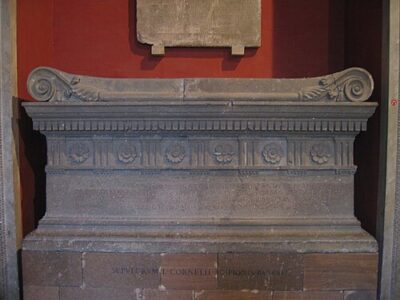
Lucius Cornelius Scipio Barbatus
Lucius Cornelius Scipio Barbatus was a Roman consul in 298 BCE. Born 4th century BC, in Ancient Rome. Died 3rd century BC, in Rome. Positions held include ancient Roman senator, curule aedile and Roman consul (-298).
Facts
18 facts · 0 confirmed by two sources · 6 cited · 12 from one source
Where this comes from
Papalocal keeps its own record. It started from these sources; what each one said is kept here as it was copied, so a change on their side never changes this page by itself. Tap one to read its version.
What Wikidata says · copied November 18, 2026 · revision 2494809894
- Described as
- Roman consul in 298 BCE
- Other names
- Lucius Cornelius Cn.f. Scipio Barbatus
- Born
- 4th century BC
- Died
- 3rd century BC
- Born in
- Ancient Rome
- Died in
- Rome
- Buried in
- Tomb of the Scipios
- Citizen of
- Ancient Rome
- Occupation
- Roman magistrate; military personnel; consul · 1 reference
- Positions held
- ancient Roman senator · 1 reference; curule aedile; Roman consul (-298) · 1 reference; legatus (2 times) (-297–-295); Propraetor (-295); Roman censor (-280)
- Children
- Gnaeus Cornelius Scipio Asina · 2 references; Lucius Cornelius Scipio · 2 references
- Father
- Gnaeus Cornelius Scipio · 1 reference
- Wikipedias with a page
- 23
Wikidata item Q374630 (wikidata.org/wiki/Q374630), public domain (CC0). Copied November 18, 2026.
What Wikipedia says · copied November 18, 2026 · revision 1338338360
Lucius Cornelius Scipio Barbatus (c. 337 BC – 270 BC) was one of the two elected Roman consuls in 298 BC. He led the Roman army to victory against the Etruscans near Volterra. A member of the noble Roman family of Scipiones, he was the father of Lucius Cornelius Scipio and Gnaeus Cornelius Scipio Asina and great-grandfather of Scipio Africanus.
From the Wikipedia article “Lucius Cornelius Scipio Barbatus” (en.wikipedia.org/wiki/Lucius_Cornelius_Scipio_Barbatus), by its contributors, under CC BY-SA 4.0 (creativecommons.org/licenses/by-sa/4.0/). Copied November 18, 2026; not changed.
Confirmed Two sources agree. Cited One source, and it names where it got it. One source One source, without a reference of its own. Sources disagree The sources disagree. We show the best-supported value and keep theirs below.
