
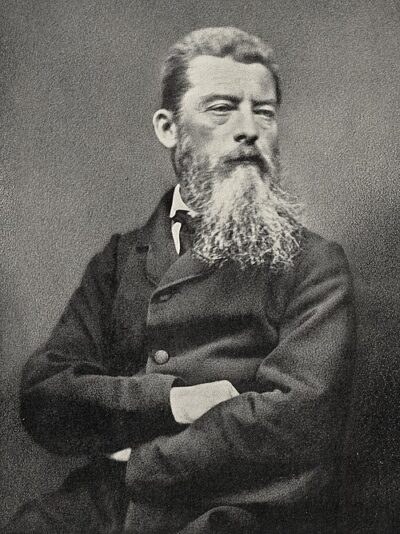
Ludwig Feuerbach
Ludwig Feuerbach was a German philosopher and anthropologist. Born July 28, 1804, in Landshut. Died September 13, 1872, in Rechenberg. Known for Thoughts on Death and Immortality and The Essence of Christianity. Educated at Heidelberg University and Humboldt-Universität zu Berlin.
Facts
37 facts · 2 confirmed by two sources · 15 cited · 20 from one source
Where this comes from
Papalocal keeps its own record. It started from these sources; what each one said is kept here as it was copied, so a change on their side never changes this page by itself. Tap one to read its version.
What Wikidata says · copied November 16, 2026 · revision 2567477860
- Described as
- German philosopher and anthropologist (1804–1872)
- Other names
- Ludwig Andreas von Feuerbach, Ludwig Andreas Feuerbach
- Born
- July 28, 1804 · 12 references
- Died
- September 13, 1872 · 12 references
- Born in
- Landshut · 3 references
- Died in
- Rechenberg · 1 reference
- Buried in
- Johannisfriedhof (Nürnberg)
- Name at birth
- Ludwig Andreas Feuerbach · 1 reference
- Citizen of
- Kingdom of Bavaria
- Occupation
- anthropologist; philosopher · 3 references; university teacher · 1 reference; writer · 3 references; theologian · 2 references; critic of religions · 1 reference; beekeeper · 1 reference
- Worked for
- University of Erlangen (1829–)
- Education
- Heidelberg University (1823–1824) · 1 reference; Humboldt-Universität zu Berlin (1824–1826) · 1 reference; University of Erlangen (1826–1828) · 1 reference; University of Erlangen–Nuremberg
- Known for
- Thoughts on Death and Immortality · 1 reference; The Essence of Christianity · 2 references
- Field
- Young Hegelians; philosophy of religion · 1 reference; ethics · 1 reference; epistemology · 1 reference; philosophical anthropology · 1 reference; philosophy · 1 reference
- Spouse
- Bertha Löw
- Father
- Paul Johann Anselm Ritter von Feuerbach · 2 references
- Siblings
- Joseph Anselm Feuerbach · 1 reference; Karl Wilhelm Feuerbach · 1 reference; Friedrich Feuerbach · 1 reference; Eduard August Feuerbach · 2 references
- Religion
- atheism (1823) · 1 reference
- Lived in
- Bruckberg (1836–1859) · 1 reference; Rechenberg (1859–1872) · 1 reference
- Website
- https://ludwig-feuerbach.de/ · 1 reference
- Wikipedias with a page
- 110
Wikidata item Q76422 (wikidata.org/wiki/Q76422), public domain (CC0). Copied November 16, 2026.
What Wikipedia says · copied November 16, 2026 · revision 1384161300
Ludwig Andreas Feuerbach ( FOIR-bahkh; German: [ˈluːtvɪç ˈfɔʏɐbax]; 28 July 1804 – 13 September 1872) was a German philosopher and anthropologist who was a leading figure among the Young Hegelians. He is best known for his 1841 book The Essence of Christianity, which argued that God is a projection of the essential attributes of humanity. His critique of religion formed the basis for his advocacy of atheism, materialism, and sensualism. His thought served as a critical bridge between the philosophy of Georg Wilhelm Friedrich Hegel and that of Karl Marx.
The son of a distinguished jurist, Feuerbach studied theology at Heidelberg before moving to Berlin to study directly under Hegel. His academic career was cut short in 1830 when his anonymously published first book, Thoughts on Death and Immortality, was condemned as scandalous for its attack on the concept of personal immortality. Barred from university posts, Feuerbach lived and worked in rural isolation for much of his life, in which he produced most of his significant writings supported by his wife's share in a porcelain factory.
Feuerbach's philosophy developed as a critique of Hegel's speculative idealism, which he viewed as the last, most abstract form of theology. He argued that idealism inverted the true relationship between thought and being, and that philosophy's proper subject was not the abstract Absolute, but the concrete, sensuous human being. In The Essence of Christianity, he contended that religion is a form of self-alienation in which humanity projects its own "species-essence"—its unlimited capacity for reason, love, and will—onto a divine being, which it then worships. In his later works, including the Lectures on the Essence of Religion, he developed a "bipolar" theory of religion in which religious belief arises from the human confrontation with nature, driven by the "drive to happiness" and the fear of death.
Feuerbach's thought was a major influence on his contemporaries, particularly Marx and Friedrich Engels. Marx adopted Feuerbach's materialist inversion of Hegel and his theory of alienation, but later criticized him in his Theses on Feuerbach for having a materialism that was too contemplative and for understanding humanity in terms of a static "essence" rather than in terms of concrete social and historical practice (praxis). Feuerbach's work also exerted an influence on the thought of Friedrich Nietzsche and Sigmund Freud.
- Born, in its opening lines
- July 28, 1804
- Died, in its opening lines
- September 13, 1872
From the Wikipedia article “Ludwig Feuerbach” (en.wikipedia.org/wiki/Ludwig_Feuerbach), by its contributors, under CC BY-SA 4.0 (creativecommons.org/licenses/by-sa/4.0/). Copied November 16, 2026; not changed.
Confirmed Two sources agree. Cited One source, and it names where it got it. One source One source, without a reference of its own. Sources disagree The sources disagree. We show the best-supported value and keep theirs below.
