
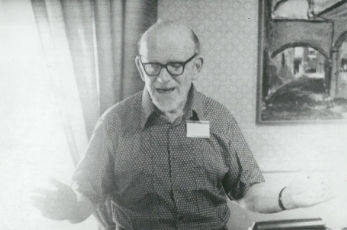
Ludwig Lachmann
Ludwig Lachmann was a German economist. Born February 1, 1906, in Berlin. Died December 17, 1990, in Johannesburg. Educated at London School of Economics and Political Science and Humboldt-Universität zu Berlin.
Facts
10 facts · 2 confirmed by two sources · 1 cited · 7 from one source
Where this comes from
Papalocal keeps its own record. It started from these sources; what each one said is kept here as it was copied, so a change on their side never changes this page by itself. Tap one to read its version.
What Wikidata says · copied November 18, 2026 · revision 2568988392
- Described as
- German economist (1906–1990)
- Other names
- Ludwig Maurits Lachmann
- Born
- February 1, 1906 · 1 reference
- Died
- December 17, 1990
- Born in
- Berlin
- Died in
- Johannesburg
- Citizen of
- Germany
- Occupation
- economist · 1 reference
- Worked for
- University of the Witwatersrand
- Education
- London School of Economics and Political Science; Humboldt-Universität zu Berlin · 1 reference
- Field
- economics
- Wikipedias with a page
- 20
Wikidata item Q61265 (wikidata.org/wiki/Q61265), public domain (CC0). Copied November 18, 2026.
What Wikipedia says · copied November 18, 2026 · revision 1380506972
Ludwig Maurits Lachmann (; German: [ˈlaxman]; 1 February 1906 – 17 December 1990) was a German economist, economic theorist and important contributor to the Austrian School of Economics. Lachmann, Israel Kirzner, and Murray Rothbard were the three primary catalysts of the Austrian 'revival', beginning in 1974. He wrote on economic theory, history, and methodology, as well as on the application of Hermeneutics to economic thought, in order to interpret economic phenomena.
- Born, in its opening lines
- February 1, 1906
- Died, in its opening lines
- December 17, 1990
From the Wikipedia article “Ludwig Lachmann” (en.wikipedia.org/wiki/Ludwig_Lachmann), by its contributors, under CC BY-SA 4.0 (creativecommons.org/licenses/by-sa/4.0/). Copied November 18, 2026; not changed.
Confirmed Two sources agree. Cited One source, and it names where it got it. One source One source, without a reference of its own. Sources disagree The sources disagree. We show the best-supported value and keep theirs below.
