
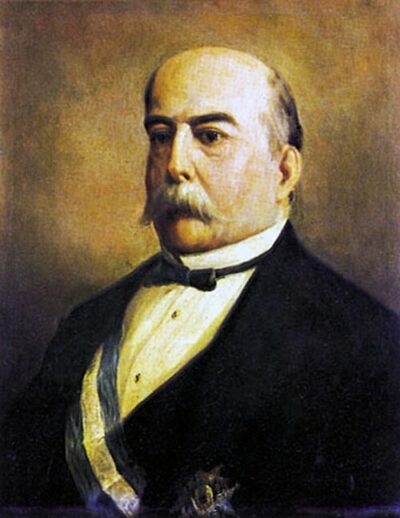
Luis González Bravo
Luis González Bravo was a Spanish journalist and politician. Born July 8, 1811, in Cádiz. Died September 1, 1871, in Biarritz. Positions held include member of the Cortes during the reign of Isabel II (4 times) (1841–1868), ambassador of Spain to the Kingdom of Portugal (2 times) (1844–1856) and ambassador of Spain to the United Kingdom of Great Britain and Ireland (1857–1858). Educated at University of Alcalá. Awards include Knight of the Order of the Golden Fleece and Knight of the Order of Carlos III.
Facts
25 facts · 2 confirmed by two sources · 14 cited · 9 from one source
Where this comes from
Papalocal keeps its own record. It started from these sources; what each one said is kept here as it was copied, so a change on their side never changes this page by itself. Tap one to read its version.
What Wikidata says · copied November 18, 2026 · revision 2562753354
- Described as
- Spanish journalist and politician (1811-1871)
- Other names
- Luis Gonzalez-Bravo y Lopez de Arjona, Luis González Brabo y López de Arjona, Luis González Bravo y López de Arjona
- Born
- July 8, 1811 · 2 references
- Died
- September 1, 1871 · 2 references
- Born in
- Cádiz · 1 reference
- Died in
- Biarritz · 1 reference
- Citizen of
- Spain
- Occupation
- journalist · 1 reference; diplomat; lawyer · 1 reference; politician · 1 reference; head of government · 1 reference
- Positions held
- member of the Cortes during the reign of Isabel II (4 times) (1841–1868) · 1 reference; ambassador of Spain to the Kingdom of Portugal (2 times) (1844–1856) · 1 reference; ambassador of Spain to the United Kingdom of Great Britain and Ireland (1857–1858) · 2 references; President of the Council of Ministers (2 times) (1843–1868) · 1 reference; ministro de Gobernación (1864–1868) · 2 references; Minister of State of Spain (1843–1844) · 2 references; Member of the Royal Spanish Academy (1863–1871) · 1 reference; Academic of the Royal Academy of Moral and Political Sciences (1857–1871) · 1 reference
- Political party
- Progressive Party
- Education
- University of Alcalá
- Member of
- Royal Spanish Academy; Royal Academy of Moral and Political Sciences · 1 reference; Comissió General de Codificació · 1 reference
- Awards
- Knight of the Order of the Golden Fleece (1867) · 1 reference; Knight of the Order of Carlos III (1844)
- Wikipedias with a page
- 20
Wikidata item Q940626 (wikidata.org/wiki/Q940626), public domain (CC0). Copied November 18, 2026.
What Wikipedia says · copied November 18, 2026 · revision 1378176364
Luis González Bravo y López de Arjona (8 July 1811 – 1 September 1871) was a Spanish politician, diplomat, intellectual, speaker, author, arts mentor, arts promoter and journalist. He graduated from law school and served twice as prime minister of Spain (president of the Council of Ministers), in 1843–1844 and in 1868. During his first term, his government officially recognized Chile as an independent state.
He held other important offices, such as once serving as minister of State and twice as minister of Home Affairs. He was appointed ambassador of Spain to the United Kingdom in Queen Victoria's rule, and ambassador of Spain to Portugal. He was a member of the Moderate Party, and occupied three times the post of Spanish Congressman for Cádiz, Madrid, Jaén, Málaga and the Canary Islands. He was acting minister of Justice for five days. He was head of the Spanish civil troops "Milicia Nacional". He was Knight of the Order of the Golden Fleece and Knight of the Order of Charles III (of King Charles III of Spain, Carlos III). He founded four newspapers in Spain, and was the noted Spanish poet Gustavo Adolfo Bécquer's benefactor and patron.
- Born, in its opening lines
- July 8, 1811
- Died, in its opening lines
- September 1, 1871
From the Wikipedia article “Luis González Bravo” (en.wikipedia.org/wiki/Luis_González_Bravo), by its contributors, under CC BY-SA 4.0 (creativecommons.org/licenses/by-sa/4.0/). Copied November 18, 2026; not changed.
Confirmed Two sources agree. Cited One source, and it names where it got it. One source One source, without a reference of its own. Sources disagree The sources disagree. We show the best-supported value and keep theirs below.
