
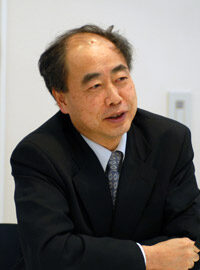
Makoto Kobayashi
Makoto Kobayashi is a Japanese theoretical physicist. Born April 7, 1944, in Nagoya. Educated at Nagoya University. Awards include Order of Culture, Nobel Prize in Physics and High Energy and Particle Physics Prize.
Facts
19 facts · 1 confirmed by two sources · 9 cited · 9 from one source
Where this comes from
Papalocal keeps its own record. It started from these sources; what each one said is kept here as it was copied, so a change on their side never changes this page by itself. Tap one to read its version.
What Wikidata says · copied November 16, 2026 · revision 2567594819
- Described as
- Japanese theoretical physicist (1944–)
- Born
- April 7, 1944 · 3 references
- Born in
- Nagoya · 1 reference
- Citizen of
- Japan
- Occupation
- theoretical physicist; physicist · 1 reference
- Worked for
- Nagoya University; Kyoto University · 1 reference; High Energy Accelerator Research Organization
- Education
- Nagoya University
- Member of
- Japan Academy (2010–) · 1 reference
- Awards
- Order of Culture (2008); Nobel Prize in Physics (2008) · 2 references; High Energy and Particle Physics Prize (2007) · 1 reference; Person of Cultural Merit (2001); Asahi Prize (1994) · 1 reference; Sakurai Prize (1985) · 2 references; honorary doctor of the Shanghai Jiao Tong University (2011) · 1 reference; Nishina Memorial Prize (1979) · 1 reference
- Field
- particle physics
- Wikipedias with a page
- 67
Wikidata item Q202164 (wikidata.org/wiki/Q202164), public domain (CC0). Copied November 16, 2026.
What Wikipedia says · copied November 16, 2026 · revision 1372437415
Makoto Kobayashi (小林 誠, Kobayashi Makoto; born April 7, 1944) is a Japanese physicist known for his work on CP-violation who was awarded one-fourth of the 2008 Nobel Prize in Physics "for the discovery of the origin of the broken symmetry which predicts the existence of at least three families of quarks in nature."
- Born, in its opening lines
- April 7, 1944
From the Wikipedia article “Makoto Kobayashi” (en.wikipedia.org/wiki/Makoto_Kobayashi), by its contributors, under CC BY-SA 4.0 (creativecommons.org/licenses/by-sa/4.0/). Copied November 16, 2026; not changed.
Confirmed Two sources agree. Cited One source, and it names where it got it. One source One source, without a reference of its own. Sources disagree The sources disagree. We show the best-supported value and keep theirs below.
