
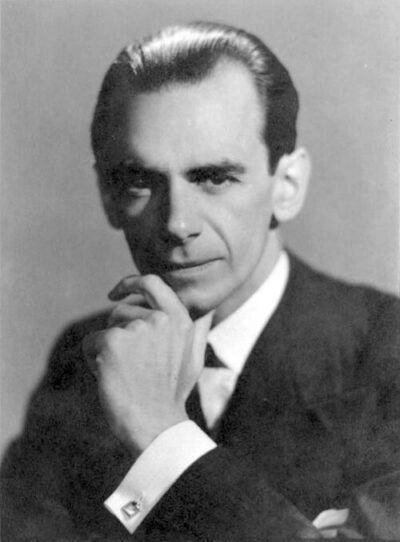
Malcolm Sargent
Malcolm Sargent was an English conductor, organist and composer. Born April 29, 1895, in Ashford. Died October 3, 1967, in London. Educated at Durham University and Stamford School. Awards include Knight of the Legion of Honour, Royal Order of the Polar Star and Order of the White Rose of Finland.
Facts
27 facts · 2 confirmed by two sources · 4 cited · 21 from one source
Where this comes from
Papalocal keeps its own record. It started from these sources; what each one said is kept here as it was copied, so a change on their side never changes this page by itself. Tap one to read its version.
What Wikidata says · copied November 18, 2026 · revision 2558145086
- Described as
- English conductor, organist and composer (1895-1967)
- Other names
- Sir Malcolm Sargent, Sir Harold Malcolm Watts Sargent, Harold Malcolm Watts Sargent
- Born
- April 29, 1895 · 10 references
- Died
- October 3, 1967 · 10 references
- Born in
- Ashford
- Died in
- London · 1 reference
- Buried in
- Stamford
- Cause of death
- pancreatic cancer
- Name at birth
- Harold Malcolm Watts Sargent
- Citizen of
- United Kingdom
- Occupation
- conductor · 1 reference; choir director; music educator; organist; music arranger · 1 reference; musician · 1 reference
- Worked for
- University of London
- Education
- Durham University; Stamford School
- Instrument
- organ
- Record label
- His Master's Voice; Decca
- Awards
- Knight of the Legion of Honour (1967); Royal Order of the Polar Star; Order of the White Rose of Finland; Royal Philharmonic Society Gold Medal (1959); Knight Bachelor
- Spouse
- Eileen Laura Harding Horne (1923–1967) · 1 reference
- Military branch
- British Army
- Wikipedias with a page
- 22
Wikidata item Q731292 (wikidata.org/wiki/Q731292), public domain (CC0). Copied November 18, 2026.
What Wikipedia says · copied November 18, 2026 · revision 1371057649
Sir Harold Malcolm Watts Sargent (29 April 1895 – 3 October 1967) was an English conductor, organist and composer widely regarded as Britain's leading conductor of choral works. The musical ensembles with which he was associated included the Ballets Russes, the Huddersfield Choral Society, the Royal Choral Society, the D'Oyly Carte Opera Company, and the London Philharmonic, Hallé, Liverpool Philharmonic, BBC Symphony and Royal Philharmonic orchestras. Sargent was held in high esteem by choirs and instrumental soloists, but because of his high standards and a statement that he made in a 1936 interview disputing musicians' rights to tenure, his relationship with orchestral players was often uneasy. Despite this, he was co-founder of the London Philharmonic, was the first conductor of the Liverpool Philharmonic as a full-time ensemble, and played an important part in saving the Royal Philharmonic Orchestra from disbandment in the 1960s.
As chief conductor of London's internationally famous summer music festival the Henry Wood Promenade Concerts ("the Proms") from 1947 to 1967, Sargent was one of the best-known English conductors. When he took over the Proms, he and two assistants conducted the two-month season between them. By the time he died, he was assisted by a large international roster of guest conductors.
At the outbreak of the Second World War, Sargent turned down an offer of a musical directorship in Australia and returned to Britain to bring music to as many people as possible as his contribution to national morale. His fame extended beyond the concert hall: to the British public, he was a familiar broadcaster in BBC radio discussion programmes, and generations of Gilbert and Sullivan devotees have known his recordings of the most popular Savoy Operas. He toured widely throughout the world and was noted for his skill as a conductor, his championship of British composers, and his debonair appearance, which won him the nickname "Flash Harry".
- Born, in its opening lines
- April 29, 1895
- Died, in its opening lines
- October 3, 1967
From the Wikipedia article “Malcolm Sargent” (en.wikipedia.org/wiki/Malcolm_Sargent), by its contributors, under CC BY-SA 4.0 (creativecommons.org/licenses/by-sa/4.0/). Copied November 18, 2026; not changed.
Confirmed Two sources agree. Cited One source, and it names where it got it. One source One source, without a reference of its own. Sources disagree The sources disagree. We show the best-supported value and keep theirs below.
