
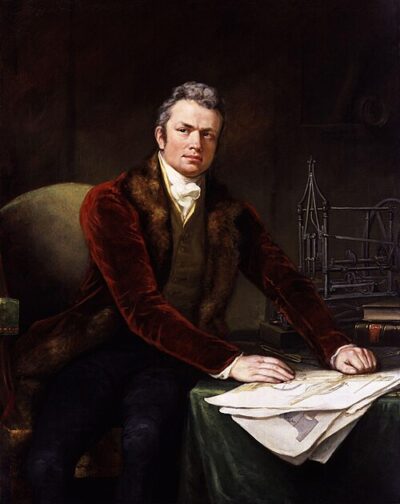
Marc Isambard Brunel
Marc Isambard Brunel was a French engineer. Born April 25, 1769, in Hacqueville. Died December 12, 1849, in London. Known for Thames Tunnel. Awards include Fellow of the Royal Society, Fellow of the Royal Society of Edinburgh and Knight Bachelor.
Facts
27 facts · 2 confirmed by two sources · 17 cited · 8 from one source
Where this comes from
Papalocal keeps its own record. It started from these sources; what each one said is kept here as it was copied, so a change on their side never changes this page by itself. Tap one to read its version.
What Wikidata says · copied November 16, 2026 · revision 2562464579
- Described as
- French engineer (1769-1849)
- Other names
- Marc Isambard, Sir Brunel, Sir Marc Isambard Brunel, M. J. Brunel, Sir Isambard Brunel
- Born
- April 25, 1769 · 14 references
- Died
- December 12, 1849 · 9 references
- Born in
- Hacqueville · 2 references
- Died in
- London · 8 references
- Buried in
- Kensal Green Cemetery · 2 references
- Citizen of
- France; United Kingdom of Great Britain and Ireland; Kingdom of Great Britain (–1801)
- Occupation
- engineer · 1 reference; civil engineer; architect · 2 references
- Member of
- Royal Society of London (1814–) · 1 reference; Royal Swedish Academy of Sciences (1828–); American Academy of Arts and Sciences (1834–) · 2 references; Royal Society of Edinburgh (1845–) · 1 reference
- Known for
- Thames Tunnel
- Awards
- Fellow of the Royal Society · 1 reference; Fellow of the Royal Society of Edinburgh (1845) · 1 reference; Knight Bachelor; Knight of the Legion of Honour (1828) · 1 reference
- Spouse
- Sophia Kingdom · 1 reference
- Children
- Isambard Kingdom Brunel · 1 reference; Emma Joan Brunel · 2 references; Sophia Macnamara Brunel · 2 references
- Father
- Jean Charles Brunel · 1 reference
- Mother
- Marie Victorie Lefebvre · 1 reference
- Military branch
- French Navy · 1 reference
- Wikipedias with a page
- 29
Wikidata item Q445306 (wikidata.org/wiki/Q445306), public domain (CC0). Copied November 16, 2026.
What Wikipedia says · copied November 16, 2026 · revision 1363654532
Sir Marc Isambard Brunel (, French: [maʁk izɑ̃baʁ bʁynɛl]; 25 April 1769 – 12 December 1849) was a French-British engineer who is most famous for the work he did in Britain. He constructed the Thames Tunnel, the world's first underwater tunnel, and was the father of Isambard Kingdom Brunel.
Born in France, Brunel fled to the United States during the French Revolution. In 1796, he was appointed Chief Engineer of New York City. He moved to London in 1799, where he married Sophia Kingdom. In addition to the construction of the Thames Tunnel, his work as a mechanical engineer included the design of machinery to automate the production of pulley blocks for the Royal Navy.
Brunel preferred the given name Isambard, but is generally known to history as Marc to avoid confusion with his more famous son. In 1841, Marc was knighted by the young Queen Victoria in anticipation of his successful completion of the Thames Tunnel.
- Born, in its opening lines
- April 25, 1769
- Died, in its opening lines
- December 12, 1849
From the Wikipedia article “Marc Isambard Brunel” (en.wikipedia.org/wiki/Marc_Isambard_Brunel), by its contributors, under CC BY-SA 4.0 (creativecommons.org/licenses/by-sa/4.0/). Copied November 16, 2026; not changed.
Confirmed Two sources agree. Cited One source, and it names where it got it. One source One source, without a reference of its own. Sources disagree The sources disagree. We show the best-supported value and keep theirs below.
