
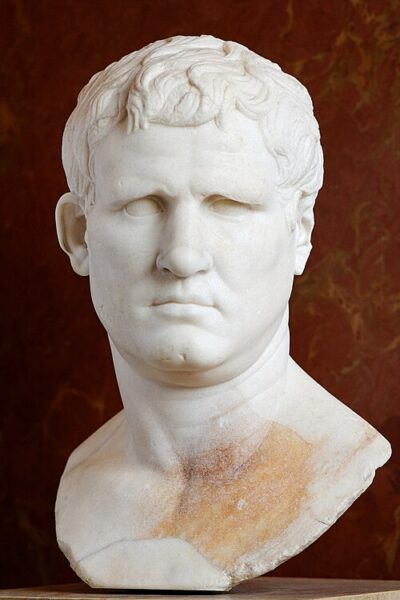
Marcus Vipsanius Agrippa
Marcus Vipsanius Agrippa was an ancient Roman statesman and general. Born 63 BC, in Istria. Died 12 BC, in Campania. Positions held include Roman governor, ancient Roman senator and Roman consul (-37). Known for founding of Caesaraugusta.
Facts
33 facts · 0 confirmed by two sources · 22 cited · 11 from one source
Where this comes from
Papalocal keeps its own record. It started from these sources; what each one said is kept here as it was copied, so a change on their side never changes this page by itself. Tap one to read its version.
What Wikidata says · copied November 16, 2026 · revision 2565087116
- Described as
- ancient Roman statesman and general
- Other names
- M. Vipsanius Agrippa, Marcus Agrippa, Agrippa
- Born
- 63 BC · 4 references
- Died
- 12 BC · 5 references
- Born in
- Istria
- Died in
- Campania
- Buried in
- Mausoleum of Augustus
- Citizen of
- Ancient Rome
- Occupation
- architect; writer · 1 reference; politician · 1 reference; military personnel; military leader · 1 reference
- Positions held
- Roman governor; ancient Roman senator · 1 reference; Roman consul (-37) · 1 reference; moneyer (-38) · 1 reference; legatus Augusti pro praetore Syriae (-23–-13)
- Known for
- founding of Caesaraugusta
- Spouse
- Attica · 2 references; Claudia Marcella Major (-28–-21) · 4 references; Julia the Elder (-21–-12) · 5 references
- Children
- Vipsania Agrippina · 1 reference; Vipsania Attica · 1 reference; Vipsania Marcella Major · 1 reference; Vipsania Marcella Minor · 1 reference; Gaius Caesar · 1 reference; Julia the Younger · 1 reference; Lucius Caesar · 1 reference; Agrippina the Elder · 1 reference; Agrippa Postumus · 2 references
- Father
- Lucius Vipsanius Major · 2 references
- Mother
- Ignota
- Siblings
- Vipsania Polla · 2 references; Lucius Vipsanius Minor · 2 references
- Wikipedias with a page
- 68
Wikidata item Q48174 (wikidata.org/wiki/Q48174), public domain (CC0). Copied November 16, 2026.
What Wikipedia says · copied November 16, 2026 · revision 1378370443
Marcus Vipsanius Agrippa (; c. 63 BC – 12 BC) was a Roman general and statesman who was a close friend, son-in-law and lieutenant to the Roman emperor Augustus. Agrippa is well known for his important military victories, notably the Battle of Actium in 31 BC against the forces of Marcus Antonius and Cleopatra. He was also responsible for the construction of some of the most notable buildings of his era, including the original Pantheon.
Born to a plebeian family c. 63 BC, in an uncertain location in Roman Italy, he met the future emperor Augustus, then known as Octavian, at Apollonia, in Illyria. Following the assassination of Octavian's great-uncle Julius Caesar in 44 BC, Octavian returned to Italy. Around this time, Agrippa was elected tribune of the plebs. He served as a military commander, fighting alongside Octavian and Caesar's former general and right-hand man Marcus Antonius in the Battle of Philippi. In 40 BC, he was praetor urbanus and played a major role in the Perusine war against Lucius Antonius and Fulvia, respectively the brother and wife of Marcus Antonius. In 39 or 38 BC, Agrippa was appointed governor of Transalpine Gaul. In 38 BC, he put down a rising of the Aquitanians and fought the Germanic tribes. He was made consul for 37 BC, despite being well below the usual minimum age of 43, in order to oversee the preparations for war against Sextus Pompeius (Pompey), who had cut off grain shipments to Rome.
Agrippa defeated Pompey in the battles of Mylae and Naulochus in 36 BC. In 33 BC, he served as curule aedile. Agrippa commanded the victorious Octavian's fleet at the Battle of Actium in 31 BC. A few years after the victory at Actium, Octavian became emperor and took the title of Princeps, while Agrippa remained as his close friend and lieutenant. Agrippa assisted Augustus in making Rome "a city of marble". Agrippa renovated aqueducts to provide Roman citizens from every social class access to the highest quality public services, and was responsible for the creation of many baths, porticoes, and gardens. He was also awarded powers almost as great as those of Augustus. He had veto power over the acts of the Senate and the power to present laws for approval by the People. He died in 12 BC at the age of 50–51. Augustus honoured his memory with a magnificent funeral and spent over a month in mourning. His remains were placed in Augustus' own mausoleum.
Agrippa was also known as a writer, especially on geography. Under his supervision, Julius Caesar's design of having a complete survey of the empire made was accomplished. From the materials at hand he constructed a circular chart, which was engraved on marble by Augustus and afterwards placed in the colonnade built by his sister Vipsania Polla. Agrippa was also husband to Julia the Elder (who had later married the second emperor Tiberius), and was the maternal grandfather of Caligula and the maternal great-grandfather of the Emperor Nero.
From the Wikipedia article “Marcus Vipsanius Agrippa” (en.wikipedia.org/wiki/Marcus_Vipsanius_Agrippa), by its contributors, under CC BY-SA 4.0 (creativecommons.org/licenses/by-sa/4.0/). Copied November 16, 2026; not changed.
Confirmed Two sources agree. Cited One source, and it names where it got it. One source One source, without a reference of its own. Sources disagree The sources disagree. We show the best-supported value and keep theirs below.
