
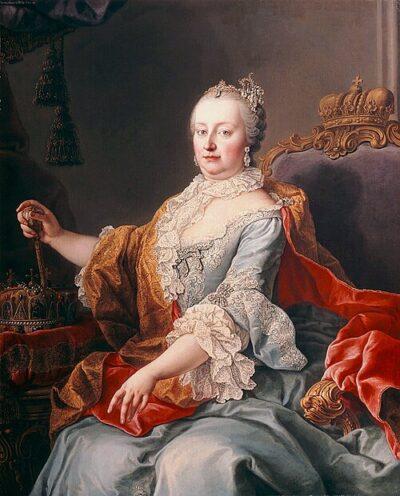
Maria Theresa of Austria
Maria Theresa of Austria was a ruler of the Habsburg Dominions. Born May 13, 1717, in Hofburg Palace. Died November 29, 1780, in Vienna. Positions held include Prince-Elector, King of Bohemia (1740–1780) and Apostolic King of Hungary (1740–1780).
Facts
33 facts · 2 confirmed by two sources · 10 cited · 21 from one source
Where this comes from
Papalocal keeps its own record. It started from these sources; what each one said is kept here as it was copied, so a change on their side never changes this page by itself. Tap one to read its version.
What Wikidata says · copied November 16, 2026 · revision 2567565776
- Described as
- ruler of the Habsburg Dominions (1717-1780)
- Other names
- Empress Maria-Theresa, Maria Theresa Walburga Amalia Christina, Maria Theresa I, Maria-Theresa Holy Roman Empress, Empress of Austria Maria Theresa, Holy Roman Empress consort and Queen consort of Germany Maria Theresa, Empress of Austria Maria Therese, Empress of Austria Maria Theresia, Maria Theresa, Empress of Germany, Mariya tereziya, Maria Theresia, Maria Theresa
- Born
- May 13, 1717 · 17 references
- Died
- November 29, 1780 · 17 references
- Born in
- Hofburg Palace
- Died in
- Vienna · 5 references
- Buried in
- Imperial Crypt
- Cause of death
- stroke
- Citizen of
- Habsburg monarchy
- Occupation
- aristocrat · 1 reference; monarch · 1 reference; politician · 1 reference
- Positions held
- Prince-Elector; King of Bohemia (1740–1780); Apostolic King of Hungary (1740–1780) · 1 reference
- Field
- state governance · 1 reference; politics · 1 reference
- Spouse
- Francis I, Holy Roman Emperor (1736–) · 2 references
- Children
- Archduchess Maria Elisabeth of Austria; Archduchess Maria Anna of Austria; Archduchess Maria Carolina of Austria; Joseph II, Holy Roman Emperor; Maria Christina, Duchess of Teschen; Archduchess Maria Elisabeth of Austria; Archduke Charles Joseph of Austria; Archduchess Maria Amalia of Austria; Leopold II, Holy Roman Emperor; Archduchess Maria Johanna Gabriela of Austria; Archduchess Maria Josepha of Austria; Maria Carolina of Austria · 1 reference
- Father
- Charles VI, Holy Roman Emperor · 1 reference
- Mother
- Elisabeth Christine of Brunswick-Wolfenbüttel
- Siblings
- Archduchess Maria Anna of Austria; Archduchess Maria Amalia of Austria
- Religion
- Catholic Church
- Wikipedias with a page
- 107
Wikidata item Q131706 (wikidata.org/wiki/Q131706), public domain (CC0). Copied November 16, 2026.
What Wikipedia says · copied November 16, 2026 · revision 1385923953
Maria Theresa (Maria Theresia Walburga Amalia Christina; 13 May 1717 – 29 November 1780) ruled the Habsburg monarchy from 1740 until her death in 1780, and the only woman to hold the position in her own right. She was the sovereign of Austria, Hungary, Croatia, Bohemia, Transylvania, Slavonia, Mantua, Milan, Moravia, Galicia and Lodomeria, Dalmatia, Austrian Netherlands, Carinthia, Carniola, Gorizia and Gradisca, Austrian Silesia, Tyrol, Styria, and Parma. By marriage, she was Duchess of Lorraine, Grand Duchess of Tuscany, and Holy Roman Empress.
Maria Theresa started her 40-year reign when her father, Charles VI, Holy Roman Emperor, died on 20 October 1740. Charles VI paved the way for her accession with the Pragmatic Sanction of 1713 and spent his entire reign securing it through international diplomacy. He neglected the advice of Prince Eugene of Savoy, who believed that a strong military and a rich treasury were more important than mere signatures. Eventually, Charles VI left behind a weakened and impoverished state, particularly due to the War of the Polish Succession and the Russo-Turkish War (1735–1739). Moreover, upon his death, Saxony, Prussia, Bavaria, and France all repudiated the sanction they had recognised during his lifetime. Frederick the Great of Prussia (who became Maria Theresa's greatest rival for most of her reign) promptly invaded and took the affluent Habsburg province of Silesia in the eight-year conflict known as the War of the Austrian Succession. In defiance of the grave situation, she managed to secure the vital support of the Hungarians for the war effort. During the war, Maria Theresa successfully defended her rule over most of the Habsburg monarchy, apart from the loss of Silesia and a few minor territories in Italy. Maria Theresa later unsuccessfully tried to recover Silesia during the Seven Years' War.
Although she was expected to cede power to her husband, Emperor Francis I, and her eldest son, Emperor Joseph II, who were officially her co-rulers in Austria and Bohemia, Maria Theresa ruled as an autocratic sovereign with the counsel of her advisers. She promulgated institutional, financial, medical, and educational reforms, with the assistance of Wenzel Anton of Kaunitz-Rietberg, Friedrich Wilhelm von Haugwitz, and Gerard van Swieten. She also promoted commerce and the development of agriculture, and reorganised Austria's ramshackle military, all of which strengthened Austria's international standing. A pious Catholic, she despised Freemasons, Jews and Protestants, and on certain occasions she ordered their expulsion to remote parts of the realm. She also advocated for the Catholic Church.
Despite bearing 16 children surviving infancy, she remained active throughout her rule, although her rule is often split into two parts (before and post loss of Silesia) to distinguish two radically different depths of competency and reforms.
- Born, in its opening lines
- May 13, 1717
- Died, in its opening lines
- November 29, 1780
From the Wikipedia article “Maria Theresa” (en.wikipedia.org/wiki/Maria_Theresa), by its contributors, under CC BY-SA 4.0 (creativecommons.org/licenses/by-sa/4.0/). Copied November 16, 2026; not changed.
Confirmed Two sources agree. Cited One source, and it names where it got it. One source One source, without a reference of its own. Sources disagree The sources disagree. We show the best-supported value and keep theirs below.
