
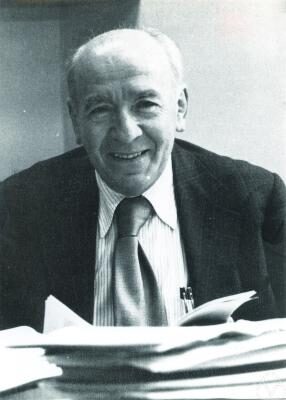
Mark Kac
Mark Kac was a mathematician. Born August 3, 1914, in Kremenets. Died October 25, 1984, in Los Angeles. Known for Enigmas of Chance: An Autobiography. By Mark Kac. Harper & Row, Can One Hear the Shape of a Drum? and Random Walk and the Theory of Brownian Motion. Educated at Lviv University and Johns Hopkins University. Awards include Guggenheim Fellowship, George David Birkhoff Prize and Josiah Willard Gibbs Lectureship.
Facts
42 facts · 1 confirmed by two sources · 23 cited · 17 from one source · 1 where the sources disagree
What’s different
- Died: we show October 25, 1984 (Sources disagree). Wikipedia says October 26, 1984
Where this comes from
Papalocal keeps its own record. It started from these sources; what each one said is kept here as it was copied, so a change on their side never changes this page by itself. Tap one to read its version.
What Wikidata says · copied November 16, 2026 · revision 2544793311
- Described as
- mathematician (1914–1984)
- Other names
- M. Kac, Marek Kac
- Born
- August 3, 1914 · 7 references
- Died
- October 25, 1984 · 5 references
- Born in
- Kremenets · 1 reference
- Died in
- Los Angeles · 2 references
- Buried in
- cremation
- Name at birth
- Marek Kac
- Citizen of
- United States; Poland · 1 reference
- Occupation
- mathematician · 1 reference; university teacher · 2 references
- Worked for
- University of Southern California (1981–1984) · 3 references; Cornell University (1939–1961) · 3 references; Utrecht University (1980) · 2 references; Leiden University (1962–1963) · 1 reference; The Rockefeller University (1961–1981) · 1 reference
- Education
- Lviv University (1931–1937) · 3 references; Johns Hopkins University (1938–1939) · 2 references; Krzemieniec Lyceum (1925–1931) · 1 reference
- Member of
- American Academy of Arts and Sciences; National Academy of Sciences; Royal Netherlands Academy of Arts and Sciences · 1 reference; Institute of Mathematical Statistics (1946–) · 1 reference; American Philosophical Society (1969–)
- Known for
- Enigmas of Chance: An Autobiography. By Mark Kac. Harper & Row; Can One Hear the Shape of a Drum?; Random Walk and the Theory of Brownian Motion; On Some Probabilistic Aspects of Classical Analysis; Erdős–Kac theorem; Kac–Bernstein theorem; Feynman–Kac formula; Weyl–Kac character formula
- Awards
- Guggenheim Fellowship (1946) · 1 reference; George David Birkhoff Prize (1978) · 1 reference; Josiah Willard Gibbs Lectureship (1967) · 1 reference; Chauvenet Prize (1968) · 3 references; Paul R. Halmos - Lester R. Ford Awards (1967) · 1 reference; Jurzykowski Prize (1976) · 1 reference; Fellow of the Institute of Mathematical Statistics (1946) · 1 reference
- Field
- probability theory · 1 reference; mathematics · 1 reference; spectral theory · 1 reference
- Children
- Michael B. Kac
- Wikipedias with a page
- 21
Wikidata item Q736380 (wikidata.org/wiki/Q736380), public domain (CC0). Copied November 16, 2026.
What Wikipedia says · copied November 16, 2026 · revision 1371970931
Mark Kac ( KAHTS; Polish: Marek Kac; August 3, 1914 – October 26, 1984) was a Polish-American mathematician. His main interest was probability theory. His question, "Can one hear the shape of a drum?" set off research into spectral geometry, the idea of understanding the extent to which the spectrum allows one to read back the geometry. In the end, the answer was generally "No," although certain shapes, such as a circular drum, can be inferred from the spectrum of the Laplacian.
- Born, in its opening lines
- August 3, 1914
- Died, in its opening lines
- October 26, 1984
From the Wikipedia article “Mark Kac” (en.wikipedia.org/wiki/Mark_Kac), by its contributors, under CC BY-SA 4.0 (creativecommons.org/licenses/by-sa/4.0/). Copied November 16, 2026; not changed.
Confirmed Two sources agree. Cited One source, and it names where it got it. One source One source, without a reference of its own. Sources disagree The sources disagree. We show the best-supported value and keep theirs below.
