
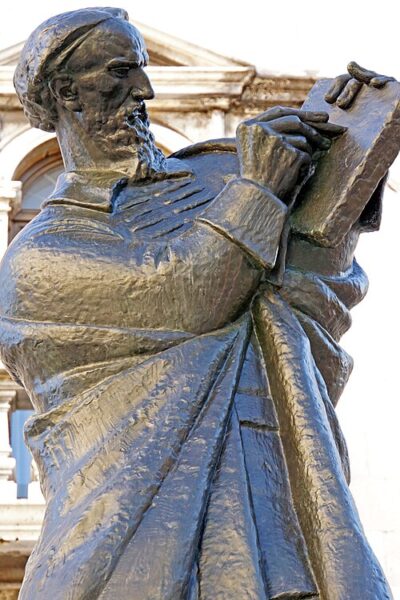
Marko Marulić
Marko Marulić was a Croatian national poet and European humanist. Born August 18, 1450, in Split. Died January 5, 1524, in Split. Known for Judita, De institutione bene vivendi per exempla sanctorum and Evangelistarium. Educated at University of Padua.
Facts
28 facts · 2 confirmed by two sources · 22 cited · 4 from one source
Where this comes from
Papalocal keeps its own record. It started from these sources; what each one said is kept here as it was copied, so a change on their side never changes this page by itself. Tap one to read its version.
What Wikidata says · copied November 16, 2026 · revision 2558683275
- Described as
- Croatian national poet and European humanist
- Born
- August 18, 1450 · 3 references
- Died
- January 5, 1524 · 3 references
- Born in
- Split · 3 references
- Died in
- Split · 2 references
- Buried in
- Saint Francis Monastery and Church · 1 reference
- Citizen of
- Republic of Venice
- Occupation
- poet · 1 reference; writer · 2 references; translator · 1 reference; examiner (1474–1480) · 1 reference; judge (1479–1487) · 1 reference
- Education
- University of Padua
- Known for
- Judita · 1 reference; De institutione bene vivendi per exempla sanctorum · 1 reference; Evangelistarium · 1 reference; Davidiad · 1 reference; Suzana · 1 reference; Epistola domini Marci Maruli Spalatensis ad Adrianum VI · 1 reference; De humilitate et gloria Christi · 1 reference; Quinquaginta parabolae · 1 reference; De Veteris instrumenti viris illustribus commentarium · 1 reference; De laudibus Herculis, interlocutores poeta et theologus · 1 reference
- Field
- renaissance humanism · 2 references
- Father
- Nikola Marulić
- Religion
- Catholic Church
- Lived in
- Nečujam (1509–1511) · 1 reference; Venice (1480–1482) · 1 reference; Rome (1500–) · 1 reference
- Wikipedias with a page
- 37
Wikidata item Q336571 (wikidata.org/wiki/Q336571), public domain (CC0). Copied November 16, 2026.
What Wikipedia says · copied November 16, 2026 · revision 1385565034
Marko Marulić Splićanin (pronounced [mâːrko mǎrulitɕ splîtɕanin]; Latin: Marcus Marulus Spalatensis; 18 August 1450 – 5 January 1524) was a Croatian poet, lawyer, judge, and Renaissance humanist. He is the national poet of Croatia. According to George J. Gutsche, Marulić's epic poem Judita "is the first long poem in Croatian", and "gives Marulić a position in his own literature comparable to Dante in Italian literature." Marulić's Latin poetry is of such high quality that his contemporaries dubbed him "The Christian Virgil." He has been called the "crown of the Croatian medieval age", the "father of the Croatian Renaissance", and "The Father of Croatian literature."
Marulić scholar Bratislav Lučin notes that he was well-versed in both the Christian Bible and in the Fathers of the Church. At the same time, Marulić also attentively read the Pre-Christian Greek and Latin Classics. He read and interpreted Latin epigrams, wrote glosses on the erotic poetry of Catullus, read Petronius' Satyricon, and admired Erasmus of Rotterdam. Marulić also composed humanist elegies, satirical poetry, erotic epigrams inspired by Ovid, and Latin Christian poetry inspired not only by the epics of Homer and Virgil, but also by Lucan, Statius, Faltonia Betitia Proba, Juvencus, Venantius Fortunatus, Cyprianus Gallus, Coelius Sedulius, and many other both Pagan and Christian writers in the same language.
According to Franz Posset, Marulić aspired to the Renaissance humanist ideal of the uomo universale ("universal man"). To this end, he was interested in painting and drawing, local and national history, languages, and poetry. His overall goal always remained renovatio Christiana ("The Renewal of Christianity") as represented by the future Counter-Reformation. Accordingly, like many other Renaissance humanists who shared his views, Marulić denounced simony and immorality among Catholic priests and members of the hierarchy in often violent language throughout his writings.
Marulić's work was admired both by many of the greatest and most influential Catholic saints of the Counter-Reformation and also, since much of Marulić could be read without violating sola scriptura, by generations of believers in Protestantism.
His writings in Renaissance Latin, once adored and envied across Europe, shared the destiny that befell most Renaissance Humanist literature and faded into obscurity. According to Lučin, however, the passage of time has slowly revealed the important web of influence that the poet and writer wove all over Europe and far beyond its borders. Marulić's writings were admired by churchmen such as Saints Francis Xavier, Francis de Sales, Peter Canisius, and Charles Borromeo, by monarchs and statesmen such as King Henry VIII, Thomas More, and Emperor Charles V, emulated by poets like Jan Dantyszek, Conrad Peutinger, and Francisco de Quevedo, and translated into vernacular verse by still other poets; including Fray Luis de León, St Philipp Howard, Rhina Espaillat, and Edward Mulholland. Furthermore, manuscripts of Marulić works previously thought lost, such as his Christian epic poem the Davidiad in 1952, his Latin-Croatian literary translation of Thomas à Kempis' The Imitation of Christ in 1989, and the Glasgow Codex in 1995, continue to resurface and to belatedly see publication for the first time.
One of Marulić's books published in the 1510s is also the first time a literary work used the term "psychology". More recently, Pope John Paul II quoted from a Marulić poem during his 1998 apostolic visit to Solin, Croatia.
- Born, in its opening lines
- August 18, 1450
- Died, in its opening lines
- January 5, 1524
From the Wikipedia article “Marko Marulić” (en.wikipedia.org/wiki/Marko_Marulić), by its contributors, under CC BY-SA 4.0 (creativecommons.org/licenses/by-sa/4.0/). Copied November 16, 2026; not changed.
Confirmed Two sources agree. Cited One source, and it names where it got it. One source One source, without a reference of its own. Sources disagree The sources disagree. We show the best-supported value and keep theirs below.
